






 Portuguese
  Spanish
  3 min of reading
  0 comments


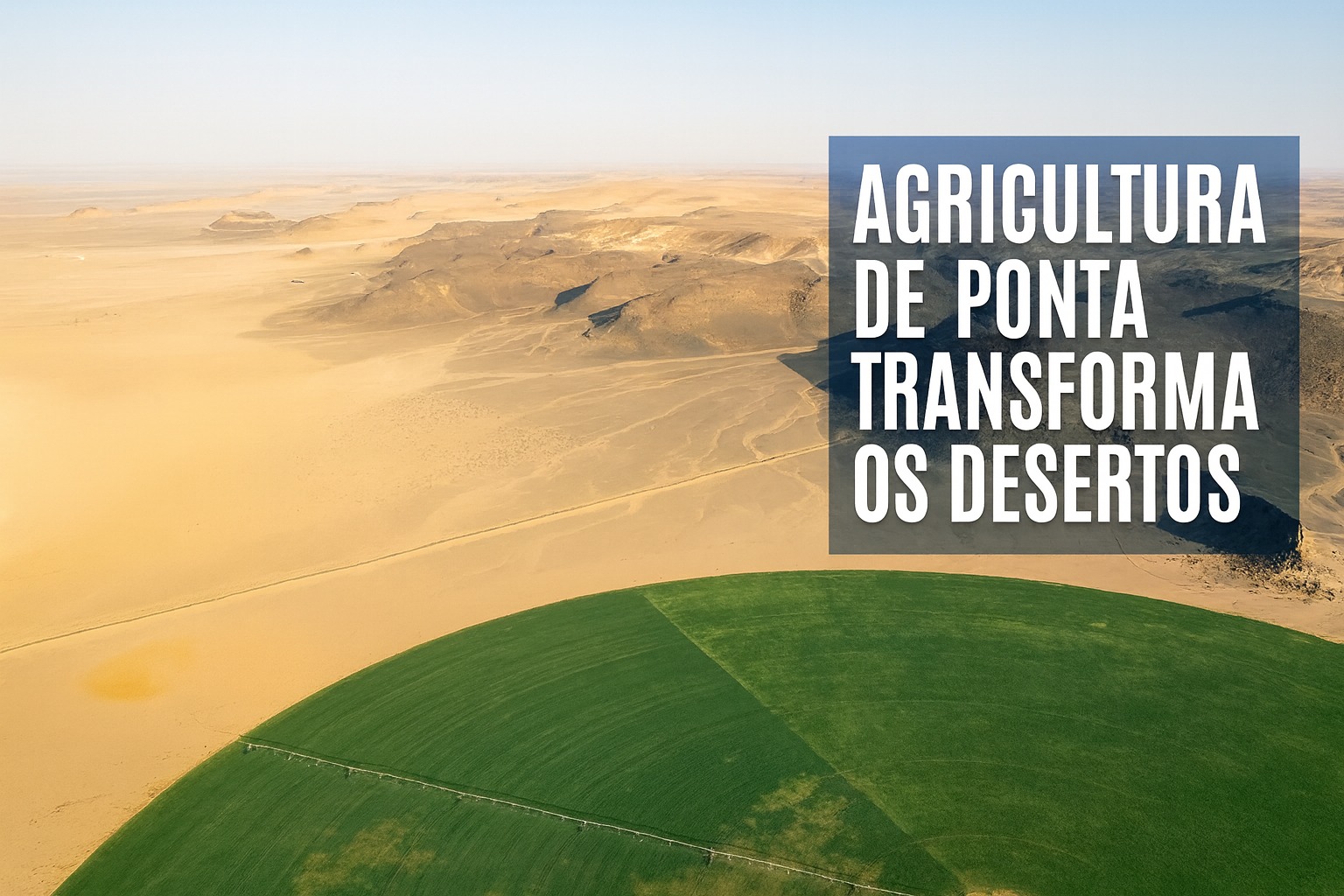
Advancement Of Efficient Irrigation, Solidification, Solar Energy And Controlled Agriculture Redefines Production In Deserts, Sustains Global Growth Of 6.22% And Reorganizes Agricultural Economies
The advancement of high-efficiency irrigation technologies, controlled environment agriculture, liquid nano-clay, and soil restoration drives food production in deserts, where agricultural expansion grows 6.22% per year between 2023 and 2029 and alters regional economies.
Agricultural transformation in arid regions occurs on a global scale, driven by smart irrigation systems, solar energy, and techniques that convert sand into productive soil. This trend alters food security and creates markets in previously unproductive areas.
Technologies That Reshape Desert Environments
Precision irrigation reduces water losses, with drip irrigation capable of decreasing evaporation by up to 80% and center pivot cutting consumption by over 50%. Each technique reorganizes water use and increases agricultural productivity under extreme conditions.
-
Helicopter Drops 180 Tons of Sand and Gravel on Swedish River to Revive Ecosystem Damaged by Decades of Exploitation

-
Brazilian Company Launches Retro Smartphone with 48 MP Camera, T9 Keyboard, and Privacy Features for Social Media-Free Use

-
Self-Taught Chinese Farmer Builds 5-Ton Submarine from Scrap, Launches It in Anhui River
-
Invisible Induction Technology Enables Wireless Power for Blenders, Coffee Makers, and Air Fryers, Reducing Countertop Cables




Controlled environment agriculture utilizes greenhouses, vertical farms, and hydroponic systems that maintain continuous production. Water usage reduction reaches 90%, allowing for viable crops even under intense heat. Environmental control ensures operational stability.
Soil restoration and solidification transform sand into fertile soil through a water-based paste that modifies physical properties. Nutrient and moisture retention enables crops in landscapes previously incapable of adequately supporting plants.
Accelerated Agricultural Expansion And Economic Impacts
The global market for desert agriculture presents a growth rate of 6.22% per year between 2023 and 2029, surpassing the projected global agricultural growth of 5.66%. The scientific and water combination recreates agricultural zones and reorganizes production chains directly.
This evolution also connects to ancient practices, such as in the Negev Desert, where farmers were already capturing rainwater around 5000 B.C. Current technology elevates this historical principle, converting rudimentary methods into highly efficient systems.
Regions like the Imperial Valley and the Salton Sea Valley demonstrate how intensive irrigation, aquifer management, and water infrastructure transform deserts into agricultural belts. The resulting productivity alters the economic landscape of these territories.
The Case Of Peru As A Continental Reference
The desert plains of Ica, marked by dust and water scarcity, have been converted into productive orchards. The country has developed efficient irrigation models, canals, and desalination that have brought water to areas previously entirely unproductive.
Until the 1990s, fruit cultivation on the Peruvian desert coastline was considered unfeasible. Today, blueberry, mango, and avocado plantations occupy large areas near the Pacific, redefining the national agricultural map.
Agricultural exports grew 11% per year between 2010 and 2024, reaching US$ 9.185 billion in 2024. Peru has become the world’s largest exporter of grapes and blueberries, consolidating a strategic position in specialized international markets.
Blueberries, almost nonexistent before 2008, dominate the Peruvian export portfolio. The desert strip between the Pacific and the Andes has turned into one of the largest continuous orchards, altering productive structures and increasing agricultural revenue.
The Peruvian success demonstrates how water management, engineering, and renewable energy enable overcoming environmental limitations. The model inspires other arid regions seeking to enhance agricultural competitiveness and reduce dependency on imports.
Additional information includes the role of high-efficiency irrigation in redesigning productive belts, as well as the increasing use of salt-resistant, heat-resistant, and drought-resistant varieties to consolidate crops in extreme climate areas.
With information from Compre Rural.




-

-

-

-

-

9 people reacted to this.