






 Portuguese
  Spanish
  3 min of reading
  0 comments


New photos released on Chinese social media show the Bohai Sea Monster with four rigid points under the wings, turboprop engines, and seaplane structure, reinforcing analysts’ interest in the role of the craft in maritime operations, Taiwan, and the South China Sea
Images published on Chinese social media show new details of the Bohai Sea Monster, a ground effect craft prototype observed since 2025, with turboprop engines, a hull for water operation, and structures under the wings that raise questions about potential military function.
New images of the Bohai Sea Monster reveal four external posts under the wings of the Chinese experimental craft, seen near the Bohai Sea since June 2025, reinforcing doubts about military use beyond rapid maritime transport.
Ground effect craft combines speed and low flight
The prototype is described as a wing-in-ground effect craft, or ekranoplan. This vehicle moves a few meters above the surface, using compressed air between wings and sea to gain lift.
-
New Realme phones have a giant battery of up to 7,500 mAh, military-grade durability, Android 16, and an affordable price; meet the P4x and P4 Lite.

-
For the first time, researchers find the fuel of the first stars in galaxies formed only 700 million years after the Big Bang.
-
Silent invasion in the Amazon raises alarm: 82 exotic animals and 59 plants threaten native species, crops, and the forest’s balance, while authorities rush to prevent something worse caused by invasive species.

-
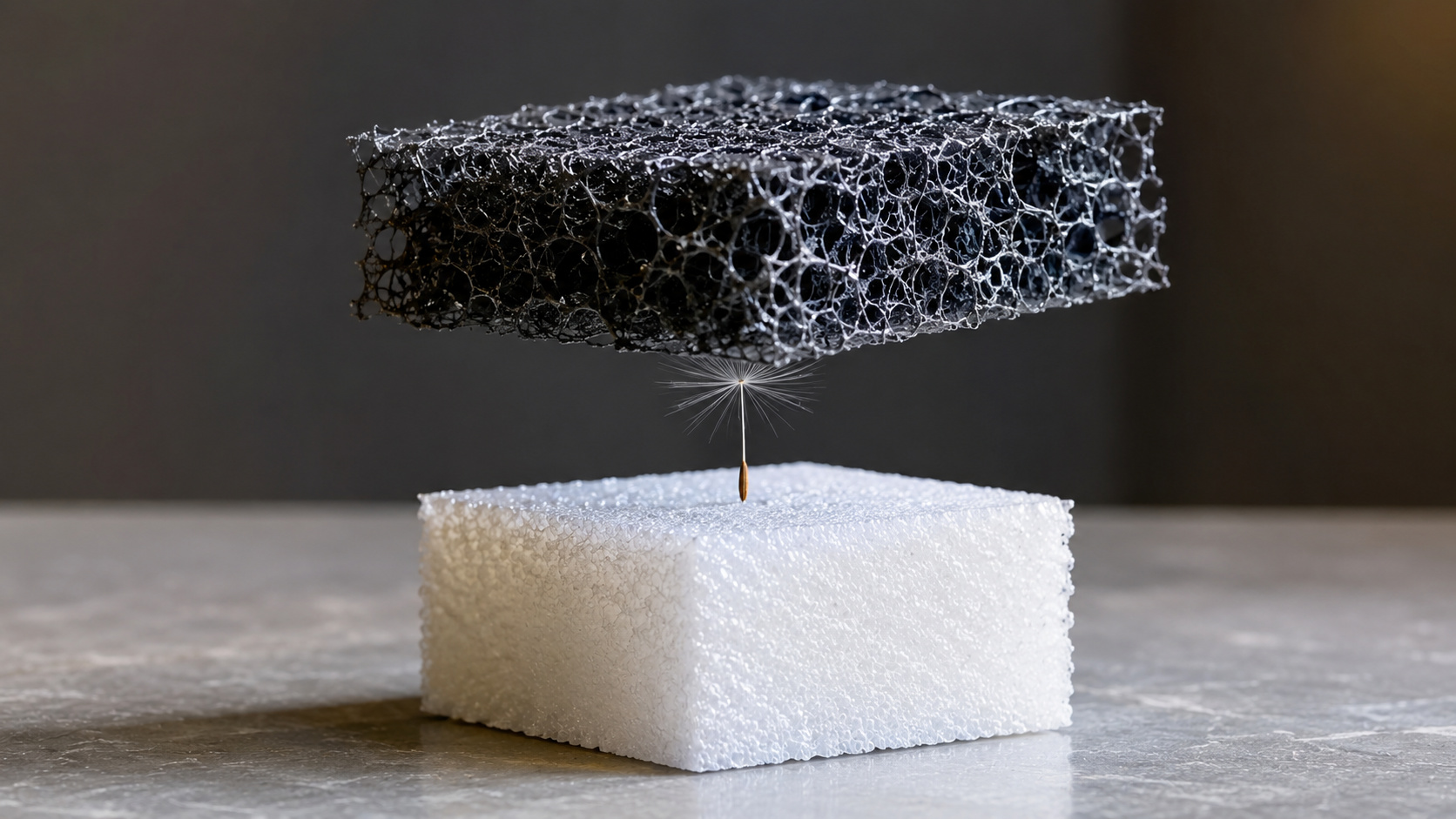
Scientists have created a material six times lighter than air, 75 times lighter than styrofoam, and that becomes stronger the more it is compressed: aerographite seems impossible, but it can reinforce structures, batteries, and satellites.




The advantage lies in the combination of speed greater than ships and low altitude, below the radar line used to detect conventional aircraft. Instead of flying high, it glides over the waves.
The concept dates back to the 1930s with Toivo Kaario. In the 1960s, Alexander Lippisch advanced the project. Later, the Soviet Union applied the idea in transport on the Caspian Sea.
One of these Soviet models caught the attention of United States intelligence and was nicknamed the Caspian Sea Monster. Initially, reconnaissance teams had difficulty understanding what they were observing.
Photos show turboprops and rigid points under the wings
The new images help correct initial readings about propulsion. The aircraft does not appear as a large jet ekranoplan. The visible setup indicates four turboprop engines, mounted above the wings in pairs.
Each engine drives large multi-blade propellers. The result brings the design closer to a maritime patrol aircraft, although the seaplane-style hull maintains a stepped bottom for water landing.
The configuration includes a front cabin, V-shaped tail, stabilizers at the wingtips, and smaller lateral structures. The relevant detail is the four external posts seen under the wings.
These rigid points are usually used for missiles, bombs, sensors, or extra tanks. The photos do not confirm installed armament but make it less likely to treat the prototype as conventional transport.
Taiwan and South China Sea Expand Interest
Analysts associate the Bohai Sea Monster with Beijing’s interests in Taiwan and the South China Sea. Taiwan is 180 kilometers from mainland China at the closest point.
A fast ground-effect vehicle could cross this distance in less than an hour and operate with less exposure to radars. It could also bypass amphibious threats, such as mines and submarines.
Another possibility is supplying Chinese island bases. Even so, doubts remain about range, performance, payload, and final function.






Be the first to react!