






 Portuguese
  Spanish
  3 min of reading
  0 comments


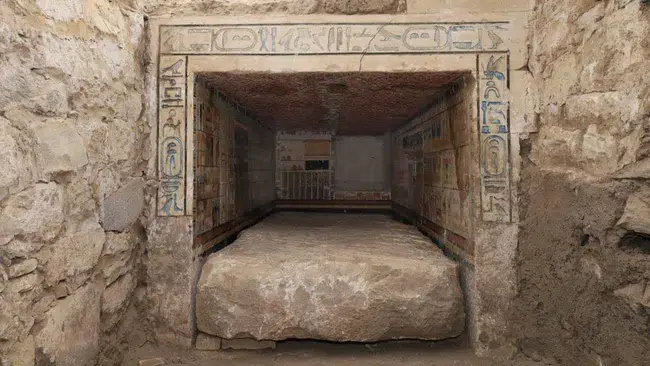
A Richly Decorated Tomb Of A Doctor Who Served Egyptian Pharaohs 4,100 Years Ago Was Discovered By Archaeologists In Egypt.
Recently discovered, an intricately decorated tomb in Egypt revealed impressive details about the life of a doctor who served the pharaohs over four millennia ago.
The burial chamber, located in Saqqara, the necropolis of the ancient Egyptian capital Memphis, belonged to Tetinebefou, a multifunctional royal physician, highly esteemed by the pharaohs.
The richly adorned tomb offers a fascinating insight into medicine and society in Ancient Egypt.
-
Survivor of 1966 SS Daniel J. Morrell Shipwreck in Lake Huron Recounts 38-Hour Ordeal in Extreme Cold

-
The Greatest Hoax in World Cup History? The Film That Denied Brazil’s 1958 Victory and Exposed How Fake Evidence Can Seem Convincing on TV
-
Fake South Korean Online Stores Offer Shopping Thrill Without Spending Money or Receiving Products
-
The War of Jenkins’ Ear: How a Severed Ear Sparked One of the 18th Century’s Most Unusual Conflicts


A Discovery Of Great Significance
French and Swiss archaeologists, in collaboration with Egypt’s Ministry of Tourism and Antiquities, excavated the tomb that dates back approximately 4,100 years.
The discovery was considered remarkable due to the vibrant sculptures and artwork found, including a false door painted with scenes of funerary offerings. These elements help to better understand the funerary rituals and beliefs of the period.
Inside the tomb, researchers identified a stone sarcophagus with hieroglyphs containing the doctor’s name.
The inscriptions indicate that Tetinebefou held various prestigious positions, such as chief physician of the palace, chief dentist, director of medicinal plants, and priest of the goddess Serket, a deity associated with healing from venomous bites.

The Importance Of Tetinebefou In The Royal Court
Tetinebefou likely served under the reign of Pepi II, a pharaoh of the Old Kingdom of Egypt who ruled for a prolonged period of 60 to 90 years.
Pepi II was crowned in childhood and, upon his death, was buried in Saqqara, near the newly discovered tomb of the doctor.
The titles found on the sarcophagus indicate that Tetinebefou was not only a health professional but also a specialist in various fields, making him an essential figure in the pharaonic court.
According to Philippe Collombert, an Egyptologist at the University of Geneva, the titles of “director of medicinal plants” and “chief dentist” are extremely rare, reinforcing Tetinebefou’s privileged position in Egyptian society.
The Advanced Medical Knowledge Of Ancient Egypt
The ancient Egyptians are widely recognized for their medical advancements and sophisticated knowledge of human anatomy.
They were capable of performing complex surgical procedures, such as the removal of brain tumors, as well as diagnosing diseases like diabetes and developing prosthetics.
The Greek historian Herodotus, in the 5th century BC, observed that Egyptian doctors were highly specialized, with professionals dedicated to specific areas of the human body.
Roger Forshaw, an Egyptologist at the University of Manchester, highlighted that evidence of dentists in Ancient
Egypt is extremely scarce, making the discovery of Tetinebefou’s tomb even more significant.
The murals found depict objects that the doctor might have used in his practice, such as jars and vessels, providing a rare glimpse into the medical tools of the time.
Saqqara – An Archaeological Treasure
The necropolis of Saqqara is one of the most important archaeological sites in Egypt, housing a vast collection of tombs and monuments from different eras.
Although it has been looted over the centuries, new discoveries continue to reveal valuable information about Egyptian civilization.
The tomb of Tetinebefou, even without many funerary artifacts, offers a deeper understanding of medical practices and social structure of the Old Kingdom.
Future Prospects For Research
The discovery of this tomb raises new questions about Egyptian medicine and the interaction between medicine and religion in antiquity.
Researchers hope that more detailed analyses of the inscriptions and wall paintings will reveal additional information about the treatment methods used at the time and the organization of healthcare professionals.
With this, it is possible that new excavations in Saqqara will uncover more tombs of significant figures, allowing for an even greater understanding of Egyptian medical science and its evolution over the centuries.
With information from Live Science.





Be the first to react!