






 Portuguese
  Spanish
  5 min of reading
  0 comments


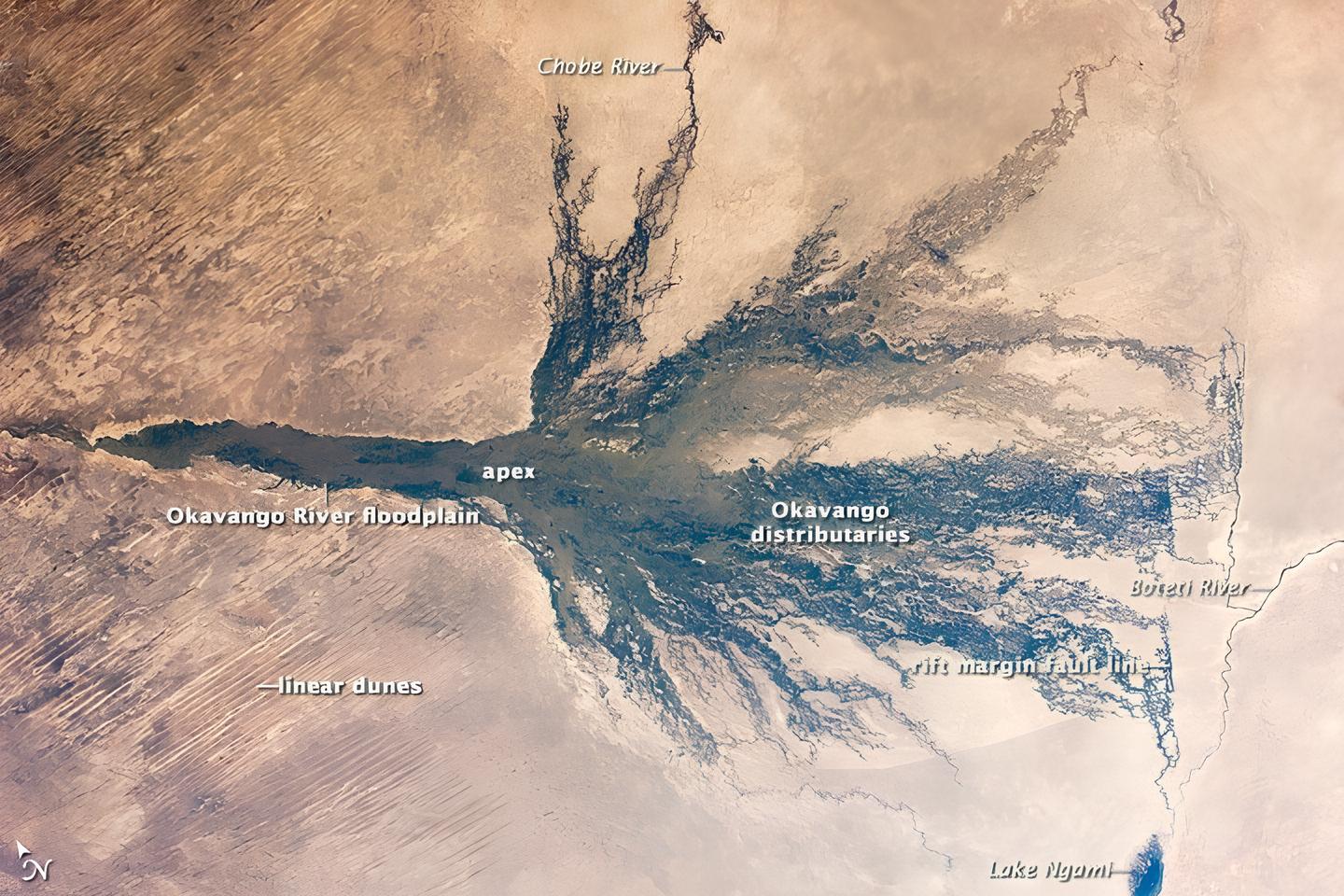
Okavango Delta defies geography by emerging in the Kalahari Desert, growing in the dry season, and forming one of the largest inland deltas on the planet.
In images captured by astronauts and published by the NASA Earth Observatory, the Okavango Delta appears as a giant green patch in the midst of the aridity of the Kalahari Desert in Botswana. NASA itself describes the location as a vast wetland area in the country’s interior, an oasis of biodiversity that emerges in one of the driest regions of southern Africa.
What makes this system so unique is that it does not flow into the sea. Instead of following the traditional path of the planet’s great rivers, the Okavango River spreads across the continent’s interior and forms an inland delta, dissipating its water into channels, lagoons, swamps, and flooded areas. The UNESCO classifies the Okavango as a large low-gradient delta, one of the rare systems of this type in the world without a direct connection to an ocean or sea.
Okavango Delta grows at the peak of the drought and defies the most intuitive logic of geography
According to the NASA Earth Observatory, the water that feeds the delta originates in the highlands of Angola and travels a long journey to reach Botswana. This movement creates an impressive effect: the peak of the flood occurs precisely during the local dry season, when the rest of the surrounding landscape is more arid.
-
Fragment of the Moon found in Africa holds a mark of a giant impact from 3.5 billion years ago and may reveal what the solar system was like when life was beginning to emerge on Earth.

-
Alexa+ arrives in Brazil with generative AI in the ChatGPT style, promises to understand even the Brazilian way, costs R$ 99.90 outside of Prime, and can transform Amazon’s old assistant into a smart hub for conversations, tasks, connected home, emails, and even Uber requests.
-
Scientists are studying the creation of toothpaste from human hair capable of reconstructing tooth enamel: keratin forms a crystalline layer similar to natural protection and could change the fight against cavities in dentistry.

-
Maritime engine without diesel receives international certification and can deliver pure hydrogen to ships with power up to 2,670 kW, without CO₂, without sulfur, without soot, and with exhaust composed of water vapor.





This behavior makes the Okavango a highly dynamic system. The water slowly spreads across the delta, advances through channels and low areas, nourishes forests and wetlands, and then disappears without ever reaching the sea. It is this combination of desert, late flood, and lack of ocean outlet that transforms the location into one of the most unusual natural phenomena on the planet.
Flooded area of the Okavango can exceed 15,000 km² during flood periods
UNESCO reports that the area recognized as a world heritage site includes about 600,000 hectares of permanent swamps and up to 1.2 million hectares of seasonally flooded fields. Combined, these areas amount to more than 18,000 km², showing that the system can reach colossal dimensions during periods of water expansion.
This expansion does not occur uniformly. The delta changes shape over time, with channels that open and close, islands that shift, and water bodies that appear or recede according to the flood pulse. It is precisely this mutable nature that makes the Okavango so valuable for studies on hydrology, ecology, and landscape dynamics.
Almost all the river’s water disappears in the delta itself without reaching the ocean
According to the NASA Earth Observatory, most of the water entering the Okavango Delta is lost through evaporation, absorption by vegetation, and soil infiltration. Only a very small fraction manages to exit the system.
This behavior makes the Okavango a classic case of internal drainage. Instead of feeding an estuary or ocean mouth, the river ends its journey within the continent itself. This characteristic explains why the delta is often described as one of the most unlikely aquatic systems on Earth.
Landscape seen from space turned the Okavango into one of the most striking images of Earth
The images highlighted by the NASA Earth Observatory show the delta as an organic network of channels and green areas surrounded by the brown and yellowish tones of the desert.

The contrast between water and aridity is so strong that the location has become one of the most impressive natural landscapes ever observed from Earth’s orbit.
The absence of intense urbanization in much of the region helps maintain the legibility of the system on a continental scale. This allows the natural design of the delta to be observed with rare clarity, something that reinforces its scientific, visual, and ecological value.
Okavango Delta concentrates extraordinary biodiversity in the middle of the Kalahari
UNESCO highlights that the Okavango is one of Africa’s most important wetland systems and hosts an exceptional biodiversity. The seasonal and permanent presence of water transforms the delta into a refuge for a wide variety of species adapted to aquatic, semi-flooded, and dry environments.
This environmental mosaic creates different ecological niches and sustains a rare biological richness for a region surrounded by arid conditions. It is precisely for this reason that the delta has become a world reference in conservation and one of the most important natural environments on the African continent.
Rare geology explains why the Okavango River spreads in the interior of Botswana
UNESCO defines the Okavango as a large low-slope inland alluvial delta, formed in an area where the relief favors the dissipation of water instead of flowing to the sea. This geological base is crucial to understanding why the system exists exactly there.
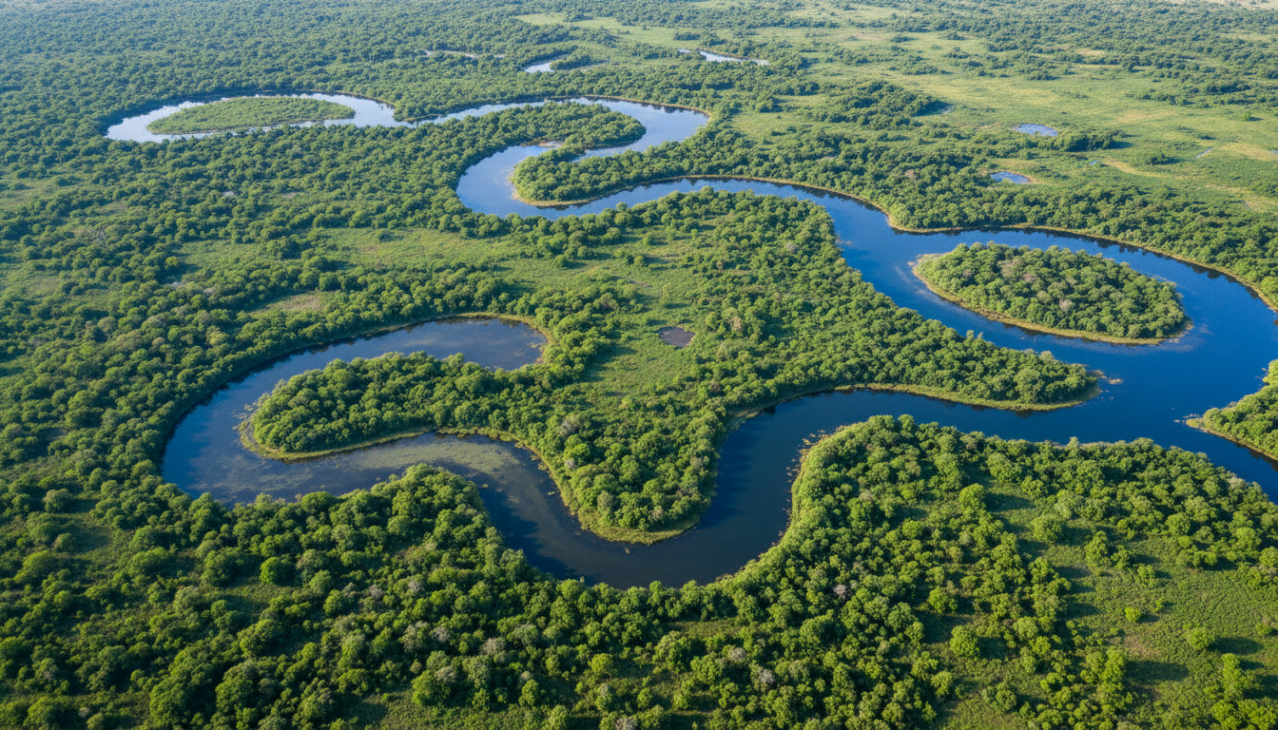
Without this combination of gentle relief, internal basin, and specific hydrological dynamics, the river would probably follow another path. Instead, it forms a landscape that seems to invert the more known logic of river geography and creates one of the rarest examples of a delta without an oceanic outlet on a global scale.
UNESCO recognized the Okavango as a world heritage for its global importance
The Okavango Delta was recognized by UNESCO as a World Heritage Site, with an area of over 2 million hectares and a wide buffer zone. The international recognition reinforces that the site is not only relevant to Botswana or Southern Africa but to the planet’s natural heritage.
Preserving the Okavango means protecting a system where water, climate, relief, and biodiversity combine in an extremely rare way. Few places on Earth manage to bring together, at the same time, continental scale, unusual hydrological behavior, and such impressive visibility from space.





Be the first to react!