Portuguese


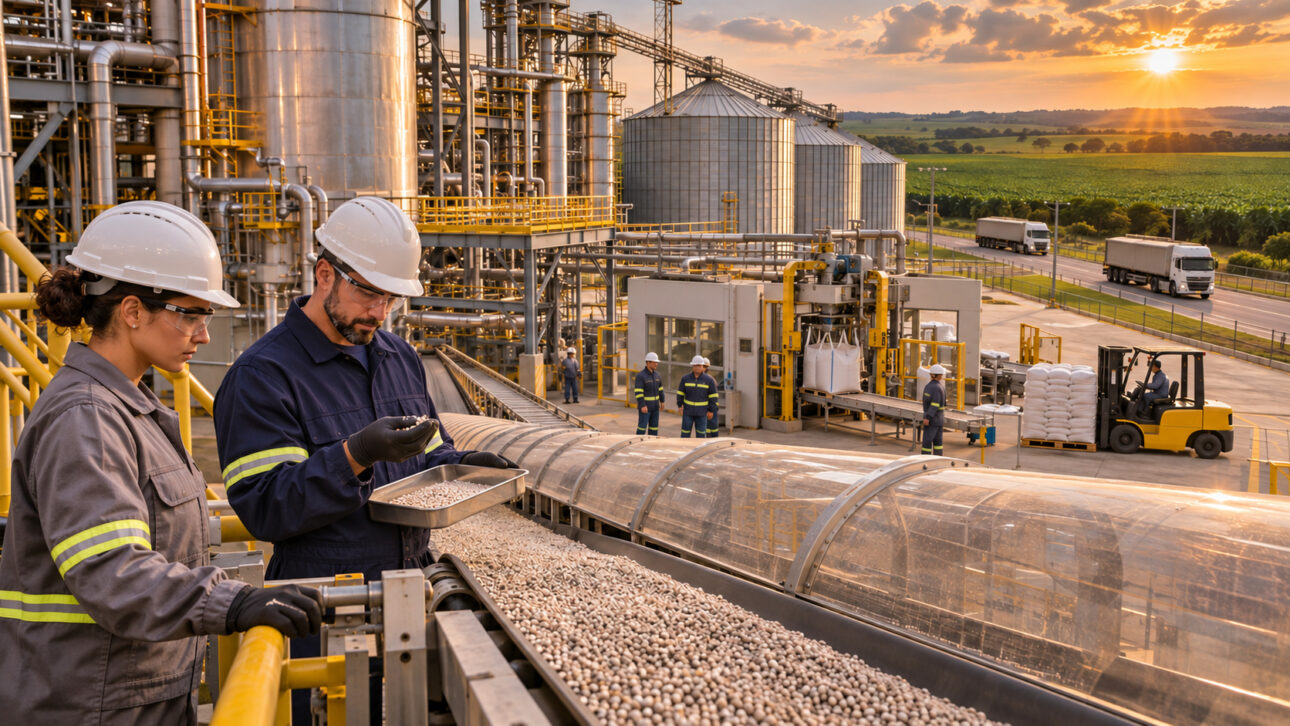

Brazil’s public development bank has approved R$8.3 billion in financing since 2023 for new plants, mining and innovation. In 2026 alone, approvals reached R$3.7 billion through October, the institution’s highest annual total for the sector
The National Bank for Economic and Social Development (BNDES), Brazil’s development bank, announced that it has approved R$8.3 billion in credit for fertilizer production in Brazil since 2023. The financing supports industrial projects, technological innovation and mineral exploration, with the goal of strengthening domestic supplies of agricultural inputs. Approvals in 2026 also reached a historic high.
The increase comes amid concern about Brazil’s reliance on imported fertilizers, particularly in the face of international tensions and logistical challenges.
However, the R$8.3 billion represents credit approved over nearly four years, not a single new investment announced this week.
-
Onion prices surge to R$161.25 per sack and may stay high for months as yields fall and planting shrinks

-
Brazilian agribusiness to take technologies and business opportunities to China on international mission
-
Company Invests Over R$100 Million in New Tocantins Depot That Could Handle 5,000 Metric Tons of Grain a Day
-
Poor rural roads hinder agricultural transport and school access in Paraná, where the priority network needs R$2.2 billion in annual investment


BNDES financing rises 399% to a record R$3.7 billion in 2026
The volume of financing approved by BNDES for the fertilizer industry grew significantly compared with the previous period.
Between 2019 and 2022, the bank approved about R$1.7 billion in credit for the sector.
From January 2023 through October 2026, approvals totaled R$8.3 billion, a 399% increase.
The results show a substantial expansion of public financing for activities related to domestic fertilizer production.
In addition, 2026 has been a standout year for the sector.
From January through October alone, BNDES approved R$3.7 billion, the largest annual amount the institution has ever recorded for fertilizer production.
The bank expects approvals to reach about R$4 billion by the end of December.
That figure is a projection. The final result will depend on the credit transactions actually approved by year-end.
BNDES president Aloizio Mercadante said the increase in financial support reflects the effects of international conflicts on fertilizer supply chains.
He also said that more than R$3 billion had been approved for the sector through the Brazil Sovereign Plan.
That amount is included in the financing disclosed by the bank and should not be added to the R$8.3 billion a second time.
As a result, the 2026 total combines a historic expansion of credit with initiatives aimed at addressing instability in international supplies.
Credit could fund new plants, mineral exploration and technologies for domestic fertilizer production
The financing announced by BNDES covers different stages of the fertilizer supply chain.
One area is the construction of new industrial facilities, which are needed to expand domestic production of agricultural inputs.
The bank also supports technological innovation projects and the exploration of mineral resources used to produce these materials.
The main nutrients used in agriculture include nitrogen, phosphorus and potassium, known by the acronym NPK.
Nitrogen supports plant development, while phosphorus contributes to root growth and metabolic processes. Potassium, in turn, plays an important role in water balance and plant resilience.
In industry, producing these inputs involves a range of chemical and mineral processes.
The production of nitrogen fertilizers, for example, depends on specialized raw materials and industrial facilities.
Phosphate fertilizers, in turn, require mining, processing and chemical transformation.
As a result, strengthening the fertilizer industry could generate business for suppliers of machinery, engineering services, mining equipment and industrial services.
However, the announcement released by BNDES, Brazil’s development bank, does not list the individual projects that make up the R$8.3 billion.
It also does not say how many factories will be built, which states will receive financing or how many jobs will be created.
Therefore, these approvals cannot be linked to specific projects without consulting the relevant contracts.
Another important issue is the disbursement of funds.
Approved credit does not necessarily mean that the money has been fully disbursed or that a factory has already been built.
Financing may be subject to contractual conditions, industrial schedules and stages for releasing funds.
Brazil imports most of its fertilizer and is preparing new industrial incentives to reduce the vulnerability of its agribusiness sector
The expansion of credit comes amid heavy reliance on international suppliers.
According to data released by Brazil’s Ministry of Agriculture and Livestock in October 2026, about 93% of the fertilizer consumed in Brazil comes from abroad.
In 2025, Brazil’s fertilizer imports reached a record 45.5 million metric tons.
China and Russia are among the main suppliers, while maritime transport plays a key role in domestic supply.
However, international conflicts, port disruptions and price swings can undermine the reliability of deliveries.
Brazil’s Ministry of Agriculture said imports of nitrogen and phosphate fertilizers fell 8.7% from January through May 2026 compared with the same period a year earlier.
At the same time, the average landed cost of these products rose 14.4%.
As a result, Brazil spent more on certain imports despite buying a smaller volume.
To reduce this vulnerability, the government is continuing its National Fertilizer Plan, which sets a planning horizon through 2050.
The strategy aims to increase domestic production and strengthen Brazilian companies’ role in manufacturing inputs for agribusiness.
In addition, a measure approved in August 2026 created new tax incentives for domestic production.
Complementary Law No. 235/2026 provides for up to R$5 billion in tax credits from 2027 through 2031 for fertilizer and raw-material projects, as well as certain bioinputs and soil remineralizers.
The program sets a basic annual limit of R$1 billion, subject to the terms of its regulations and tax legislation.
As a result, strengthening the domestic supply chain will depend on a combination of financing, private investment and the capacity to execute industrial projects.
The next financial milestone announced by BNDES will be its year-end 2026 results, when the institution aims to reach R$4 billion in annual approvals for the sector.