Portuguese
  Spanish


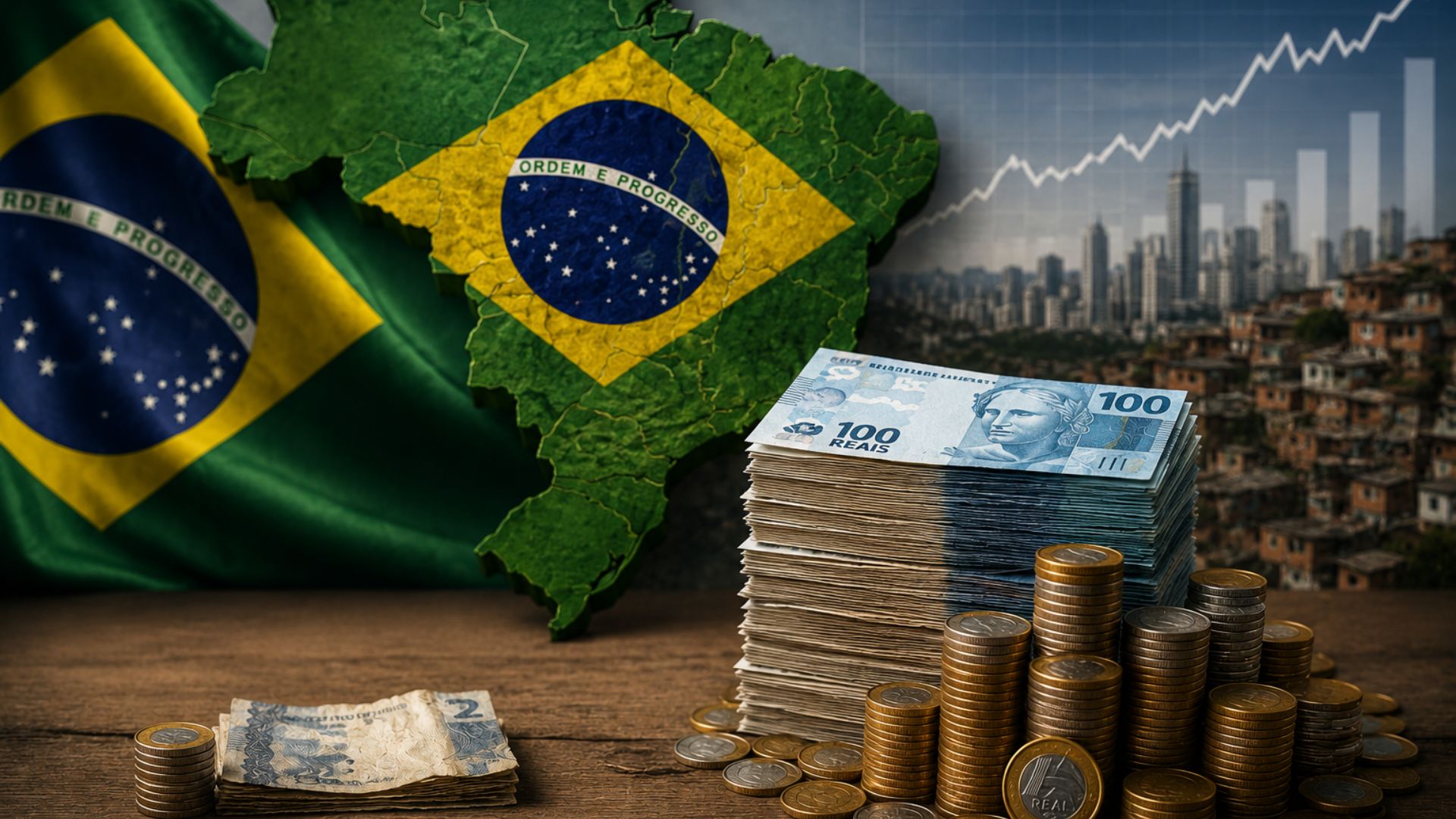


Average income of Brazilians reaches highest level in historical series, while stronger growth among higher-income groups again widens inequality in the country, according to the latest Pnad Contínua data released by IBGE.
The average monthly income of the Brazilian population reached its highest level in 2025 since the beginning of the Pnad Contínua historical series, a survey produced by IBGE.
Even with the expansion of income, employment, and the total earnings of families, indicators show that inequality has grown again in the country.
Average income in Brazil reaches historical record
Data released by the Brazilian Institute of Geography and Statistics indicate that the average real income from all sources reached R$ 3,367 last year.
-
A city with 8,000 inhabitants will receive R$ 25 billion to host the largest single-stage pulp mill in the world, with a production of 3.5 million tons per year and a cost of R$ 45 million.

-
He left India for Oman in 1976, entered through the door of luxury finishes, and took Sobha to the premium real estate market in the Middle East.

-
China wants to impress the world once again with a mega canal featuring giant locks, deep waters, and space for the largest ships, in a project aimed at shortening journeys, reducing queues, and rivaling the Panama Canal in global trade.

-
Brazil saved US$ 32.4 billion in 2025 by switching from fossil to renewable energy and only ranked behind China and the United States on the IRENA global podium.




The value represents a 5.4% increase compared to 2024 and surpasses the previous record registered by the survey, which began in 2012.
At the same time, the Gini Index, an indicator used to measure income concentration, rose from 0.487 to 0.491.
Although it remains below pre-pandemic levels, the increase indicates that income grew at a faster pace among the higher-income segments of the population.
The survey shows that approximately 143 million Brazilians had some type of income in 2025.
This group corresponds to 67.2% of the resident population in the country and includes people with income from work, retirements, pensions, social programs, rent, and other sources.
Labor market drives record income
Income from work remained the main driver of Brazilians’ earnings. According to the survey, 47.8% of the population had income from employment last year.
The percentage represents a growth of 0.7 percentage points compared to 2024. Among workers, the average monthly income reached R$ 3,560.
The value was 5.7% above the average recorded in the previous year and also set a new historical record for the Pnad Contínua series.
Income expansion occurred in a heated labor market scenario, with increased employment and unemployment maintained at historically low levels. Furthermore, real minimum wage adjustments and the continuation of income transfer programs contributed to raising the average earnings of the population.
Pnad Contínua analyst Gustavo Geaquinto Fontes stated that the recent improvement in incomes is directly related to the increase in employment and the recovery of the labor market after the economic impacts of recent years.
According to him, income growth was also influenced by the minimum wage valorization policy and the expansion of social programs.
Nevertheless, the specialist observed a slowdown in the pace of income growth among the poorest groups.
Retirements and social programs in income composition
In addition to income from work, other sources of income continued to play a relevant role in the budget of Brazilian families. The percentage of the population receiving retirement or pension increased from 13.5% to 13.8% in 2025.
With this increase, the contingent of retirees and pensioners reached 29.3 million people. The average monthly income for this group was estimated at R$ 2,697, a value 2.1% higher than that recorded in 2024.
Since the beginning of the survey’s historical series in 2012, the share of income associated with retirement and pensions has increased from 11.7% to the current 13.8%. This trend accompanies the gradual aging of the Brazilian population and the growth in the number of Social Security beneficiaries.
Other income modalities also saw moderate growth. There was an increase in the participation of people with income from rent and leasing, which rose from 1.8% to 1.9%, in addition to growth among those receiving alimony, donations, and allowances.
In contrast, social programs were the only modality with a retraction in average income. The amount received by beneficiaries fell from R$ 875 to R$ 870 in 2025.
Despite the annual reduction, social benefits remain well above pre-pandemic levels. In 2019, the average income for this group was R$ 508, which represents an accumulated growth of over 70% during the period.
Per capita household income grows in the country
Per capita household income, an indicator that considers earnings divided by the number of household residents, also hit a record in 2025. According to the IBGE, the average monthly value reached R$ 2,264.
The result represents a real growth of 6.9% compared to the previous year. In 2024, the per capita household income was R$ 2,118.
Compared to 2019, the accumulated increase reaches 18.9%. Compared to the beginning of the historical series, the growth was approximately 27%.
The data also shows that labor income accounted for 75.1% of the household income of Brazilian families. Retirement and pensions follow, with a participation of 16.4%.
Social programs accounted for 3.5% of the household income composition, while earnings from rent and leasing represented 2.1%.
Inequality grows between rich and poor
Although average income has grown in practically all groups, the speed of this increase was greater among Brazilians with higher incomes.
The share of the richest 10% of the population registered an 8.7% increase in average earnings. The income of this group rose from R$ 8,385 to R$ 9,117 in just one year.
Among the 40% of the population with lower incomes, growth was more limited. The per capita household income of this group rose by 3.1%, from R$ 260 to R$ 268.
The IBGE also pointed out that the poorest 40% ended 2025 with a per capita family income of up to R$ 1,027. Even with an annual growth of 4.7%, the performance was below that observed among higher income classes.
Compared to 2019, however, the average income of the poorest groups accumulated an increase of 37.6%, a result mainly associated with the expansion of social programs and the gradual recovery of the labor market.
Even so, the gap between rich and poor increased again. In 2025, the richest 10% received, on average, 13.8 times more than the poorest 40%.
In the previous survey, this gap was 13.2 times. Despite the recent increase, the indicator still remains below the levels recorded before the pandemic.
Brazilian regions show differences in inequality
The regional analysis reveals important differences in income distribution across the country. The South remained the least unequal region in Brazil, with a Gini Index of 0.445.
The Northeast continued to show the highest concentration of income among all Brazilian regions. Even so, there was a slight improvement in the regional indicator, which fell from 0.509 to 0.507.
In the North, however, inequality grew more intensely again. The regional Gini Index advanced from 0.477 to 0.491 in the analyzed period.
In the Central-West, the indicator rose from 0.464 to 0.485, while the Southeast registered an increase from 0.476 to 0.482.
The numbers reinforce that income growth did not occur homogeneously across regions and social strata. Although the country achieved the highest average income in the historical series, stronger gains among higher-income strata again increased concentration.
IBGE specialists evaluate that the current scenario combines positive labor market factors with historical structural limitations of income distribution in Brazil. Economic recovery raised average incomes, but it was not enough to prevent the recent advance of inequality.