






 Portuguese
  Spanish


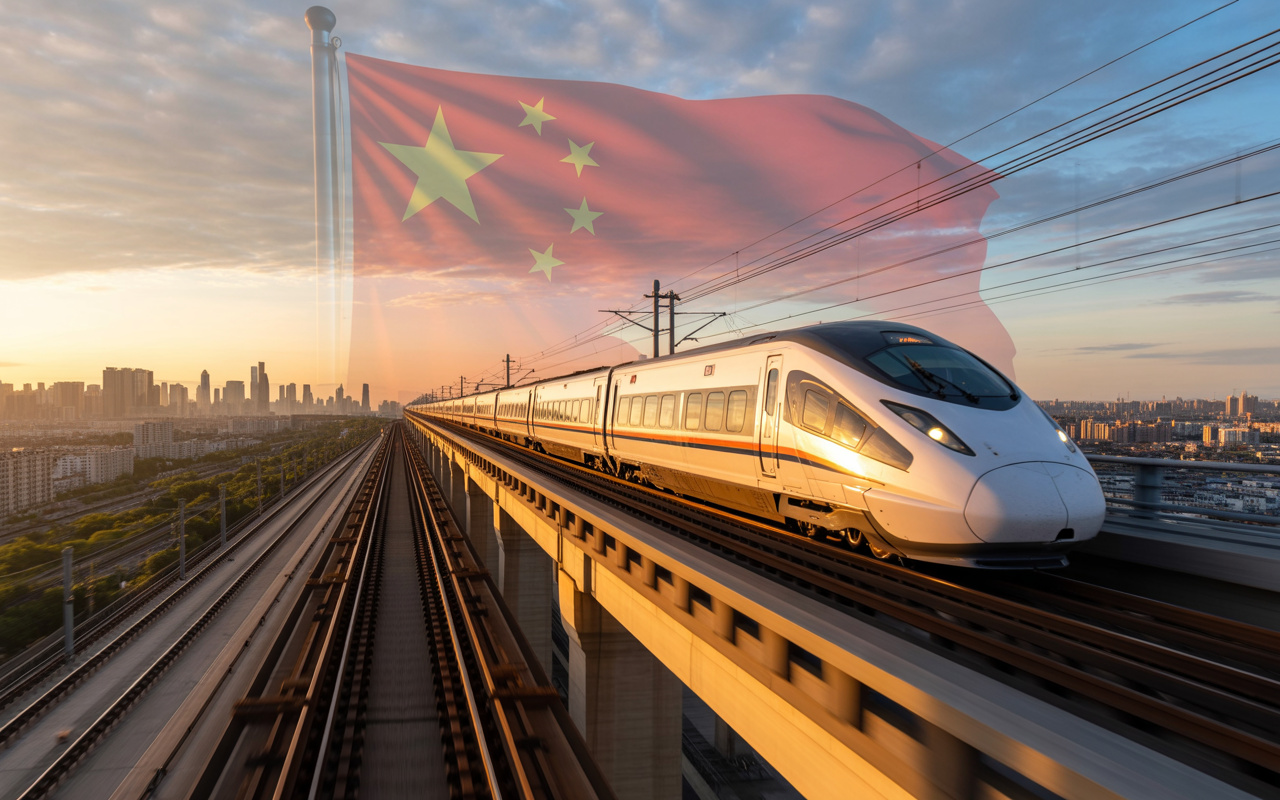


With More Than 40 Thousand Km of Tracks and Trains at 350 Km/h, China Created the Largest High-Speed Rail Network in the World in Just Two Decades.
Few people grasp what this means in physical, logistical, and historical terms. In just over 20 years, China has built a high-speed rail infrastructure larger than the sum of all similar networks on the rest of the planet. This is not an isolated or regional project, but a continuous system that connects coastal metropolises, provincial capitals, medium-sized inland cities, and regions that, until the early 2000s, relied almost exclusively on highways or expensive flights.
The result is a network with over 40 thousand kilometers in operation, designed for commercial speeds between 250 km/h and 350 km/h, with technical standards and scale unprecedented in the history of land transportation.
The Physical Dimension of the Largest Rail Network in the World
The extent of the Chinese high-speed train network is, in itself, hard to visualize. There are over 40 thousand kilometers of dedicated tracks, equivalent to making a complete circle around the Earth at the equator. This network spans virtually the entire continental territory of the country, linking densely populated coastal regions to mountainous inland areas, agricultural plains, and extreme climate zones.
-
Brazilian Students Turn Recycled Plastic Bottles into Synthetic Yarn for Scarves to Aid Needy Families

-
Why the Same Citrus Fruit Has Different Names Across Brazil and How Varieties Differ
-
India Paints Road Red and Uses Smart Asphalt to Slow Drivers and Protect Wildlife in Nature Reserve

-
Yellow vs. White Fat: The Little-Known Difference That Can Impact the Quality and Flavor of Your Barbecue






The lines were designed with gentle curves, long tunnels, elevated viaducts, and drainage systems intended to operate in environments ranging from cold deserts to humid subtropical areas. In several provinces, more than half of the route consists of bridges and tunnels, reducing interference with cities, rivers, and agricultural areas.
Operational Speed and Technical Standards
The Chinese high-speed trains mostly operate at commercial speeds of up to 350 km/h, a figure that places them among the fastest in the world in regular service. Unlike one-off records, these speeds are maintained in daily routines, with tens of thousands of trips per year.
To achieve this, the infrastructure requires millimeter tolerances. The tracks use special ballast or continuous concrete slabs, with strict thermal expansion control. Signaling systems based on continuous communication between train and track allow for short intervals between trains, maintaining high levels of safety even at elevated speeds.
The power supply occurs through dedicated high-voltage networks, with substations distributed along the lines, ensuring stable supply even in remote areas.
Stations That Function as Urban Hubs
Another aspect little perceived outside China is the scale of high-speed train stations. Many of them are not just boarding points, but complete urban complexes, integrated with subways, bus terminals, commercial areas, and new planned neighborhoods.
These stations were designed to handle massive passenger flows, with long platforms, multiple access points, and control systems capable of operating volumes comparable to those of major airports. On peak days, some move hundreds of thousands of people.
Territorial Integration on a Continental Scale
The Chinese high-speed rail network was not built as a collection of independent lines. It follows a logic of integrated mesh, allowing direct travel or with few connections between very distant regions.
Today, routes that previously took more than 20 hours by conventional train or airplane with layovers can be completed in just a few hours, with high schedule predictability. This has transformed mobility patterns, shortened economic distances, and redefined the relationship between urban centers.
Cities that were once outside the major national axes have now integrated into the main flow of people and light goods, something possible only when the infrastructure achieves truly continental scale.
Accelerated Construction and Industrial Standardization
One of the factors that allowed this rapid expansion was the standardization of design and construction methods. Viaducts, pillars, slabs, and permanent way systems were industrialized on a large scale, reducing unit costs and execution time.

Entire segments were constructed simultaneously in different provinces, with dozens of work sites operating in parallel. This approach transformed rail construction into an almost industrial process, something unprecedented outside of China.
Operational Safety and Reliability
Despite the scale and speed, the system was designed with multiple layers of safety. Continuous track monitoring, automated inspections, climate control, and electrical redundancy are part of daily operations.
The reliability of the system is one of its pillars for massive usage. High punctuality and service regularity have made high-speed trains a dominant alternative in many corridors, even replacing air travel over medium distances.
A Historical Milestone in Modern Engineering
When viewed from a historical perspective, the Chinese high-speed rail network represents one of the largest infrastructure projects ever undertaken by a single country in such a short span of time. Its scale surpasses any railway effort of the 20th century and redefines what is considered possible in transportation engineering.
More than kilometers of tracks, the project materializes a profound change in how a continental territory can be connected by rapid, continuous, and integrated land transport.
The question that remains is not whether this network is large — the numbers have already answered that clearly — but how it will continue to shape the movement of hundreds of millions of people in the coming decades and what new limits of global infrastructure can still be surpassed from this model.







You probably meant to write 40’000 km, not 40 km ! According to my research, its even above 50’000 km ! Just incredible !
Simplesmente o oposto do que fizeram no Brasil abandonando as ferrovias e sem planejamento urbano de desenvolvimento algum… 2026EleiçõesNelesJá