Portuguese
  Spanish


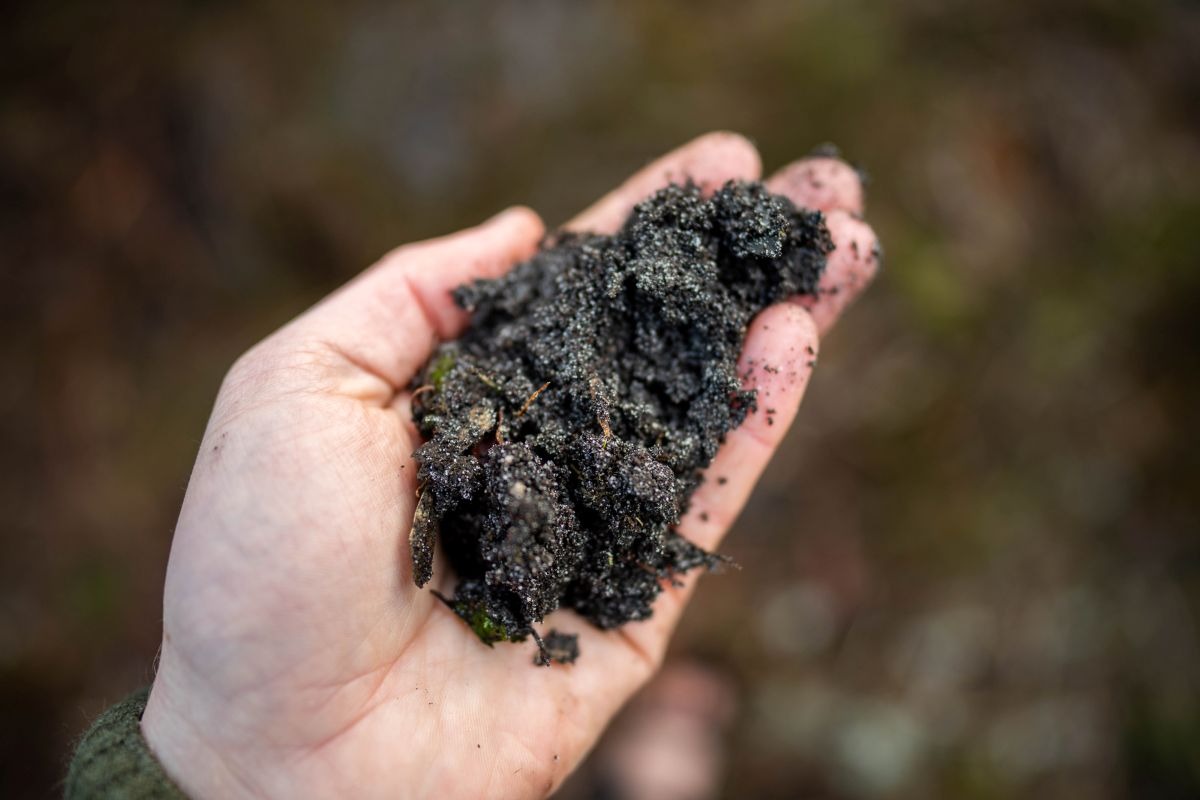

A New International Study Shows That Biochar — A Black Powder Made From Plant Residues — Accelerates Decomposition, Reduces Methane Emissions By Up To 51%, and Improves Soil Quality
A new international study led by Sichuan Agricultural University revealed that adding biochar — a type of charcoal made from agricultural waste — to composting reduces methane emissions by up to 51% and accelerates the maturation process of the compost.
The finding, resulting from an analysis involving 125 projects in various countries, demonstrates that a simple change can make organic waste management cleaner, more efficient, and sustainable, without the need for complex technologies or chemicals.
Biochar: The Natural Accelerator That Was Missing
Biochar resembles a black powder and is obtained through pyrolysis — a process that heats plant residues like straw or peels in the absence of oxygen. The result is a porous material rich in carbon, capable of transforming traditional composting into a much more controlled and less polluting system.
-
She spent 73 years breathing inside an iron lung, survived the aftereffects of polio, and became the last woman in the United States dependent on the equipment before dying at 78 years old.

-
Brazilian students created a $1 filter using pine bark, cotton, and 3D-printed parts to clean cassava wastewater, reduce the toxicity of a hazardous waste, and transform contaminated water into biofertilizer.

-
Astronaut from Artemis II steps down after mission to the Moon and decision surprises after a record of 406,771 km, a historic 10-day journey, and an unprecedented achievement for Canada.

-
A fossil kept for years in a small museum in Montreal concealed 450-million-year-old soft tissue, a discovery that has only happened once before in history.


Although Indigenous communities in the Amazon have been using similar forms of this material for centuries to improve soil fertility, the Chinese study now provides robust scientific evidence of the role of biochar as a composting enhancer and reducer of harmful emissions.
Faster, Cleaner, and More Nutritious Composting
The research showed consistent results: the germination rate of the compost increased by 25%, nitrogen nitrate grew by 32%, and ammonium decreased by 35%.
The carbon-nitrogen ratio, in turn, decreased by 5%. In practical terms, the compost becomes more stable, nutritious, and less toxic, maturing more quickly and with better quality.
These improvements occur because biochar acts as a structure that optimizes oxygenation and retains essential nutrients. Thus, nitrogen waste is avoided while reducing the generation of harmful gases such as methane, ammonia, and nitrogen oxides — all recognized contributors to global warming.
Less Emissions, More Environmental Efficiency
The addition of biochar to the composting process led to significant reductions in emissions: methane (-51%), nitrogen oxides (-43%), and ammonia (-48%).
According to researchers, the porous structure of biochar acts like a sponge and a ventilation channel, allowing air circulation and hindering the emergence of anaerobic bacteria — the main responsible for methane formation.
Moreover, the material retains nitrogen that would otherwise escape as a toxic gas.
The result is a more efficient and less polluting composting process, viable in both medium-sized facilities and urban spaces, where organic waste management faces structural limitations.
The Ideal Mixture: Balance is Essential
The study’s results also showed that not all biochar performs the same. The type of raw material, the pyrolysis temperature, and even the size of the pores directly influence the efficiency of the process.
The most effective biochar is produced from plant straw, subjected to temperatures above 400 °C, with small pores and moderate surface area.
In the compost, the ideal proportion is 12% biochar and 55 to 60% moisture, with an initial carbon-nitrogen ratio between 24 and 28. This balance ensures controlled fermentation, homogeneous texture, and absence of unpleasant odors.
Microorganisms: The Invisible Allies of Decomposition
In addition to acting physically, biochar alters the microbial ecosystem of composting. Its micro-cavities serve as shelter for beneficial bacteria that speed up decomposition and increase the efficiency of the process.
The study demonstrated that biochar with small pores — especially that derived from straw — promotes more active and diverse microbial communities, whereas wood-derived biochar, with large pores, reduces oxygen circulation and slows down decomposition.
This microbial reorganization transforms compost into a more balanced aerobic environment, favoring complete decomposition and drastically reducing the formation of hazardous gases.
Predictable and Scalable Composting
Scientists defined four key factors for successful composting with biochar: pore volume, type of biochar, proportion used, and moisture content. This hierarchy allows for the development of more predictable and replicable systems at different scales without relying on long periods of trial and error.
The research shows that adding more than 12% of well-distributed straw biochar is enough to ensure more stable and safe composts.
When combined with treated organic sludge — such as that from wastewater treatment facilities — biochar closes recycling loops in rural and urban areas, turning waste into valuable resources.
From Agricultural Waste to Strategic Resource
Biochar represents a dual-function technology: it converts agricultural waste into a useful material and significantly reduces greenhouse gas emissions. It is a simple, low-cost approach with the potential to revolutionize waste management and the recovery of degraded soils.
Concrete examples are already emerging in different regions of the world. In India, rural cooperatives use biochar to compost sugarcane leftovers.
In Spain, local governments have started integrating the material into community composting programs. In Chile, researchers are studying its simultaneous application in urban and agricultural waste.
Besides making composting more efficient, biochar improves deeper soil properties, such as the formation of humic acids and long-term carbon retention capacity — decisive factors in combating environmental degradation.
In summary, the study led by Sichuan Agricultural University indicates that the simple inclusion of biochar in composting can transform a traditional practice into a powerful solution against climate change.
With fewer harmful gases, faster decomposition, and more fertile soils, biochar is solidifying itself as an essential tool for a more sustainable agricultural and urban future.