






 Portuguese
  Spanish
  5 min of reading
  0 comments


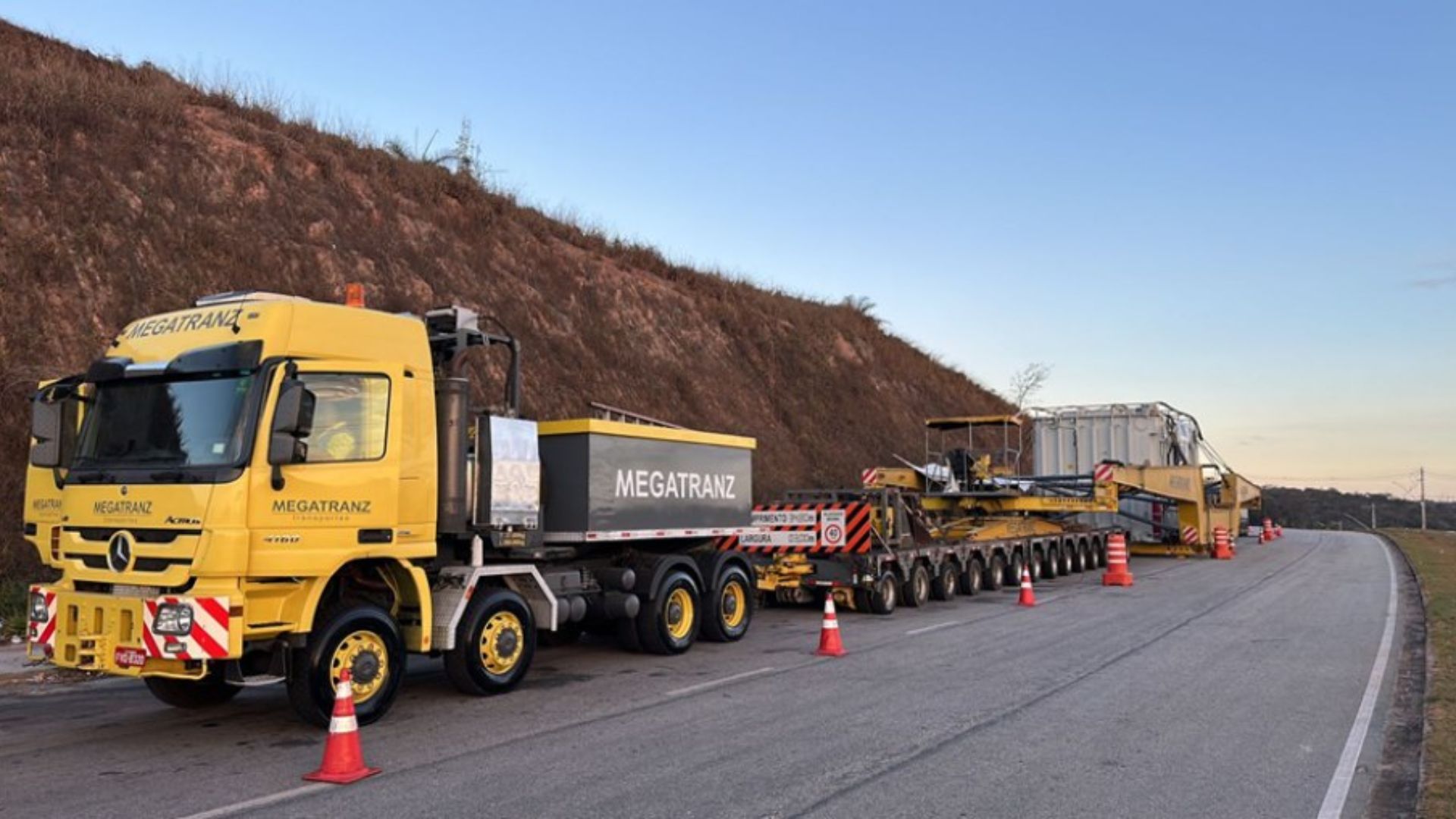
Numbers Out of Standard, Police Escort on Federal Highway and Stage Crossings Garnered Attention When a Convoy of Almost 600 Tons Completed a Mining Section of BR-040 and Continued Its Journey Toward Rio.
A special transportation operation that drew attention for its size and impact on traffic completed, in early December 2025, the crossing of the mining section of BR-040 managed by the concessionaire EPR Via Mineira.
The convoy was described as 99 meters long, almost seven meters wide, and 594 tons, numbers that help explain why the journey took place in stages, with traffic control and operational monitoring along the route.
The conclusion of this phase occurred on December 2, when the passage through the concessioned section was completed at Juiz de Fora, at km 773, after six stages of movement from the entry into the concession area in Belo Horizonte, at km 544.
-
Survivor of 1966 SS Daniel J. Morrell Shipwreck in Lake Huron Recounts 38-Hour Ordeal in Extreme Cold

-
The Greatest Hoax in World Cup History? The Film That Denied Brazil’s 1958 Victory and Exposed How Fake Evidence Can Seem Convincing on TV
-
Fake South Korean Online Stores Offer Shopping Thrill Without Spending Money or Receiving Products
-
The War of Jenkins’ Ear: How a Severed Ear Sparked One of the 18th Century’s Most Unusual Conflicts


The same update reports that the unit left Betim, crossed 15 municipalities, and had the end of the mining section recorded at 10:16 AM, before heading towards the state of Rio de Janeiro.
Curiosities That Explain Why the Convoy Becomes an “Event” on the Road
Although the most recent episode occurred at the beginning of the month, what keeps the story “alive” for the reader is the collection of logistical curiosities that such a convoy exposes in practice: why the trailer needs to occupy more than one lane, why the speed is low, why there are set times, and what rules allow a load far above the standard to operate on a federal highway.
In operations of this type, the presence of support teams is a central part of the planning, and the conduct often involves escort and specific signaling, precisely because any change in trajectory or braking has more impact than in a regular truck.
AET of DNIT and the Limits That Show the Size of the “Surplus”

The starting point to understand the “size of the excess” lies in the official references of what is considered standard.
In Brazil, DNIT explains that the Special Traffic Authorization (AET) is the document required for a vehicle or combination of vehicles that does not fall within the limits of weight and dimensions set by Contran.
On the same page, the agency lists examples of usual dimension and weight limits for circulation: height of 4.40 m, width of 2.60 m, maximum lengths around 19 meters (depending on the combination), and a reference weight of 57 tons.
When placed side by side, this “ceiling” helps to gauge why a unit described as 99 meters and 594 tons becomes, in itself, an event on the road.
Rules and Planning Behind an Oversized Load
The requirement for AET is not a bureaucratic detail: it formalizes, for each trip, the circulation conditions, the route, and the necessary safety measures on federal highways for indivisible or excess loads.
DNIT itself compiles normative acts on this subject and points out that the use of federal highways by vehicles intended for the transport of indivisible and excess loads depends on this authorization, observing Contran requirements.
In practice, the authorization and operational plan help explain why the convoy does not “just take off.”

In communications and reports about the transport of a load of 594 tons on BR-040, the concessionaire EPR Via Mineira was cited indicating that the passage in the concessioned section would have low speed, around 10 km/h, with two lanes occupied and monitoring by operational teams.
This same material emphasizes that the schedule may suffer changes due to adjustments and unforeseen events along the route, which helps explain why, for the driver encountering the convoy, the movement seems intermittent: progress occurs when the conditions of the stretch and traffic allow, and not at the pace of a regular journey.
Escort of the PRF and How the Operation is Organized
Another curiosity that often raises questions is who “directs” the escort.
The Federal Highway Police maintains a dedicated area for cargo escort on its official channel, with guidelines, forms, and rules for providing the service, as well as tables of fees linked to the type of escort and the speed established in the AET.
This indicates that, when there is dedicated escort, it follows a framework of specific norms and procedures, and not local improvisation.
In the case of the crossing completed on December 2, the published update reports joint action by teams from the concessionaire with the PRF throughout the course in the mining stretch, with monitoring of the highway, traffic control, guidance to drivers, and operational adjustments in more critical points.
These elements frequently appear when oversized loads traverse regions with topography, special structures, and heavy traffic: the convoy, by its own geometry, tends to require more maneuvering space, more braking distance, and more predictability of the surrounding environment.

Why the Movement Occurs in Stages and with Scheduled Stops
For this reason, the movement in “stages” becomes a key component of the narrative.
In another coverage of the same transport of 594 tons, referring to the crossing of BR-040, the PRF was cited stating that the cargo advanced through defined stretches, with stops between stages, while heading towards Rio de Janeiro, with the indicated destination as Itaguaí.
This way of traveling, in which the convoy covers a limited distance, parks at a previously chosen point, and resumes in the next window, is what allows for reducing the time of continuous interference in traffic while maintaining control of the operation.





-

-

-

-

-

-

29 people reacted to this.