






 Portuguese
  Spanish
  5 min of reading
  0 comments


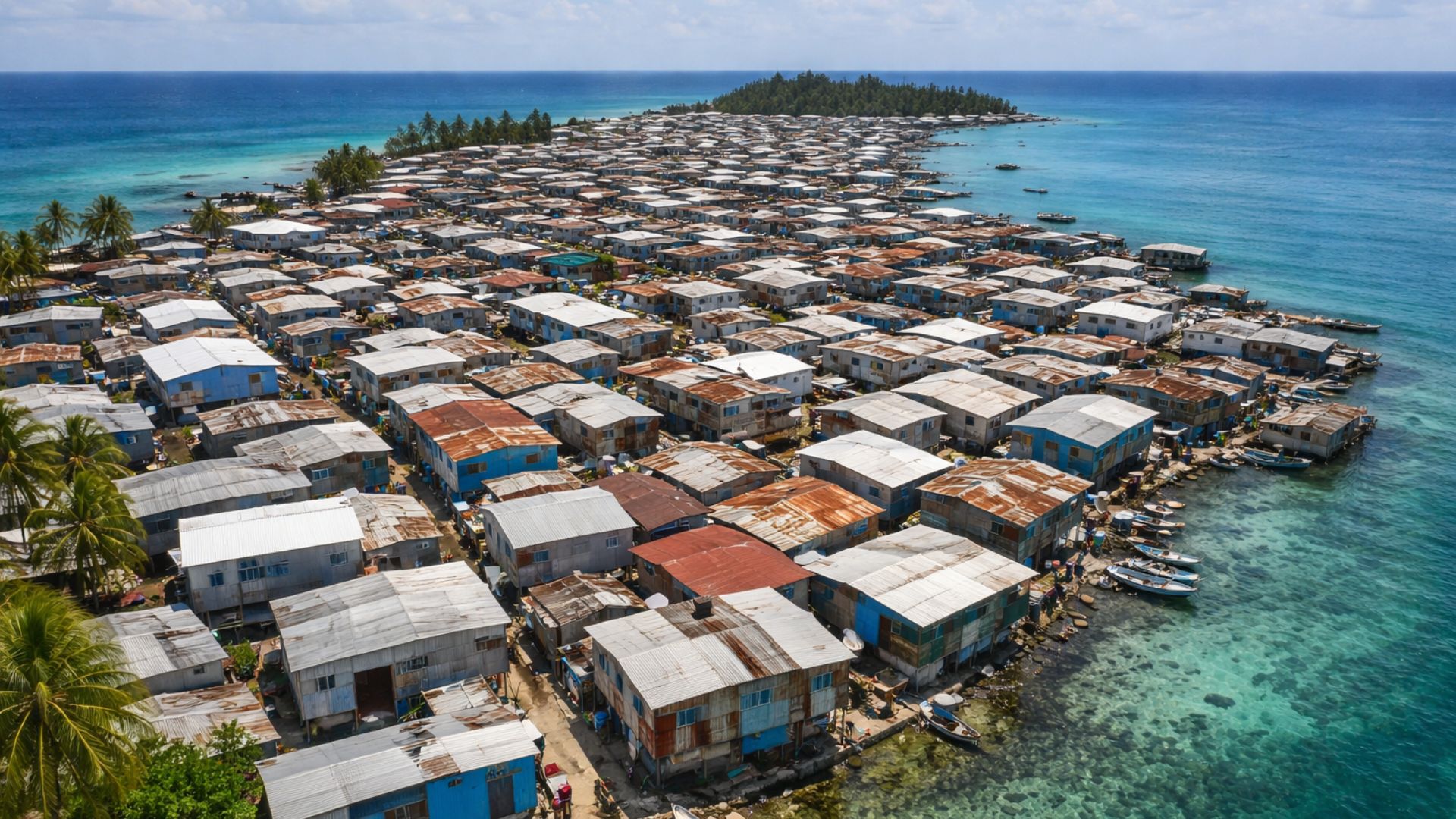
Pacific Island Concentrates City Population in Tiny Territory, with Houses Stuck Together and Infrastructure Pressured by Limited Space. Density Recorded in Census and Public Water and Sewer Projects Show How Basic Services Need to Operate on an Urban Scale, Surrounded by Sea and Coastal Vulnerability.
Ebeye is a tiny strip of land in the Kwajalein Atoll, in the Republic of the Marshall Islands, in the Pacific, where urban life is concentrated in a few blocks of sand and concrete.
In an area of 0.36 km², the island hosts thousands of residents, houses stuck together, and an infrastructure that needs to function on a city scale, but without the space that typically supports water, sewer, and power networks.
Ebeye in the Kwajalein Atoll and Compressed Life in the Pacific
The numbers help explain why Ebeye frequently appears in reports and studies as one of the most densely populated places in the Pacific.
-
Survivor of 1966 SS Daniel J. Morrell Shipwreck in Lake Huron Recounts 38-Hour Ordeal in Extreme Cold

-
The Greatest Hoax in World Cup History? The Film That Denied Brazil’s 1958 Victory and Exposed How Fake Evidence Can Seem Convincing on TV
-
Fake South Korean Online Stores Offer Shopping Thrill Without Spending Money or Receiving Products
-
The War of Jenkins’ Ear: How a Severed Ear Sparked One of the 18th Century’s Most Unusual Conflicts


In an area of 0.36 km², the island hosts thousands of residents, houses stuck together, and an infrastructure that needs to function on a city scale, but without the space that typically supports water, sewer, and power networks.
The national census conducted by the Republic of the Marshall Islands in 2021 recorded 8,416 residents in Ebeye, while documents from international projects addressing coastal risks and urban planning cite an order of magnitude of about 10,000 inhabitants to describe the demographic pressure on the island.
The geography of Ebeye offers no room for expansion.

Situated within one of the largest atoll formations in the world, it is low, narrow, and surrounded by shallow waters that limit construction and increase the cost of any intervention.
The proximity to Kwajalein Island, where strategic facilities used by the United States are located, reinforces the local importance of transportation, labor, and supply services, further concentrating activities in the same area.
Population Density and Pressure on Housing and Services
Overcrowding in Ebeye is not just a housing issue.
It becomes a public health engineering challenge, because water and sewer networks depend on pipelines, lift stations, constant maintenance, and stable energy for pumping.
When all the territory turns into urban occupation, every failure in equipment tends to have an immediate effect on daily life, since the space for distancing, rerouting, and constructing alternative structures is limited.
In the government of the Marshall Islands itself, the density of Ebeye appears as a recurring indicator in official reports.
A summary of the 2011 census, prepared by the office of statistics and planning tied to the presidency of the country, described Ebeye as the most crowded place in the republic and presented calculations of population density at a high level by international standards, relating this type of concentration to social impacts and public health.
Drinking Water and Sanitation in an Island with No Room for Error


Water is one of the most sensitive points in any community situated on low islands in the Pacific.
The natural availability of fresh water tends to be limited and vulnerable to dry periods, in addition to relying on collection and treatment systems for safe consumption.
In the case of the Marshall Islands, the same summary report of the 2011 census pointed out that the main source of drinking water for most of the country’s residences was rainwater collection from roofs and reservoirs, a method that requires adequate storage and hygiene conditions to reduce contamination risks.
In Ebeye, the pressure for supply and sanitation led to an institutional response with targeted investment.
The island is served by a utility company of the atoll, the Kwajalein Atoll Joint Utilities Resources (KAJUR), which manages essential services and is responsible for implementing structural improvements in public projects.
Audits and official financial statements of the “Ebeye Water Supply and Sanitation Project”, recorded by the government, describe the central objective of the program: to expand access to safe water and improve sanitation on the island.

The project was partially funded by the Asian Development Bank (ADB) and received co-financing from the Australian government, as well as contributions from the Marshall Islands government itself.
In the explanatory notes of the audited financial statements, the program is presented with goals directly linked to the daily lives of Ebeye, such as modernizing the sewer system to reduce uncontrolled overflows and diminish environmental and health impacts associated with wastewater disposal.
Energy and Infrastructure: What Keeps the System Running
The interdependence between sanitation and energy also appears in the official project documents.
The same set of notes describes the intention to reinforce the security of electricity supply and internal distribution as a way to reduce risks to the operation of water and sewer systems.
In Ebeye, where infrastructure needs to operate in compressed territory, energy stability ceases to be just a matter of comfort and becomes an operational requirement to keep pumps, treatment systems, and maintenance active.
The “on the edge” nature is not limited to technical aspects: it shapes urban life on a human scale.

On an island where distances are short, housing and businesses compete for every meter, and public services must coexist with the proximity of residences, schools, small markets, and clinics.
The very form of occupation, with buildings pressed together and narrow streets, creates an environment where any work on piping or lift stations needs to be meticulously planned to avoid disrupting circulation and supply.
Coastal Risk and Vulnerability in the Pacific
Ebeye is also part of international discussions on coastal risk and climate vulnerability.
Documents from World Bank projects addressing resilience in the Pacific cite the island as an extreme example of density and exposure to coastal events, highlighting that the need for infrastructure protection in Ebeye is critical precisely because people, homes, and services are situated very close to the waterline.
Even when investments progress, the scenario remains unique: a community with city density, on a piece of land smaller than many urban neighborhoods, requiring that supply, sewer, and energy be treated as a permanent priority.
The combination of limited space, a large number of residents, and technically complex works helps explain why Ebeye continues to attract attention from reports, researchers, and international media that observe how to manage essentials when the territory is almost disappearing.





-

-

-

-

-

-

15 people reacted to this.