






 Portuguese
  Spanish


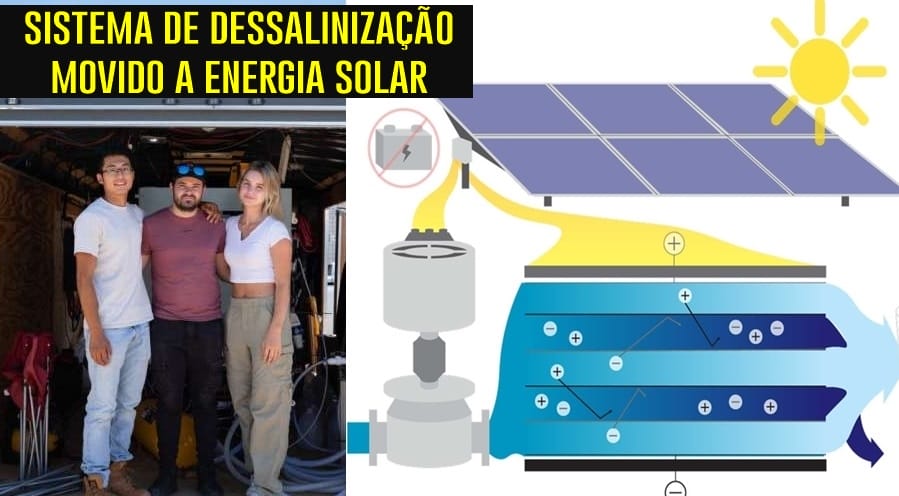

A Solar-Powered Desalination System That Requires No Batteries Can Provide Affordable Drinking Water
A team of engineers from MIT has developed an innovative desalination system that operates on solar energy without requiring extra batteries. The new technology not only ensures an efficient supply of drinking water but also promises to be an affordable solution for underserved communities around the world, especially in remote areas.
The solar-powered desalination system automatically adjusts to variations in sunlight throughout the day. As sunlight increases, the system accelerates its desalination process, and when there is a sudden drop, such as during cloudy moments, it slows down to adapt.
This ability to quickly react to small changes in sunlight allows the system to make the most of the available solar energy, producing large amounts of clean water regardless of climatic variations.
-
Brazil filled the Northeast with wind turbines but now faces the side effect of 705 giant blades reaching the end of their lifespan by 2032 just in Rio Grande do Norte, while the world projects 43 million tons of waste by 2050.

-
Brazil has filled the Northeast with wind turbines, but now it faces the side effect of 705 giant blades reaching the end of their useful life by 2032 just in Rio Grande do Norte, while the world projects 43 million tons of waste by 2050.
-
Wind farm in Namibia will have wind turbines assembled without giant cranes and is expected to avoid 200,000 tons of carbon dioxide per year when it becomes operational.

-
Taller than the Statue of Liberty, thousands of wind turbines are being planted in the middle of U.S. fields, creating two-story farms where corn and soybeans grow below while the wind turns into electricity above.




In contrast to other solar-powered systems, this new technology does not require batteries to store energy or an additional energy source like the electrical grid. This is a significant advancement, as it eliminates extra costs and simplifies installation, making the system more accessible and sustainable.
Successful Tests in Desalination

The MIT engineers tested a large-scale prototype in groundwater wells in New Mexico over six months under varying climatic conditions.
The system proved to be extremely efficient, capturing an average of 94% of the electrical energy generated by the solar panels and producing up to 5,000 liters of drinking water per day.
Even in adverse climatic conditions, the system remained stable, confirming its viability in communities facing unpredictable climate changes.
Professor Amos Winter, director of the K. Lisa Yang Global Engineering and Research (GEAR) Center at MIT, explained the significance of this development: “Traditional desalination requires a stable energy source and battery storage to compensate for the variability of solar energy. Our system automatically adjusts energy consumption according to the sun, making it possible to produce drinking water directly from renewable sources without the need for energy storage in batteries.“
Potential for Communities Without Access to Drinking Water
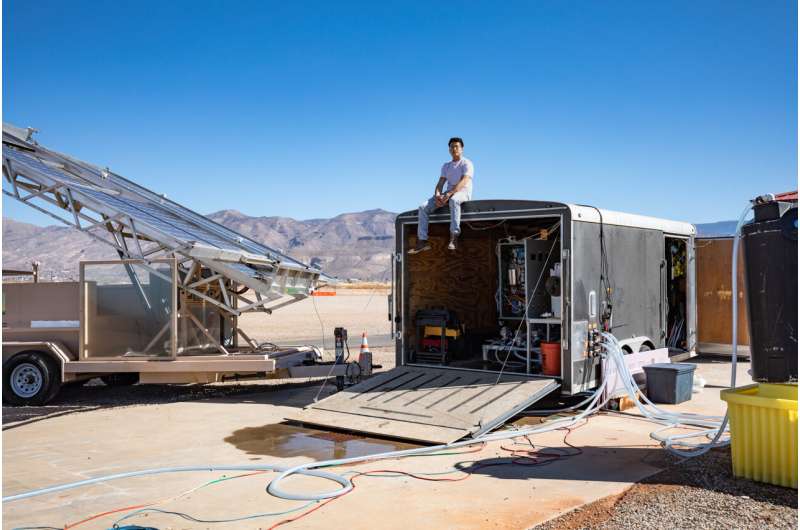
The system is primarily designed to desalinate brackish groundwater, a source of water abundant in underground reservoirs, but often unused due to its high salt content.
Unlike freshwater reserves, which are rapidly depleting in various parts of the world, brackish water remains an untapped source of drinking water.
The researchers see this resource as a promising opportunity to provide affordable drinking water, especially for communities far from coastal regions where access to seawater for desalination is not viable.
Jonathan Bessette, a PhD student in mechanical engineering at MIT and co-author of the study, highlighted the importance of this innovation for regions that rely on groundwater.
“The majority of people live far from the coast, where seawater desalination is not a viable option. In many of these regions, especially in remote and low-income areas, groundwater is essential, but it is becoming increasingly salty due to climate change. Our technology can bring clean and accessible water to these neglected places“, Bessette states.
How Does the System Work? The Technology of MIT Engineers
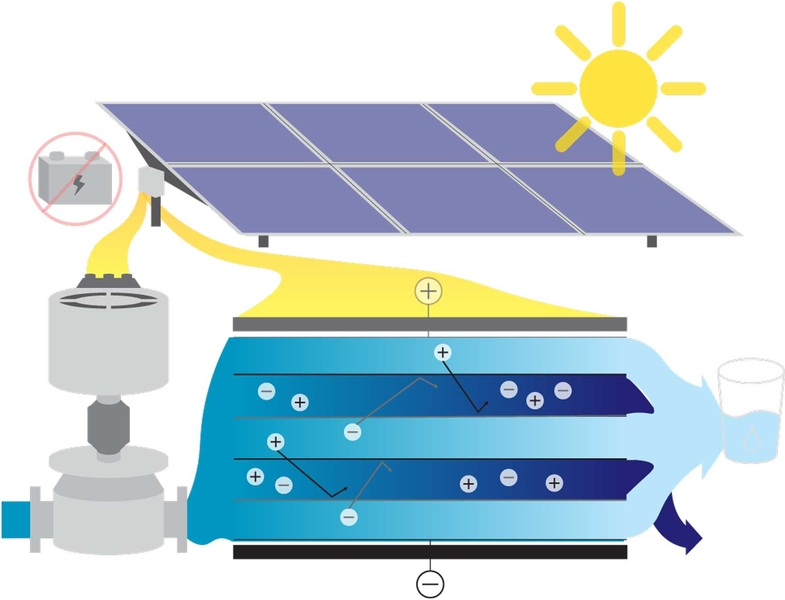
The new technology developed by MIT engineers is based on a method known as electrodialysis, in which an electric field is used to remove salt ions from the water as it passes through an ion exchange membrane.
Although other desalination methods, such as reverse osmosis, are also used, the MIT-developed system focuses on maximizing the efficiency of the process by synchronizing energy consumption directly with the availability of sunlight.
The automated control of the system is what sets it apart from other existing solutions. Based on sensor readings, the system calculates the ideal water pumping rate and the voltage needed to remove salt from the water in real-time, quickly adjusting to variations in solar energy.
In previous tests, the system had already demonstrated superior efficiency compared to traditional systems, but the researchers identified the need to improve response speed to climatic variations.
In this new version, the team managed to further enhance the system’s performance by completely eliminating the need for batteries and reducing response time to fractions of a second.
With this improvement, the system automatically adjusts its desalination rate up to five times per second, keeping the salt removal process in sync with changes in sunlight. This means that even on cloudy days, the system continues to operate effectively without relying on additional energy.
Sustainability and Economics
Professor Winter emphasizes that eliminating batteries not only reduces system costs but also makes desalination more sustainable. “Compared to the traditional way of designing a solar desalination system, we have managed to reduce almost 100% of the battery requirement“, Winter explains.
The engineers now plan to test the system on a larger scale, with the aim of providing desalinated water to entire communities and potentially entire municipalities.
With the growing demand for drinking water and challenges related to climate change, this technology could be a key response to ensure sustainable water supply in affected regions.
Next Steps
The researchers continue to work on developing cheaper and more sustainable desalination methods. Shane Pratt, an engineer on the team and co-author of the study, states that the focus is now on maximizing the reliability of the system and expanding its application to different markets around the world.
“We are still in the development phase, but we believe our technology can provide desalinated water from renewable sources to various global communities. We are building a product line that will meet the demands for sustainable and affordable drinking water,” Pratt adds.
The MIT team is also preparing to launch a company in the coming months, aiming to bring this revolutionary technology to market. The project has been funded by the National Science Foundation, the Julia Burke Foundation, and the MIT Morningside Academy of Design, along with support from companies like Veolia Water Technologies and Xylem Goulds.
With the success of initial tests and the potential for scalability, the solar-powered desalination system promises to be an effective solution to the global water crisis, providing access to drinking water for millions of people in remote and vulnerable regions.


