Portuguese
  Spanish


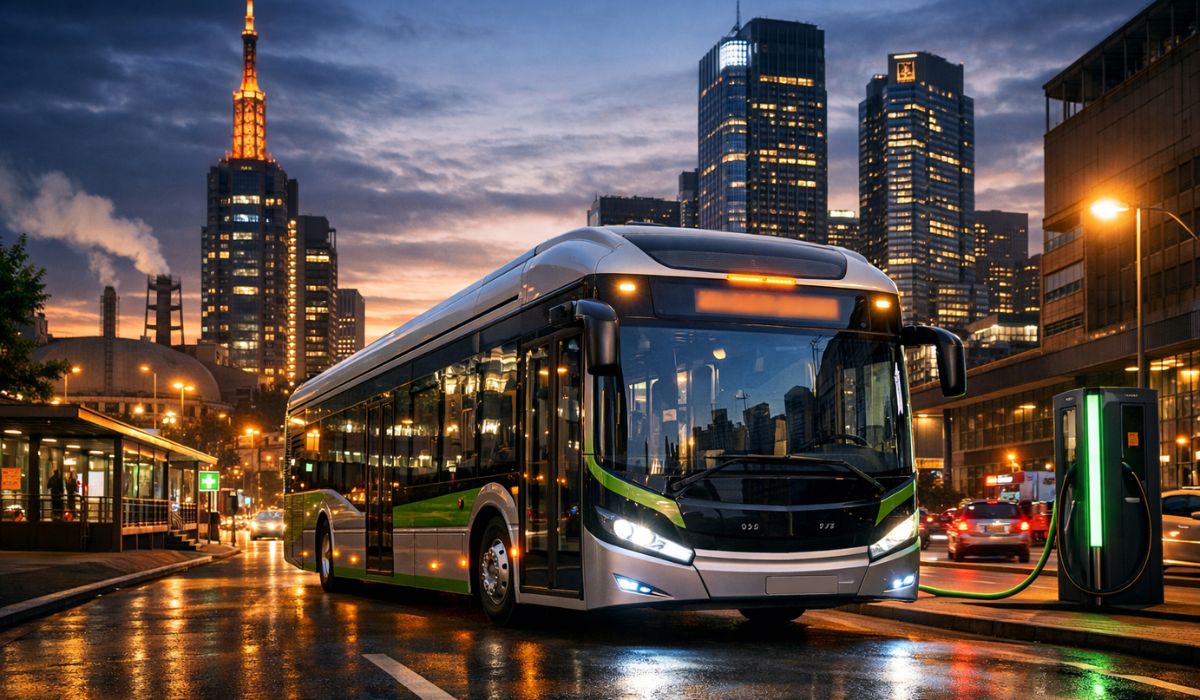


Industrial expansion, decarbonization goals, and large-scale tests place electric buses at the center of the transformation of Brazilian urban transport, with São Paulo as the main showcase of this movement and the local industry in the adaptation phase.
Brazil has expanded its presence in the production chain of electric buses and electrified chassis for public transport in recent months, in a movement that combines industrial expansion, decarbonization policies, and increased urban orders.
São Paulo, the largest market in the country, concentrates a significant part of this process and has become a reference for national and foreign manufacturers.
In practice, the electrification of buses has also become a test of the ability of cities and companies to replace diesel with batteries without compromising public transport operations.
-
Largest Known Single-Piece Meteorite, Weighing 60 Tons, Puzzles Scientists with Its Intact Fall and Lack of Visible Crater

-
Oceanographer Turns Abandoned Fishing Nets from Brazilian Waters into Bags, Creating Jobs and Earning Over $7,000 Monthly

-
Australia deploys poisoned sausages and uses traps, shooting, and fences in a battle against invasive cats that kill over 1.5 billion native animals annually, threatening more than 200 species.

-
NASA Rover Captures “Tired Face” on Mars, Highlighting Human Brain’s Tendency to See Faces in Rock Formations





Electric bus production gains scale in Brazil
This change is visible on the streets but begins earlier, in the industry.
The Chinese BYD, which already operates in Campinas focused on the production of electric bus chassis, has begun working on expansion plans in the country to increase local manufacturing of electrified commercial vehicles.

In December 2025, industry publications and international press outlets reported that the company was studying a new unit in Brazil with a potential capacity of 6,000 to 7,000 chassis per year, including electric buses and trucks, after demand exceeded the then-available structure.
In the case of the Brazilian Eletra, the strategy has also progressed with a focus on increasing production capacity.
In October 2025, the company confirmed an investment of R$ 40 million to expand its annual production of electric chassis from 1,800 to 3,000 units in São Bernardo do Campo.
This data is relevant as it signals an advancement in local production at a central stage of the vehicle, which integrates electric motor, power electronics, regenerative braking, and energy storage systems.
How electric bus efficiency works in urban transport
The expansion of the industry accompanies a characteristic unique to this type of vehicle: the operational weight of each unit in the transport system.
A bus runs for long periods, makes frequent stops, and transports a large volume of passengers throughout the day.
Therefore, the replacement of diesel with electricity tends to have a more noticeable impact on emissions and noise than the replacement of individual vehicles on a smaller scale.
In densely populated areas, this effect often appears more evident in corridors and roads with higher traffic.
Additionally, there is a technical aspect that helps explain the growing interest in the model.
Electric buses recover part of the energy during deceleration through regenerative braking, which returns electricity to the batteries.
In urban routes, marked by constant braking and acceleration, this mechanism improves efficiency and helps to extend the range.
Technical studies and public documents on electromobility point to this feature as one of the advantages of the model in urban operations.
Another factor frequently cited in analyses on the topic is the composition of the Brazilian electricity matrix.
Since the country has a significant share of renewable sources in electricity generation, the climate benefit of electric buses tends to be more significant over the vehicle’s usage than in markets that rely more heavily on fossil fuels to produce energy.
This scenario does not eliminate challenges such as infrastructure and initial cost, but it helps explain why the electrification of public transport has gained traction in technical and regulatory discussions.
São Paulo concentrates the largest showcase of electrification
No Brazilian city better synthesizes this movement than São Paulo.
In December 2025, the city hall reported that the capital reached 1,149 buses powered by clean energy after the delivery of 140 more vehicles, with an estimated avoidance of 43.5 million liters of diesel per year and a reduction of about 100 thousand tons in annual CO₂ emissions.
By March 2026, a new official balance indicated further expansion of the fleet, with 47.6 million liters of diesel avoided per year and a reduction of 109.5 thousand tons of annual CO₂.

These numbers help explain the growing interest of manufacturers in the Brazilian market.
When a metropolis the size of São Paulo increases orders, companies gain more predictability to invest, test platforms, adapt products, and expand local production.
In this context, electrification ceases to be just an environmental issue and is also viewed from an industrial, logistical, and regulatory perspective.
Traditional manufacturers enter the market competition
At the same time, the entry of traditional manufacturers shows that the electric bus already occupies a concrete space in the planning of the automotive industry.
Volkswagen Trucks and Buses has put the e-Volksbus 22L into experimental circulation with customers in São Paulo and presents the model as one of its bets for high-demand urban transport.
According to the manufacturer, the vehicle was developed in Brazil, can carry up to 82 passengers, and has an approximate range of 250 kilometers.
In December 2025, specialized vehicles recorded the first commercial deliveries on a small scale to the city.
The presence of manufacturers with a consolidated presence in the Brazilian market increases competition in a segment that relies on technical assistance, availability of parts, team training, and maintenance capacity.
These factors are pointed out by operators and specialists as central to the viability of large-scale electrification, especially in systems that require high vehicle availability.

Infrastructure and recharging still condition the sector’s advancement
The projection of regional leadership, however, requires caution.
Brazil has market scale, industrial capacity, and significant orders, especially in São Paulo, which places it in a prominent position in Latin America.
Still, transforming this potential into consolidated leadership depends on factors such as effective delivery pace, expansion of the recharging network, access to financing, integration with energy distributors, and regulatory stability.
Operational conditions of garages and urban corridors also factor into this equation.
Recent studies on recharging infrastructure in São Paulo indicate that fleet expansion requires detailed planning of electrical power, load distribution, recharging time, and adaptation of company routines.
In other words, the growth of the fleet depends not only on the purchase of vehicles but on a set of technical and operational decisions that determine the actual capacity to keep the service running.
In this scenario, Brazil’s progress has been accompanied by a combination of local production, public policy, and gradual fleet expansion.
The performance of electric buses has been observed less by the volume of announcements and more by the ability to operate continuously, meet daily demand, and maintain service regularity.
It is this practical performance, measured in the routine of urban transport, that tends to define Brazil’s weight in the Latin American low-emission mobility market.