






 Portuguese
  Spanish
  3 min of reading
  0 comments


Bilateral Agreement Announces Investments, Goals Until 2026 and Creation of Binational Group to Coordinate Critical Mineral Supply Chains
The governments of the United States and Australia signed a strategic agreement in Washington, D.C. on October 20, 2025.
The objective is to strengthen the supply and processing of critical minerals and rare earths, sectors considered vital for defense and technology.
The document was officially released on October 21, 2025, confirming one of the largest economic partnerships in the mineral sector in recent years.
According to the Department of Industry, Science and Resources of Australia, the pact aims to “accelerate the secure supply of critical minerals and essential rare earths”.
These inputs are fundamental for advanced technologies and military equipment.
Thus, the U.S. and Australia seek to reduce reliance on China and strengthen strategic supply chains.
Investments and Goals Set Until 2026
According to the White House, the partnership will allocate US$ 3 billion in direct investments over the next six months.
These resources will be applied to mining, refining, and technological innovation projects.
Additionally, the U.S. Exim Bank will issue letters of intent worth US$ 2.2 billion, ensuring supply chain financing.
Therefore, the agreement reinforces the commitment to energy security and mineral independence.
-
Ukraine launches largest drone attack on Moscow since 2022, Russia claims to have intercepted nearly 200 aircraft near the capital, Kapotnya refinery targeted again, and offensive reignites alert about war reaching the Russian energy heart just a few kilometers from the Kremlin.

-
Truck drivers, freight, and fines from 2022 take center stage in politics: Chamber approves MP with amnesty, mandatory tracking by CIOT, million-dollar penalties, and new minimum wage for those who spend more than 24 hours on the road.

-
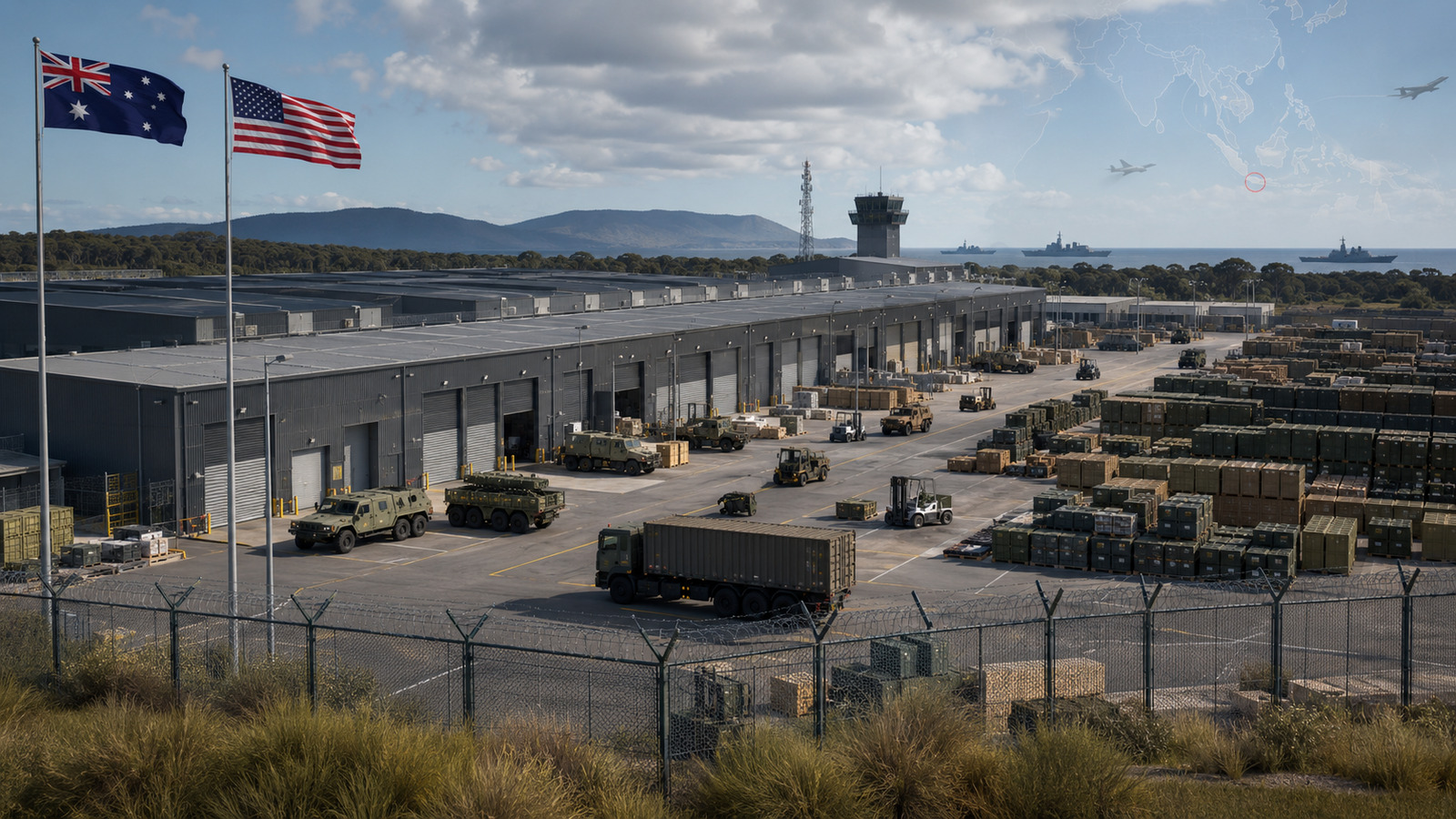
China off the radar: US plans mega $30 million weapons depot in Australia, out of reach of most Chinese missiles, with full capacity expected by 2028

-
Trump’s wall advances at a rapid pace: government promises to complete a barrier of over 3,000 km by 2027 while drones and cartels turn the US border into a new field of technological dispute



Among the goals is the construction of a gallium refinery in Australia, with an annual capacity of 100 tons.
This facility will produce essential materials for semiconductors, strengthening the electronics and defense industries of both countries.
Thus, the project ensures industrial autonomy and reduces technological vulnerabilities.
Productive Cooperation and Environmental Sustainability
The Australian government reported that both countries will use existing mining structures.
Additionally, they will create new production units by 2026, stimulating innovation and job creation.
The governments also promised to expedite environmental permits, review national security regulations, and invest in recycling mineral waste.
In this way, the pact reinforces the sustainability of modern mining and expands the reuse of strategic materials.
The agreement also establishes the U.S.–Australia Critical Minerals Supply Security Response Group.
This group will be led by the U.S. Secretary of Energy and the Australian Minister for Resources.
Therefore, it will coordinate joint actions, identify priority minerals, and ensure balanced supply between the nations.
Technological Advancement and Defense Integration
In addition to mining, the pact brings the two countries closer in high technology areas.
Australia will purchase US$ 1.2 billion in unmanned submarines from Anduril and US$ 2.6 billion in Apache helicopters.
Simultaneously, both will develop joint projects in artificial intelligence, quantum computing, and space exploration.
These initiatives will involve NASA and the Australian Space Agency, consolidating long-term scientific cooperation.
Thus, the agreement integrates mining, defense, and technological innovation, strengthening the strategic position of the West in the global critical input market.
Consequently, the U.S. and Australia gain greater geopolitical influence and industrial competitiveness.
Legal Terms and Conditions of the Pact
The Australian government emphasized that the document does not create legal obligations or binding rights.
Therefore, any country can terminate its participation with written notice, with a 30-day notice period.
This condition maintains diplomatic flexibility and allows adjustments in case of geopolitical changes.
Strategic Partnership with Global Reach
With goals until 2026 and investments exceeding US$ 5 billion, the agreement represents a milestone for the global mineral and technological transition.
Furthermore, by diversifying supply sources and strengthening production chains, the U.S. and Australia move towards a new energy and industrial balance.
However, in light of the growing competition for strategic resources, will this alliance be able to redefine the global dominance of critical minerals by 2026?





Be the first to react!