






 Portuguese
  Spanish


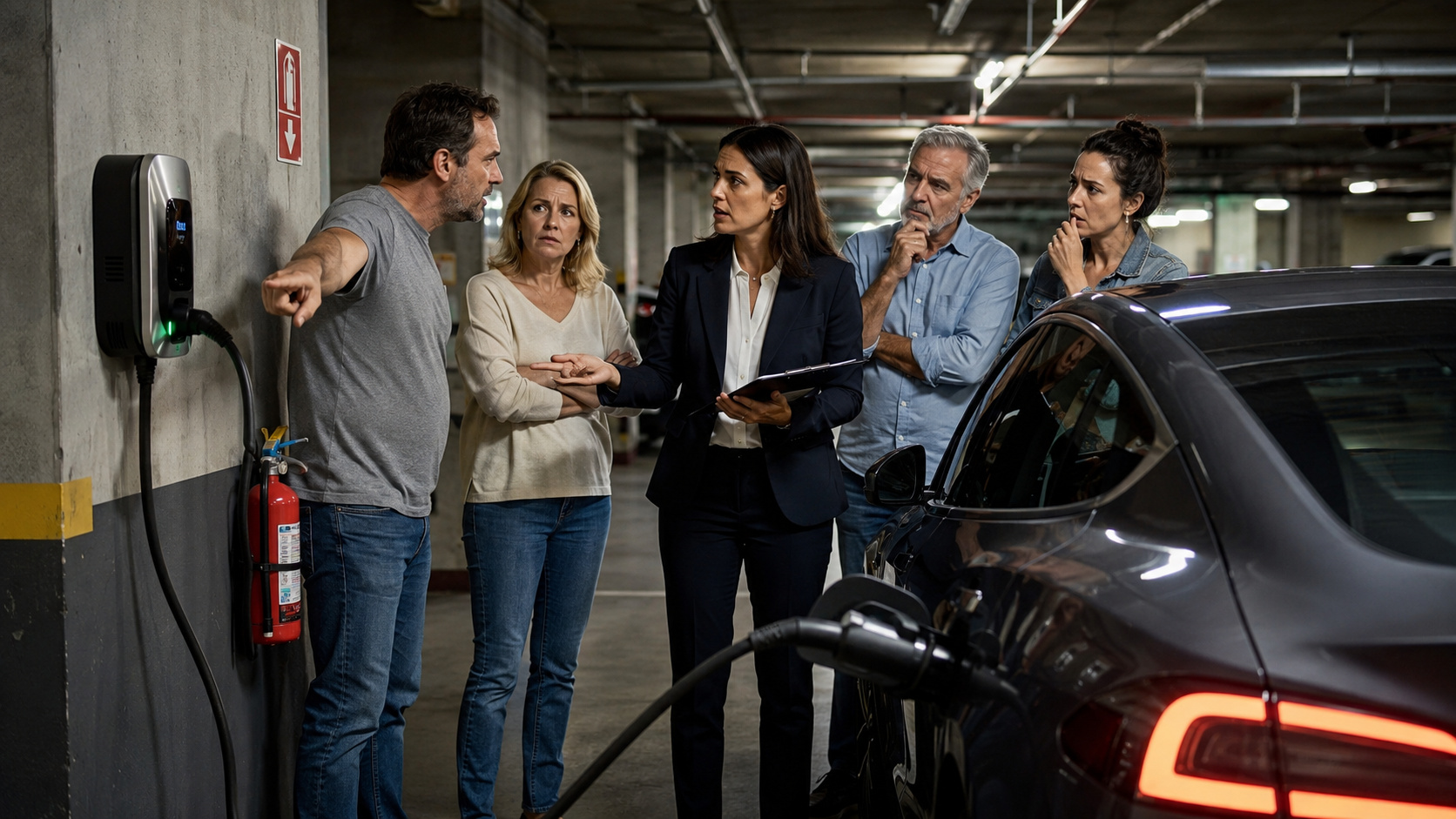


The installation of electric car chargers in underground garages has become a source of tension in condominiums, reignited fears of battery fires, and presented residents, building managers, and experts with a dilemma on how to allow the transition to electric mobility without turning the parking space into a source of conflict
Residents have started trying to prevent electric cars from charging inside buildings due to fear of battery fires. The discussion gained traction in condominiums with underground garages, where any perceived risk usually generates greater concern among neighbors.
The investigation was published by ABC News, the Australian public broadcaster’s news outlet. The case shows how the arrival of electric car chargers in buildings has placed electric mobility within a dispute that mixes safety, fear, incomplete information, and pressure among residents.
The impact for those who own or intend to buy an electric car is direct. Without authorization to charge in their own garage, the vehicle owner may depend on public charging points, face more daily difficulties, and even reconsider buying a battery-powered model.
-
1983 Chevrolet Runs Over 100,000 km Without Gasoline, Powered by Wood Chips, Reaches 125 km/h in Airport Test

-
Workshop Converts Giant Tractor Tire Tricycle into a Three-Wheel Drive Hybrid with 36,000-Watt Electric Motor Capable of Climbing Hills

-
Chery Offers Lifetime Battery Warranty and Car Replacement for Major Failures Under New Chinese Regulations
-
Sales of Brazil’s Cheapest Electric Car Halted Before First Deliveries: E-Motors Suspends Emova Easy Due to Import Tax Increase and Rising Freight Costs





The electric car arrived in the garage, but met resistance even before charging
The transition to electric cars is often presented as a point of no return. However, in many buildings, this future runs into a simple question: will the condominium allow the resident to charge the vehicle in the garage?
In underground garages, the fear focuses on the battery. For some residents, the charger represents a risk within an enclosed space, near other cars, columns, apartments, and common areas of the building.
This apprehension led strata committees, a condominium management model used in Australia, to block or hinder the charging of electric vehicles in building parking lots. In practice, the parking space has become a new frontier in the dispute over the future of mobility.

The most sensitive point is that the debate doesn’t just involve technology. It involves coexistence. One resident wants to charge their car. Another fears waking up to the building in flames. The building manager or committee is caught in the middle of the pressure.
Fear of battery fires became an argument to block chargers in buildings
The fear of battery fires doesn’t appear by chance. Electric car batteries can cause concern because many people associate this type of equipment with fires that are difficult to control.
In underground garages, this fear grows. The enclosed environment gives a greater sense of risk, especially for those who don’t understand how charging works or how safety systems are evaluated.
Even so, experts cited in the discussion state that part of this fear is fueled by disinformation and an exaggerated perception of risk. This does not mean ignoring safety. It means separating real prevention from panic.
ABC News detailed the dispute that pitted condominiums against electric car chargers
ABC News, the Australian public broadcaster’s news outlet, detailed the central points of the topic and showed that the blocking of chargers appears amidst doubts about safety, building rules, and residents’ trust.
The report also featured the case of Julie Stone, owner of a Tesla Model 3. When talking about charging from a common outlet, she compared the situation to using a simple appliance and said: “It is like plugging a toaster in”.
The comparison helps to show the size of the gap between the perception of some electric vehicle owners and the fear of some neighbors. For those who use the car, charging seems routine. For those who fear the battery, the same act seems like a threat.
This clash creates a stalemate. If the condominium prohibits everything, it hinders the adoption of electric cars. If it allows without explaining rules, it can increase insecurity among residents.
Cases in the United States show that the discussion was not restricted to Australia
Resistance to chargers also appeared in the United States. Rosemont, Illinois, imposed a pause on new electric vehicle chargers in parking garages.
The case reinforces that the discussion is spreading beyond Australian condominiums. Concerns about fire, enclosed garages, and building liability have become part of the conversation in different places.
Luxury condominiums in Saratoga Springs also entered this debate by adopting pauses or restrictions related to electric cars in underground garages. The central concern involves the presence of batteries and the perceived risk in indoor areas.
These episodes show that the electric transition does not depend solely on automakers and buyers. It also depends on local rules, collective decisions, and the trust of those who share the same building.
The dispute may delay the adoption of electric cars among building residents
For those who live in houses, charging an electric car is usually simpler. In condominiums, however, the decision goes through superintendents, assemblies, committees, and internal rules.
This difference can affect the adoption of electric cars. If residents cannot charge their vehicles where they live, their routine becomes more difficult. The promise of practicality loses its strength.
The problem also creates insecurity for those who manage buildings. Without a clear and well-communicated rule, each condominium can act differently. Some authorize. Others postpone. Others block out of fear.
Ultimately, the main consequence is practical: the advancement of electric cars may be slower in buildings and condominiums. The technology may be ready, but coexistence still needs to keep pace with this change.
Safety needs to be taken seriously, but technological panic can become a barrier
Safety in garages must be handled with care. No condominium needs to ignore doubts about electrical installation, chargers, or the correct use of equipment.
The problem begins when fear turns into an automatic prohibition. In this situation, the decision may cease to be technical and become based solely on rumors, alarmist videos, and collective insecurity.


The expression “technological panic” helps to understand this scenario. It appears when a new technology is seen as a threat even before it is clearly understood.
With electric cars, this panic enters through the garage. The charger ceases to be a mobility infrastructure and becomes a risk for the entire building.
The future of mobility now goes through the condominium assembly
The arrival of electric cars in buildings shows that the energy transition does not only happen in factories, on roads, or at charging stations. It also happens in condominium meetings.
The challenge is to build trust. Residents, therefore, need to understand the real risk, superintendents need to deal with clear rules, and electric vehicle owners need to have safe ways to charge their cars.
The dispute over chargers thus reveals a bigger change. The electric car is not just competing for market space. It is competing for acceptance within people’s daily routines.
Ultimately, should condominiums allow electric car chargers with safety rules or block everything until there is more trust among residents? Leave your opinion in the comments and share this post with anyone who lives in a building.








Education is key. I have not read or heard of fires occurring while charging, and I believe the risk is extremely low. We and others charge in the underground of our condo without complaint from our fellow owners.