Portuguese
  Spanish


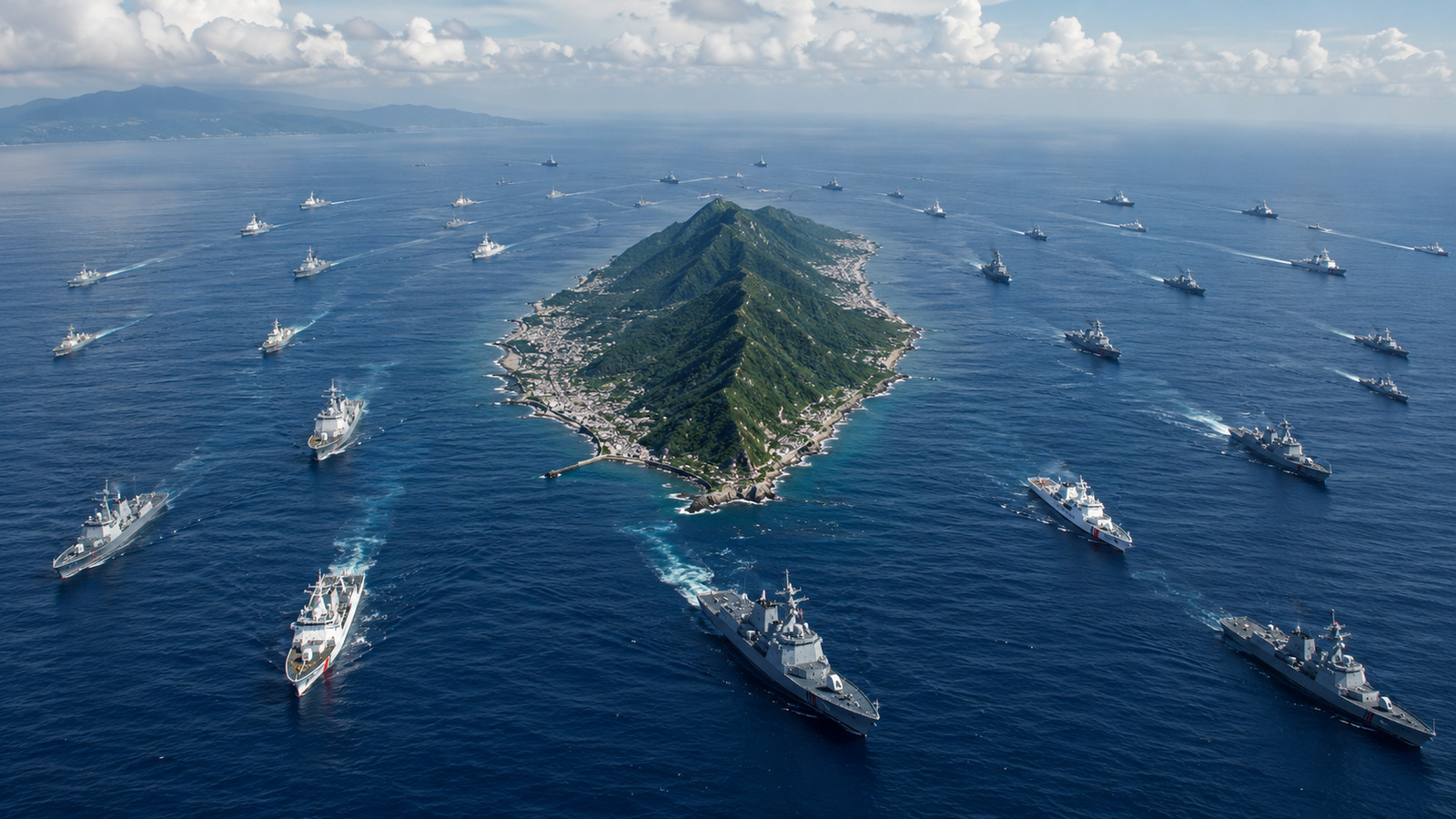

Taiwan reported that China positioned more than 100 ships between the Yellow Sea, the South China Sea, and the Western Pacific, amid uncertainty over US weapons and increased military spending on the island
More than 100 Chinese ships have been positioned in regional waters between the Yellow Sea, the South China Sea, and the Western Pacific, according to Joseph Wu, head of Taiwan’s National Security Council. The movement increased after a meeting between Donald Trump and Xi Jinping and heightened tensions around the island.


China mobilizes ships in area surrounding Taiwan
Joseph Wu posted on Saturday (5/23) on X, an image showing Chinese vessels distributed around Taiwan, forming a kind of encirclement of the autonomous island. According to him, the mobilization involves ships from the Chinese navy and coast guard.
In the post, Wu stated that China is the only “problem” that destroys the status quo and threatens regional peace and stability. Beijing considers Taiwan part of its territory and has already threatened to take the island by force.
-
U.S. Establishes Permanent Embassy in Jerusalem, Reigniting International Debate Over Israel’s Capital

-
The world has nearly 12,000 nuclear warheads, with the majority held by the United States and Russia; see the figures for China, France, and the United Kingdom.

-
Venezuela Faces UN Alert for Hunger, Disease, and Service Collapse After Earthquakes Cause Nearly 2,000 Deaths and $6.7 Billion in Damages

-
Brazil Deploys Navy Field Hospital with ICU, Orthopedics, Pediatrics to Earthquake-Stricken Area in Venezuela, Offering 30 Beds and 150 Daily Consultations


The movement of the ships began before the meeting between the United States President, Donald Trump, and the Chinese President, Xi Jinping, in Beijing. After the summit ended, the number of vessels rose to more than 100.
The information about the increased movement was passed to the AFP agency by a security official, under the condition of anonymity.
Vessels include navy, coast guard, and research ships
In addition to military and coast guard ships, the Chinese movement around Taiwan also includes research vessels, according to the same source heard by AFP.
It is unclear what these ships are doing in the region. The available material informs, however, that the Chinese Navy and coast guard have conducted training in these waters at previous times.
The presence of so many ships draws attention due to the regional scope of the operation. The vessels were reported in a range extending from the Yellow Sea to the South China Sea and the Western Pacific.
In recent years, China has intensified military pressure on Taiwan. This movement has included the almost daily deployment of fighter jets and warships around the island, as well as several large-scale exercises.
Taiwan follows uncertainty over United States arms
Tension also grew after Donald Trump suggested that U.S. arms sales to Taiwan could be used as a bargaining chip with China.
Taiwan relies heavily on American support to try to deter a potential Chinese attack. The sale of arms to the island is provided for by law in the United States.
Days after Trump’s visit to China, the acting head of the U.S. Navy told U.S. congressmen that the government had frozen the sale of $14 billion, about R$ 70 billion, in arms to Taiwan.
According to him, the measure sought to ensure sufficient ammunition for the war in Iran. The announcement came after Xi Jinping warned Trump that the “Taiwan issue” is the most important topic in U.S.-China relations.
Xi also stated that the two countries could have confrontations and even conflicts if the issue was not handled properly.
The Taiwanese government, in turn, has insisted that the United States’ commitment to its defense has not changed and that arms sales remain in place.
Protests advocate increased military spending
This Saturday, thousands of Taiwanese took to the streets in support of the government’s plan to increase defense spending. The proposal gained momentum amid U.S. pressure and increased Chinese military activity in the region.
President Lai Ching-te had proposed nearly $40 billion in additional spending on critical weapons, including American armaments. The parliament, with an opposition majority, reduced this amount to $25 billion.
Tensions over Taiwan also affected the relationship between China and Japan. Since November of last year, the crisis gained new weight after Japanese Prime Minister Sanae Takaichi stated in parliament that a Chinese attack on Taiwan could pose a threat to Japan’s survival.
The statement was also associated with the possibility of intervention by the Japanese army. Chinese authorities reacted with irritation and advised their citizens to avoid traveling to the archipelago.
This article was prepared based on information from AFP and the publication by Joseph Wu on X, with data, numbers, and statements preserved as per the consulted material.