






 Portuguese
  Spanish


The Increasing Pressure From the United States on China Aims to Block Access to High-Tech Chip Equipment, Challenging China’s Semiconductor Manufacturing Infrastructure
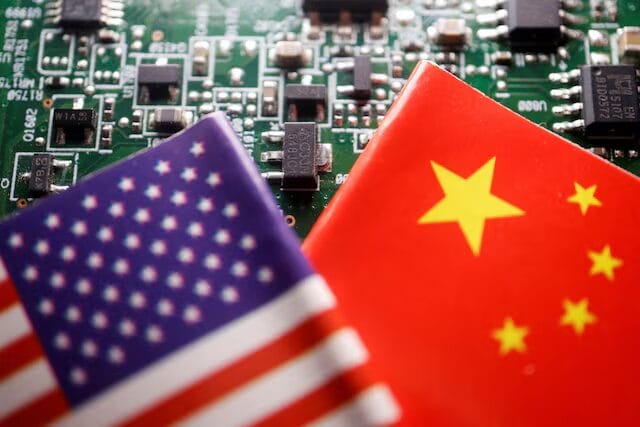
The U.S. chamber appears endless. And its next bullet aimed at China is set to be fired. The U.S. administration has confirmed that it is unwilling to allow advanced chip manufacturing equipment incorporating U.S. origin technologies to fall into the hands of Chinese integrated circuit manufacturers. A significant portion of the sanctions approved by Joe Biden’s government since October 7, 2022, have this objective.
The Dutch company ASML, the Japanese companies Tokyo Electron and Canon, and the South Korean firms Samsung and SK Hynix are some of those whose exports of certain lithography equipment to China are prevented by U.S. prohibitions. The pressure on their businesses is such that the U.S. government seems to be aware that it cannot demand much more from them. However, this does not mean that its margin for action has been exhausted. Reuters confirmed that the Biden administration is preparing new sanctions to halt the export of chip manufacturing equipment from some foreign countries to China.
For Now, ASML and Tokyo Electron Can Breathe a Sigh of Relief
The source from Reuters confirmed that the new sanctions package exempts semiconductor production equipment manufacturers from the Netherlands, Japan, and South Korea, whose businesses have been affected by the previous prohibitions. Interestingly, the shares of ASML and Tokyo Electron noticeably rose a few hours after the announcement of this news. In any case, what the U.S. government intends is to “turn off the tap” for six Chinese chip factories that are still receiving equipment from abroad.
-
15-Year-Old American Builds Ocean Generator with PVC Pipe and 3D-Printed Propeller for $12, Wins National Prize, Presents at White House, and Makes Forbes 30 Under 30 List

-
$12 Billion Invested in AI Data Centers in Semi-Desert Mexican State, But 17 of 18 Municipalities Now Face Water Shortages, Residents Receive Water Only 3 Days a Week
-
How Much Does Starlink Satellite Internet Cost for Cars, Trucks, and RVs? Prices for Antenna, Accessories, and Plans

-
Scientists Convert Food Waste into Aviation Fuel, Successfully Test 50% Blend with Conventional Kerosene to Cut Emissions and Promote Sustainable Flights



The U.S. administration argues that some companies from Israel, Taiwan, Singapore, and Malaysia are sending equipment to six Chinese semiconductor manufacturers that play a crucial role in the country’s integrated circuit manufacturing infrastructure led by Xi Jinping. And presumably, these chip manufacturing machines incorporate U.S. origin technologies. Unfortunately, for now, we do not know which Chinese semiconductor manufacturers would be affected by these new sanctions, but it is possible that SMIC and Hua Hong Semiconductor are two of them.


New Sanctions Expected in August
According to Reuters, the new U.S. sanctions package will take effect during the month of August and, as expected, the spokesperson for the Chinese Ministry of Foreign Affairs, Lin Jian, harshly criticized the measure planned by the U.S.: “The U.S. efforts to coerce other countries and suppress China’s semiconductor industry harm global trade and all parties involved […] Containment and repression cannot stop China’s development. They can only strengthen China’s determination and capacity to develop its scientific and technological self-sufficiency.”
The backdrop of this complex scenario is none other than the effort the U.S. government is making to prevent China from continuing to develop its capabilities in the fields of supercomputing and artificial intelligence. The Biden administration is convinced that these advancements will allow the Chinese government to significantly boost its armament. In any case, the U.S. faces a significant risk. If they exert too much pressure on the countries mentioned in this article to limit their exports to China, there is a possibility that some of them will rebel and “jump ship.” After all, there is a lot of money at stake.
Image | ASML
More information | Reuters






