






 Portuguese
  Spanish
  6 min of reading
  2 comments


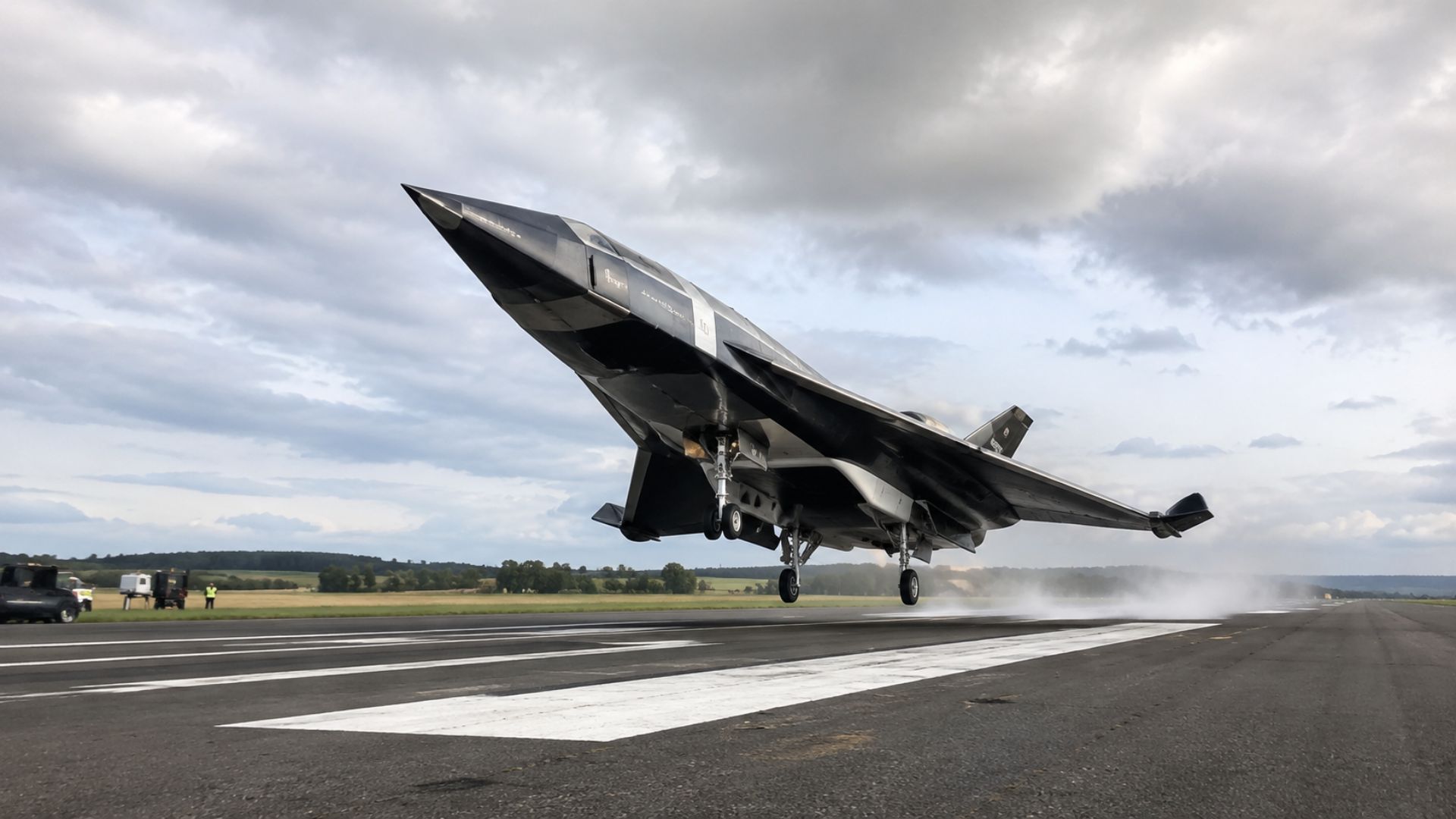


European project bets on reusable hypersonic flight, hydrogen propulsion, and horizontal takeoff to test technologies that can bring extreme aviation closer to future spaceplanes, in a strategic phase for aerospace research planned until the beginning of the next decade.
The European Space Agency and the British Frazer-Nash advance with the INVICTUS, a research program created to develop a reusable hypersonic platform, capable of taking off horizontally and reaching Mach 5 in the atmosphere, in a range close to the edge of space.
Funded by the ESA, the project’s goal is to build and fly an experimental aircraft capable of operating at five times the speed of sound by the beginning of 2031, testing essential technologies for future reusable spaceplanes.
With an estimated value of 7 million euros, the program brings together companies and research institutions to define the vehicle concept, its integrated systems, and the technical steps necessary before any flight campaign in real conditions.
-
Space technology used to search for water on Mars is now hunting for invisible leaks under the streets of São Paulo, using satellites, AI, and chlorine signals to help Sabesp recover up to 6.7 billion liters of water.

-
Japan sends ship to extract mud rich in rare earths at nearly 6,000 meters deep in the Pacific, attempts to lift 350 tons per day from the seabed, and transforms sediments near Minamitori Island into a strategic weapon to reduce dependence on China.
-
Venus Aerospace promises a rotating detonation hypersonic engine that takes the Stargazer to Mach 9 and crosses oceans in 1 hour, but the flight that made history barely surpassed the speed of sound.

-
Brazilian student creates a cheap formula that makes plants grow up to 90% faster and wins an award in a global scientific competition.




Leading the initiative is Frazer-Nash, in partnership with Spirit AeroSystems, Cranfield University, and smaller companies, in a consortium aimed at transforming hypersonic research into a repeat-use experimental platform.
Unlike traditional rockets, INVICTUS was designed to take off from a runway, like an aircraft, and not from a vertical launch base, bringing the proposal closer to a hybrid model between extreme aircraft and space vehicle.
This architecture seeks to occupy an intermediate space between ultra-high-speed aviation, space access systems, and atmospheric test platforms, focusing on reuse and operational flexibility.
INVICTUS aims for hypersonic flight at Mach 5
At the center of the program is the demonstration of sustained hypersonic flight in the atmosphere, a condition in which the air around the aircraft begins to behave very differently from that observed in commercial jets.

During this type of operation, external surfaces, air intakes, and engine components face intense heating caused by shock waves and friction, making thermal control as important as propulsion itself.
Upon reaching Mach 5, the vehicle would enter a range equivalent to five times the speed of sound, a regime in which acceleration is only part of the challenge faced by engineers and researchers involved in the project.
It will also be necessary to maintain stability, autonomous control, efficient combustion, and structural integrity at the same time, as any integration failure can compromise the performance of a system subjected to such severe conditions.
To deal with this scenario, INVICTUS relies on propulsion technologies that combine atmospheric air and hydrogen, as well as pre-cooling systems developed to quickly reduce the air temperature before entering the engine.
With this feature, the proposal is to prevent conventional components from being exposed to conditions incompatible with their operation, allowing propulsion to continue functioning in an environment normally destructive to less advanced architectures.
Part of this technological base is related to developments associated with Reaction Engines, a British company known for its work on the SABRE engine and pre-cooling systems aimed at extreme flight regimes.
After the company’s crisis, knowledge and solutions related to this field became part of efforts conducted by Frazer-Nash, which took on a central role in the technical organization of the European program.
Hydrogen helps to face extreme heat
Within the project, hydrogen appears not only as fuel but also as an element linked to thermal management, a critical requirement for hypersonic vehicles subjected to superheated air during high-speed flight.
In systems of this type, cryogenic technologies can help protect components exposed to very high temperatures, while also contributing to keeping the engine operation within a functional range.
Even so, the use of the fuel does not eliminate the main technological risks of INVICTUS, which will need to combine thermal protection, resistant materials, autonomous control, cooling, and integrated propulsion into a single reliable system.
According to ESA’s assessment, the experimental platform must be fully reusable and upgradable, allowing the exchange of materials, software, and propulsion systems between different test campaigns throughout development.

This configuration transforms the vehicle into a flying laboratory for European hypersonic technologies, with the advantage of allowing evaluations in a real environment without requiring the construction of a completely new aircraft at each stage.
With a modular platform, universities, agencies, and companies will be able to compare solutions directly in flight, reducing the exclusive reliance on computer simulations and test benches to validate critical engineering decisions.
Europe enters the race for hypersonic flight
The European bet occurs amid a global technological race for dominance in hypersonic flight, an area that brings together civil, space, and defense interests in countries like the United States, China, Japan, the United Kingdom, and members of Europe.
In this competitive environment, INVICTUS can offer Europe its own structure to mature critical technologies, without relying solely on external programs or experimental platforms developed by other aerospace powers.
The initiative, however, does not aim to present a ready passenger plane, but to create an experimental base capable of reducing technical risks before future commercial or reusable space projects.
Comparisons with historical aircraft help to gauge the complexity of the program, as the Concorde, retired in 2003, flew in a supersonic regime, but still below the hypersonic range intended by INVICTUS.
Even the SR-71 Blackbird, known for very high speeds at great altitudes, did not represent a reusable solution aimed at horizontal space access, as envisioned by the technological logic studied in the European program.
Instead of just reaching a speed mark, INVICTUS intends to operate in a category where extreme performance needs to be combined with operational repeatability, thermal control, and the ability to return for new campaigns.
In this logic, the vehicle must accelerate, conduct tests in the upper atmosphere, and return for reuse, bringing part of the space routine closer to procedures more akin to advanced experimental aviation.
Test sites reinforce British participation
In November 2025, ESA reported that Spaceport Cornwall and Machrihanish, in Scotland, were pre-selected as suitable sites to host program tests in the United Kingdom.
The choice reinforces British participation in the hypersonic experimental flight infrastructure and indicates that the development of INVICTUS also depends on locations capable of supporting complex takeoff, operation, and return campaigns.
The pre-selection, however, does not mean that the vehicle is ready to fly, as the program is still going through phases of concept, preliminary design, system requirements, risk analysis, and development planning.
Until a flight campaign capable of achieving the planned objectives, it will be necessary to integrate components, validate critical technologies, and demonstrate that the set can operate safely in an extreme regime.


The schedule targets the beginning of 2031 for an aircraft capable of reaching Mach 5 at the edge of space, although this timeline depends on simultaneous advances in propulsion, thermal control, materials, and autonomous operation.
In aerospace programs of this level, delays can occur when different systems need to operate together without a wide margin for errors, especially in environments where heat, speed, and stability impose severe limits on the design.
Platform can pave the way for space planes
The main value of INVICTUS lies in the attempt to prove technologies that can support a new generation of reusable horizontal launch vehicles, bringing space plane concepts closer to real tests in atmospheric flight.
If it advances, this model could expand operational flexibility compared to vertical rockets, although it still remains far from any broad commercial application for passenger transport, cargo, or routine space missions.
The promise of taking off from a runway and returning for a new flight makes the project relevant to the debate on space access, especially by exploring an alternative to the disposable vertical launch used in many traditional systems.
Even without carrying passengers or commercial cargo in the short term, the platform can reveal how hypersonic systems behave outside the controlled environment of laboratories, where real flight variables appear simultaneously.
Computational simulations and ground tests remain essential for aerospace development, but they do not completely replace an integrated campaign, in which engine intake, combustion, cooling, autonomous control, and materials function as a single system.
Therefore, INVICTUS remains a technology demonstrator, not a commercial aircraft, focusing on testing the boundary between aircraft and space vehicle through reuse, horizontal launch, and sustained hypersonic flight.


Keep it in Europe!!
Keep the Americans out of the loop, they can’t be trusted.