






 Portuguese
  Spanish
  5 min of reading
  2 comments


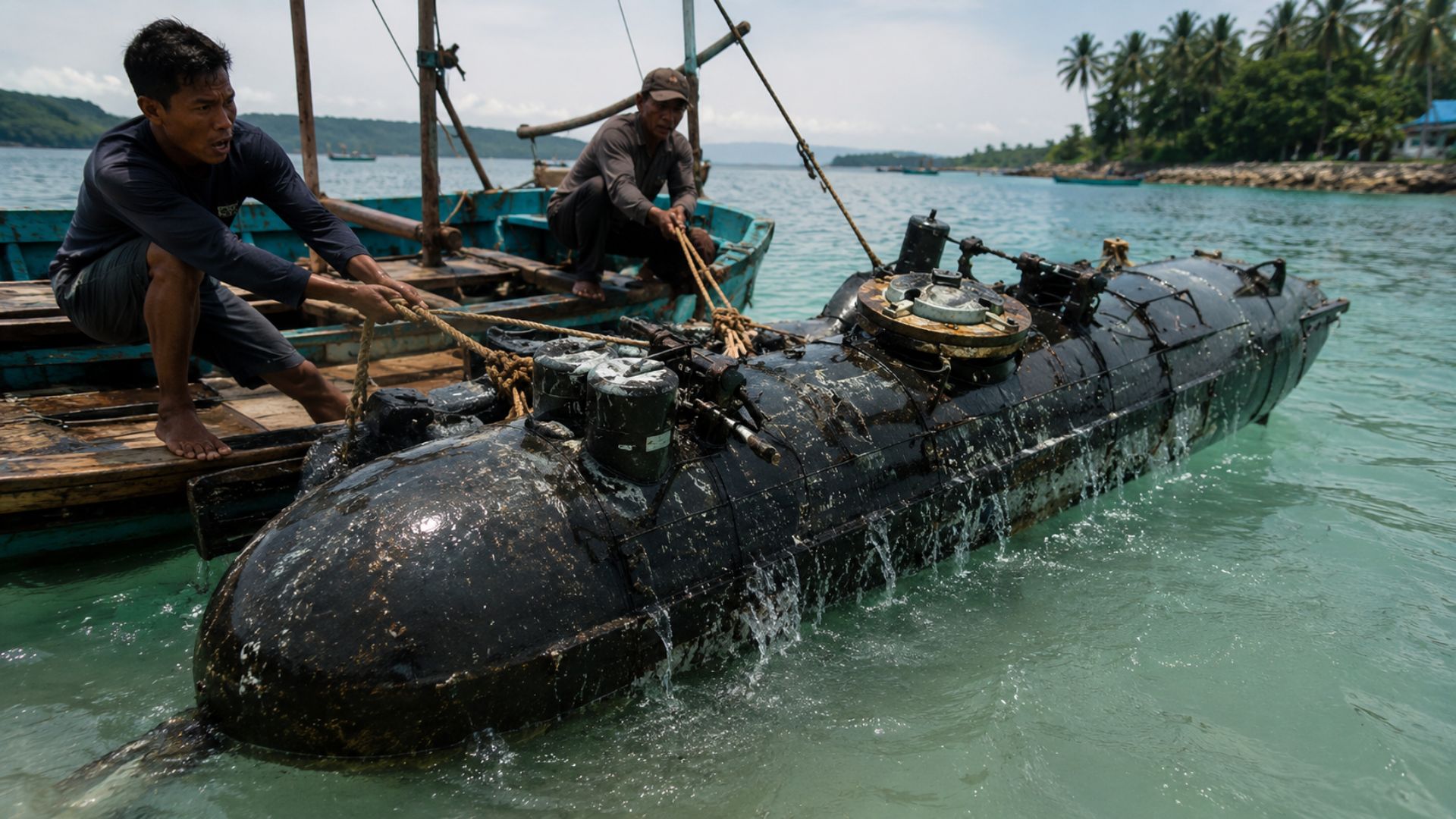


An Indonesian fisherman pulled from the sea, near the Lombok Strait, an object identified as a Chinese underwater surveillance system. The equipment would be part of the Great Underwater Wall, the network with which Beijing tries to track submarines and unmanned vehicles in strategic points of the Indo-Pacific.
An Indonesian fisherman had an unusual catch in April this year: when retrieving the nets near the Lombok Strait, between the islands of Bali and Lombok, he pulled from the sea a metallic object shaped like a torpedo. What seemed like scrap was identified by analysts as a Chinese underwater monitoring system, capable of surveilling what moves underwater.
According to experts, the equipment would be linked to the Great Underwater Wall, a vast network with which China tries to observe the underwater domain and track submarines and unmanned vehicles in strategic straits. The discovery reignited the debate about a silent race for control of the seabed in the Indo-Pacific region.
What the Indonesian fisherman found in the Lombok Strait

According to information from the DW channel, the discovery happened in early April, when an Indonesian fisherman spotted a cylindrical object floating north of the island of Gili Trawangan, near the Lombok Strait. About 3.7 meters long and with fins at the rear, the device bore the inscription “CSIC” and Chinese characters. Suspicious, the fisherman towed the piece to the beach and alerted the authorities. The Indonesian Navy took the equipment to the Mataram base, and specialized teams confirmed that there were no explosives or radioactive material.
-
Helicopter Drops 180 Tons of Sand and Gravel on Swedish River to Revive Ecosystem Damaged by Decades of Exploitation

-
Brazilian Company Launches Retro Smartphone with 48 MP Camera, T9 Keyboard, and Privacy Features for Social Media-Free Use

-
Self-Taught Chinese Farmer Builds 5-Ton Submarine from Scrap, Launches It in Anhui River
-
Invisible Induction Technology Enables Wireless Power for Blenders, Coffee Makers, and Air Fryers, Reducing Countertop Cables






The identification came later. Naval defense analyst HI Sutton pointed out that it was a real-time data transmission system fixed to the seabed, developed by a Chinese research institute linked to the state-owned CSIC, now incorporated into CSSC. This type of device is anchored to the bottom and sends information to the surface via buoys. For experts, the presence of such a large Chinese system on such a sensitive route suggests that there may be a network of sensors monitoring the region’s waters.
What is the Great Underwater Wall of China
The device is considered a piece of the so-called Great Underwater Wall, also associated with the idea of a “transparent ocean.” It is a program attributed to the Chinese state-owned CSSC to monitor what happens on the surface and underwater in seas near China. The strategy combines different layers of surveillance, ranging from satellites in space to sensors installed on the ocean floor, with the aim of detecting and tracking submarines and unmanned vehicles.
Beijing, however, offers another version. China often claims that its underwater equipment serves scientific and civil research, and stated that there is no reason for excessive suspicion around the discovery. Experts note that this may be true but point out the concept of civil-military fusion adopted by the country, where dual-use technologies transition between the civil and military industries. It is this ambiguity that makes it difficult to determine the real purpose of the Chinese system found.
Why the Lombok Strait is so strategic
The Lombok Strait, between Bali and Lombok, is not just any passage. It is one of the few deep corridors in the Indonesian archipelago where submarines can transit submerged, at operational depth, connecting the Pacific and Indian Oceans. Therefore, it is a route closely monitored by powers like the United States and Australia.
This importance is connected to the logic of the so-called first island chain, the geographical line that runs from Japan and Taiwan to the Philippines and Indonesia. Whoever controls what passes through these choke points gains a valuable picture of submarine movements. Installing sensors there would allow tracking who enters and exits this chain, which helps to understand the interest of a Chinese system precisely in this section.
Submarines, detection, and the advantage of seeing first


The military logic behind all this is simple. The best defense for a submarine is not to be detected, since once located, it becomes much more vulnerable and, in case of conflict, can be destroyed. Therefore, enhancing the ability to see the underwater domain, with sonars and unmanned vehicles, is seen as a relevant strategic advantage, although expensive and technically difficult to obtain.
In this game, the United States is considered a world leader, both in the stealth of its nuclear submarines, among the quietest in the world, and in the ability to detect other submarines, alongside NATO partners. According to analyst Jennifer Parker, a professor at the Defense and Security Institute of the University of Western Australia and a former navy officer, China recognizes that its submarines are traditionally noisier and invests to reduce this disadvantage, which explains the focus on understanding what happens at the bottom of the sea.
Taiwan and the Race for the Seabed in the Indo-Pacific
The most sensitive backdrop is Taiwan, the self-governing island that China claims. Controlling what moves underwater in that region could influence the outcome of a potential conflict: with more underwater awareness, Beijing would be able to detect, track, and even neutralize adversary submarines, should it decide to act militarily. That is why every piece of a Chinese system found there attracts so much attention.
Even so, balance is important. For Jennifer Parker, this investment is not necessarily preparation for war, but represents an important advantage in case of a crisis.
Several countries, such as Australia, Indonesia, South Korea, Japan, and China itself, are investing more in submarine capabilities as technology becomes more accessible. The result is a growing focus on the underwater domain, transforming the bottom of the Lombok Strait and other corridors into contested terrain, although it cannot be said with certainty that there is a declared arms race.
The accidental fishing in the Lombok Strait opened a rare window into a dispute that almost no one sees: the race for control of the seabed.
Tell us in the comments if you believe the Chinese system found is really part of a military espionage network or if Beijing’s scientific explanation makes sense.





Not a military weapon
Ojola isaac