






 Portuguese
  Spanish


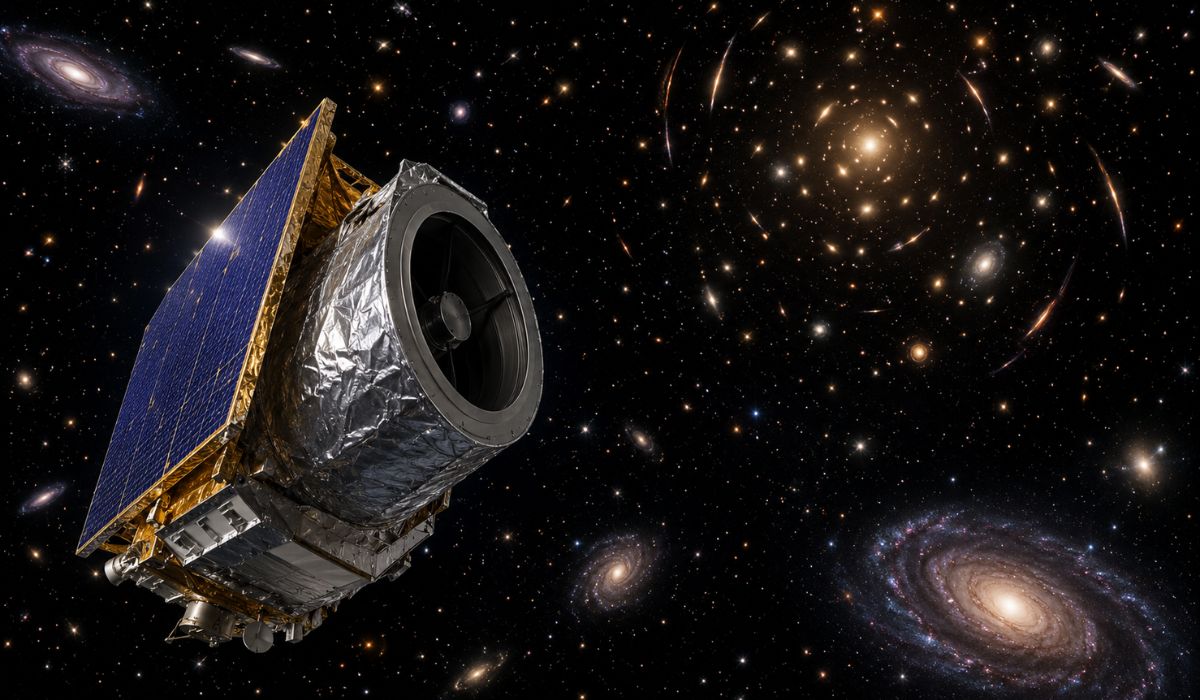


The Euclid mission gathers deep sky images to investigate invisible structures of the cosmos, combining space technology, millions of observed galaxies, and data that will help scientists study the expansion of the Universe.
The Euclid space telescope, a mission led by the European Space Agency with participation from NASA, has returned to the center of astronomical attention as the scientific community prepares for new stages of mapping the so-called dark Universe.
The first public sample of this survey, released by ESA on March 19, 2025, identified 26 million galaxies in just one week of observations of three deep sky regions.
The dataset is part of the initial phase of a mission planned to form a broad three-dimensional map of the Universe, with information about galaxies, dark matter, and dark energy at different periods in cosmic history.
-
China Develops Custom 140-Ton Electric Mining Truck with 770 kWh Swappable Battery, Deploys 290 Units in Xinjiang’s Largest Zinc Mine

-
Meta to Launch Arena, a New Prediction App Targeting 3.56 Billion Users, Competing with Polymarket and Kalshi

-
Scientist Challenges Famous Human Evolution Theory, Argues Homo Sapiens Evolved Gradually Over Thousands of Years
-
15-Year-Old American Builds Ocean Generator with PVC Pipe and 3D-Printed Propeller for $12, Wins National Prize, Presents at White House, and Makes Forbes 30 Under 30 List




The mission was created to investigate two central themes of modern cosmology: dark matter and dark energy.
The first does not emit or reflect light but exerts gravitational influence on galaxies and clusters.
The second is the name used by astronomers to refer to the still unknown cause of the accelerated expansion of the Universe.
According to ESA, Euclid seeks to measure these effects through the observation of billions of galaxies at different distances.
As light takes time to travel through space, each distant object observed by the telescope shows an earlier stage of cosmic history.
The data released covers 63 square degrees of the sky, an area equivalent to more than 300 full moons seen from Earth.
Although it represents only a part of the planned survey, the material gathers galaxies, clusters, active galactic nuclei, and candidates for gravitational lenses, phenomena used to estimate the mass distribution in the cosmos.
Among the galaxies recorded in this first sample, the most distant are up to 10.5 billion light-years away.
This means that the light captured by Euclid left these objects when the Universe was much younger.
In practice, observing such distant structures allows reconstructing different phases of cosmic evolution.
Euclid Telescope and the 3D Map of the Universe
Euclid was launched in July 2023 and began its routine scientific observations on February 14, 2024.
The telescope operates near the Lagrange point L2, about 1.5 million kilometers from Earth, a region used by space missions that require thermal stability and a wide view of the sky.
The nominal mission is expected to last six years, with the possibility of extension.
During this period, ESA expects to observe more than 1.5 billion galaxies and cover about one-third of the sky, equivalent to approximately 14,000 square degrees.
The scientific objective is not limited to image recording.
The mission was planned to produce a three-dimensional map of the distribution of galaxies and matter in the Universe.
From this survey, researchers intend to measure how large cosmic structures formed and how the expansion of the Universe varied over time.
This map uses distance as a way to organize the cosmic past.
Closer galaxies show more recent periods, while very distant galaxies reveal earlier epochs.
The comparison between these layers allows for the analysis of changes in the expansion of the Universe and the formation of filaments, clusters, and voids of the so-called cosmic web.
According to ESA, Euclid was developed to study the so-called “dark Universe”.
The expression encompasses components that cannot be directly observed with conventional telescopes but leave measurable effects on light, gravity, and the distribution of galaxies.
Dark Matter and Gravitational Lenses
Dark matter is not observed directly because it does not emit, absorb, or reflect light in a way detectable by current instruments.
Its presence, however, can be inferred by the gravity it exerts on visible matter and the path of light.
One of the main techniques used in this type of study is the gravitational lens.
The phenomenon occurs when mass curves the space around it and alters the path taken by light from more distant objects.
This curvature can distort, magnify, or multiply the image of a background galaxy.
In more intense cases, the gravitational lens forms luminous arcs or Einstein rings.
In more frequent situations, the deformation is subtle and cannot be identified just by direct observation of the image.
Therefore, scientists use software, statistical measurements, and large sets of galaxies to detect distortion patterns.
The large volume of data from Euclid is an important part of this method.
By comparing millions and then billions of galaxies, researchers can map where there is a concentration of mass, including mass that does not emit light.
This process helps estimate the distribution of dark matter around galaxies, clusters, and larger structures.
The first batch of data also includes the initial classification of more than 380,000 galaxies and about 500 gravitational lens candidates.
According to ESA, this work combines artificial intelligence, citizen scientist participation, and expert review, with the aim of preparing tools for future analyses.
Euclid’s deep fields show distant galaxies
The sample released by ESA focuses on three deep fields, regions selected to receive repeated observations throughout the mission.
The strategy is to accumulate more light from these areas, allowing the detection of progressively fainter and more distant objects.
The principle is similar to a long exposure in photography.
The longer the light collection time, the more details can appear in very faint regions of the sky.
In the case of Euclid, this technique will be applied in a planned manner over several years.
By the end of the nominal mission, each of these regions should be observed multiple times.
According to the European agency, the deep fields will serve both to study distant galaxies and to calibrate the data from the broader sky survey.
This type of observation has important precedents in astronomy.
In 1995, the Hubble Space Telescope produced its first deep field and revealed a large number of galaxies in a small, seemingly empty region of the sky.
Euclid adopts another scale of observation, combining deep areas with extensive mapping.
The main difference lies in the mission design.
While Hubble played a significant role in detailed observation of specific regions, Euclid was designed to measure statistical patterns over large areas of the sky.
This approach allows for investigating the distribution of matter and cosmic expansion on a broad scale.
Euclid mission includes NASA participation
Euclid is a European mission built and operated by ESA, with contributions from NASA.
The scientific consortium brings together more than 2,000 researchers from about 300 institutions in 15 European countries, as well as the United States, Canada, and Japan.
The spacecraft has a 1.2-meter diameter telescope and two main scientific instruments.
The VIS observes the Universe in visible light, while the NISP operates in the near-infrared as a camera and spectrometer.
NASA contributed detectors for the NISP and participates through scientific teams linked to institutions in the United States.
Centers associated with Caltech and the Jet Propulsion Laboratory also support scientific investigations and the archiving of mission data.
The next public stage of the schedule includes new data releases.
NASA’s scientific center for Euclid reports that a second quick release is scheduled for June 24, 2026, while the first major scientific data release, called DR1, is scheduled for October 21, 2026.
Until then, the first sample from Euclid already allows for scaling the volume of information that the mission is expected to produce.





