Portuguese
  Spanish


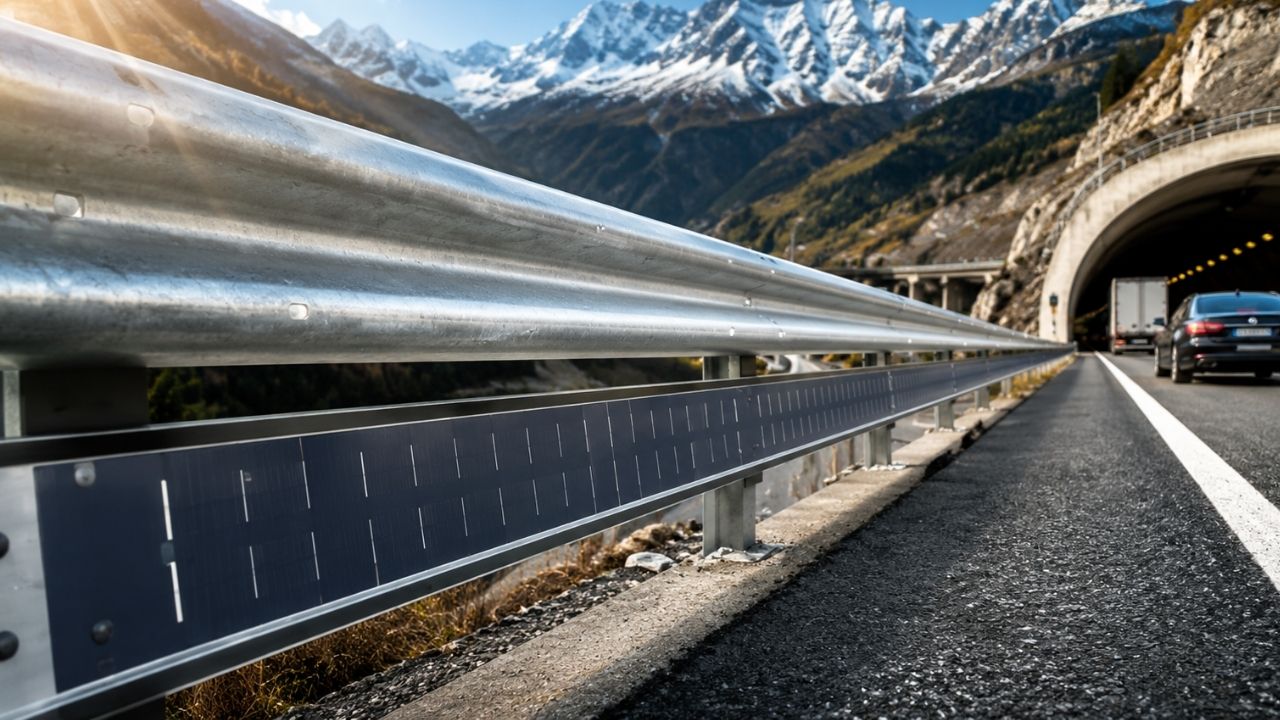


Solar highways gain strength with a photovoltaic guardrail developed by Tecnalia and Vita International, capable of producing clean energy for lighting, signals, and tunnel ventilation. The solution will be tested over 100 meters, targeting thousands of European kilometers and promises to unite road safety, circularity, and decarbonization in land infrastructure.
The solar highways have ceased to be just a futuristic idea linked to asphalt and have started to appear in a much more discreet part of the roads: the guardrails. In Europe, a new model of photovoltaic barrier uses ultra-thin solar panels to transform safety structures into small energy sources.
The project was developed by Tecnalia and Vita International within the European Liaison initiative, aimed at sustainability and circularity in transport infrastructure. The proposal is simple in appearance but ambitious in impact: to take advantage of existing surfaces along roads and highways to generate electricity without occupying new areas.
Photovoltaic guardrail looks ordinary but hides solar panels
At first glance, the new guardrail may go unnoticed. It was designed to maintain the appearance and function of a safety barrier but receives ultra-thin photovoltaic panels on a slightly upward-inclined flat plate.
-
China Launches World’s First 307-Meter Floating Wind Platform to Supply Oil Rigs, Aiming to Cut 35,000 Tons of CO2 Annually

-
Japan Deploys Offshore Concrete Factory, Constructs Massive Caissons in 8 Days, Revolutionizing Port Construction with Industrial Efficiency

-
China Builds World’s Largest Power Grid, Generating Enough Energy to Supply 15 Times Brazil’s Needs, Surpassing the US, EU, and India Combined
-
Brazil’s First 3D-Printed House Built in 30 Hours with Two Operators and 20% Lower Costs


This adaptation allows the structure to continue fulfilling its road role while starting to generate electricity. The innovation lies in using an area that already exists on the roads, without requiring large solar parks or new land dedicated to generation.
According to the source, the system is presented as the world’s first photovoltaic guardrail. It is to be tested over a stretch of 100 meters to assess real performance throughout the seasons, considering shade, dirt, maintenance, safety, and electrical production.
The idea aligns with a larger trend: transforming passive infrastructure into active infrastructure. Instead of just protecting vehicles, guardrails could also power essential equipment for highway operation.
Energy can supply lighting, signals, and tunnels
The most direct use of the energy generated by solar highways would be within the transportation infrastructure itself. The electricity could power street lighting, road signage, and tunnel ventilation systems.
This point is important because many roads have long stretches where bringing energy from the conventional grid can be expensive or complex. A solar guardrail would allow the installation of signage and lighting in areas without easy access to the electrical grid.
Irina Mella Burlacu, founder of Vita International, states that the solution can generate savings for road operators and facilitate the deployment of equipment in isolated locations. The proposal combines local generation and local use, reducing dependency on external connections.
The technology can also help in the decarbonization of road infrastructure. Even if each stretch generates a limited volume, the sum of many kilometers can form a distributed network of clean production.
One kilometer could generate about 25 MWh per year

Eduardo Román, head of the photovoltaic team at Tecnalia, estimates an annual production of about 623 kWh per kilowatt-peak, which would equate to approximately 25 MWh per kilometer of photovoltaic guardrail.
To make the number more understandable, he compares this production to residential consumption. A family of three consumes, on average, about 100 kWh per month; with 25 MWh per kilometer, it would be possible to supply something close to 20 families with this consumption profile.
The data shows that the strength of solar highways is not in a single point, but in the repetition of the solution over large extensions. One kilometer may seem small; thousands of kilometers change the scale of the debate.
Europe has about 136,700 kilometers of roads that, in theory, could be analyzed as potential surfaces for generation. The source indicates that this utilization could provide electricity to millions of people, should the solution prove viable on a large scale.
Road safety remains a central part of the project
One of the main challenges is ensuring that solar generation does not compromise the original function of the guardrail. The barrier needs to withstand impacts, protect vehicle occupants, and maintain road safety standards.
According to Vita International, the impact resistance is equivalent to that of a common guardrail. However, in the event of an accident, the solar panels in the affected section would need to be replaced.
This detail shows that the technology does not eliminate maintenance but tries to make it practical. The design considers cleaning, removal, and replacement of the panels, as well as protective layers and special coatings to reduce risks of abrasion and damage.
The proposal also includes an additional feature for motorcyclists: a slightly upward-inclined flat plate where the photovoltaic modules are installed. Thus, the project attempts to combine safety, electricity generation, and adaptation to real traffic.
Vehicle shadow is a technical obstacle
Not everything is resolved. One of the most complex challenges for solar highways in guardrails is the shadow cast by vehicles passing by the structure.
When a panel is shaded, energy production can drop and affect the performance of other connected panels. To address this, developers are studying two solutions: advanced power electronics and internal arrangements that minimize the impact of the shadow.
In the first approach, the technology would isolate the shaded panel to prevent it from affecting the rest of the system. In the second, the design of the photovoltaic cells would be organized in series-parallel connection schemes to reduce losses.
The shadow is a small problem in appearance, but large in engineering. As roads have constant traffic, testing the system in real conditions will be essential to know how much of the energy promise holds outside the laboratory.
Project is part of a larger circular infrastructure agenda
The photovoltaic guardrail did not emerge in isolation. It is part of the European Liaison project, which seeks to create solutions for circularity, sustainability, and resilience for land transport.
David Garcia Sanchez, coordinator of Liaison, highlights that Europe has more than 136 thousand kilometers of roads and more than 234 thousand kilometers of railways, networks that undergo constant maintenance. In 2020, the European Union used more than 600 million tons of aggregates, nearly 44 million tons of cement, and more than 208 million tons of asphalt in this sector.
These numbers show why transport infrastructure has become a target for environmental innovation. Roads, tracks, concrete, steel, and asphalt carry a large material and climate impact.
In addition to the solar guardrail, Liaison works on solutions such as concrete slabs with geopolymers instead of cement, 3D printing of beams with recycled materials, blockchain tracking, and digital twins to monitor components and materials.
Highways can become discreet power plants without changing the landscape


The great appeal of solar highways in guardrails lies in their discretion. Unlike large solar plants, the technology takes advantage of a linear structure that is already part of the road landscape.
This can facilitate public acceptance. The road user might not even notice the generation happening, but the energy could power services they use directly, such as lighting, signage, and security.
The proposal also avoids one of the biggest conflicts of solar energy: the dispute for space. In dense, agricultural, or environmentally sensitive regions, occupying new land can generate resistance. Using guardrails reduces part of this problem.
Even so, viability depends on cost, maintenance, durability, actual production, and the interest of road operators. The 100-meter test will be an important step in turning the concept into practical application.
Technology needs to overcome sector resistance
Even with solutions available, the source highlights that the engineering and transportation infrastructure sector is segmented and resistant to change. New projects need to convince public administrations, operators, regulators, and maintenance companies.
David Garcia Sanchez advocates for a “holistic” approach, considering climate resilience, worker and citizen safety, durability, and public acceptance. It’s not enough for the panel to generate energy; it needs to function within the real logic of roads.
This is one of the biggest barriers to the expansion of solar highways. Many sustainable technologies do not advance due to a lack of testing opportunities, public procurement, adapted tenders, and institutional trust.
Developers claim they do not want to create new problems but offer decarbonized solutions. For this, they ask for more space to implement innovative approaches in land infrastructure.
Solar guardrail can change the way we look at roads
The photovoltaic guardrail shows that the energy transition can happen in unlikely places. A protective barrier, previously seen only as a safety item, can gain a second function and become part of distributed electricity generation.
If the tests confirm performance, safety, and ease of maintenance, the technology could pave the way for new ways to utilize highways, railways, and already constructed infrastructure areas.
Solar highways are not yet a widespread reality, but the concept is advancing because it answers an important question: how to generate clean energy without taking up more space and without radically altering the landscape?
And you, do you think turning guardrails into solar panels is a smart solution to make use of existing roads, or does this type of technology still seem too expensive and difficult to move beyond testing? Share your opinion.