






 Portuguese
  Spanish


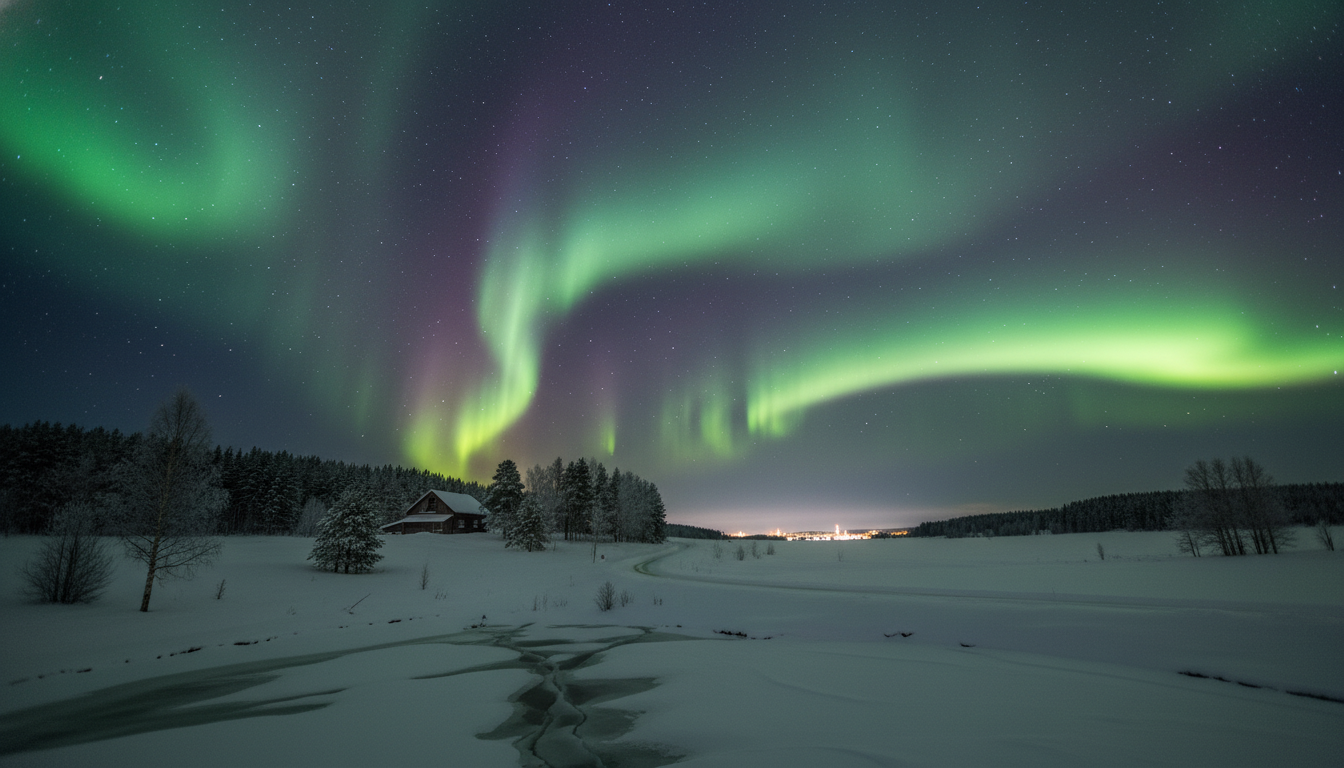


G2 Level Geomagnetic Storm Hits Earth on May 15 and May Light Up the Sky Over New York, Wisconsin, and Washington with Northern Lights
The NOAA Space Weather Prediction Center issued a G2 level (moderate) geomagnetic storm alert on May 14, 2026, with an expected arrival on May 15, according to The Watchers. The geomagnetic storm is caused by a corotating interaction region (CIR) associated with a negative polarity coronal hole that has turned towards Earth.
According to NOAA, G2 storm conditions can produce visible northern lights in the mid-latitudes of the US — as far as New York, Wisconsin, and Washington. Simultaneously, the warning predicts impacts on high-latitude power grids and low Earth orbit satellite operations. Therefore, satellite operators and power companies are on alert.
According to the released schedule, the geomagnetic field is expected to reach active conditions on May 14 if there is a sustained period of negative Bz. On May 15, G2 conditions are likely due to the CIR. On May 16 and 17, active to minor G1 levels are expected. In other words, three to four days of turbulent skies.
-
Tiny Floating Home Combines 25 Square Meters, Electric Motor, Recycled Wood, and Button-Operated Roof

-
Brazilian Farmer Revives Corn and Soybean Production with Crop-Livestock Integration in Mato Grosso After Frost Setback
-
84-Year-Old Fredolino Preserves Cedar Bowls and Family Heirlooms, Reflecting a Life of Farming and Tradition in Rural Brazil

-
70-Year-Old Brazilian Dentist Fulfills 20-Year Dream by Visiting Seven of the World’s Highest Peaks in the Himalayas




What a G2 Geomagnetic Storm Is and Why It Matters
The NOAA G scale classifies geomagnetic storms into 5 levels: G1 (minor), G2 (moderate), G3 (strong), G4 (severe), and G5 (extreme). Firstly, G2 is the second level and occurs about 600 times every 11-year solar cycle. Secondly, it is common enough not to cause catastrophic damage but strong enough to generate noticeable impacts.
According to the Space Weather Prediction Center, possible G2 impacts include voltage fluctuations in high-latitude power systems, alarms in transmission networks, and orientation corrections in communication satellites. Similarly, activities in low Earth orbit (LEO) may experience increased atmospheric drag, affecting Starlink, OneWeb, and other megaconstellations.
Simultaneously, high-frequency (HF) radio communications may be interrupted for minutes at polar latitudes. Consequently, transpolar flights between North America and Asia occasionally need to divert to lower latitude routes to maintain HF communication.

Coronal Hole: The Source of Fast Solar Wind
A coronal hole is a region of the solar corona where the magnetic field opens instead of closing. Consequently, charged particles (electrons and protons) escape at high speed — called fast solar wind. Firstly, this wind reaches Earth 2 to 4 days after leaving the Sun. Secondly, when the wind’s magnetic field (Bz) points south, it connects with Earth’s magnetic field and generates storms.
According to NOAA observations, the current coronal hole is about 500,000 kilometers long. Similarly, the solar wind will reach speeds exceeding 700 kilometers per second upon reaching Earth. In comparison, normal solar wind travels at 350-450 km/s. Therefore, Earth is “whipped” by particles at twice the normal rate.
Simultaneously, solar cycle 25 — currently underway — is nearing the peak of activity expected for July-November 2025. Consequently, events like this remain frequent over the next 18 months. For perspective, the sun released more than 30 sunspots classified as complex in just the first quarter of 2026.
Where the Northern Lights Can Be Seen in the US
The northern lights occur when charged particles from the solar wind interact with Earth’s atmosphere at high latitudes. Firstly, in G2, the aurora can descend to 55º geomagnetic latitude. Secondly, this means visibility in Maine, New York, Wisconsin, Minnesota, North Dakota, Montana, Idaho, and Washington.
According to NOAA analysis, the best conditions for observation are between 10 PM and 2 AM (local time), away from urban lights, with clear skies and no full moon. Similarly, areas like Lake Superior, the Cascades mountains, and the Upper Michigan peninsula offer ideal windows.
Simultaneously, all of Canada will have visible auroras, especially in Saskatchewan, Manitoba, Alberta, and Yukon. Consequently, photographers and amateur astronomers are preparing for one of the best aurora seasons in years. For context, the last G2 in the continental US occurred in October 2024 and attracted millions of spectators.
- G2 (moderate) — second level on the NOAA scale
- May 15 — expected storm peak
- 700+ km/s — fast solar wind speed
- 500,000 km — coronal hole length
- NY, WI, WA — southern limits of the predicted aurora
- 10 PM-2 AM local — ideal observation window
Expected Impacts on Satellites, Power Grids, and GPS
The G2 can affect LEO satellite operations — including Starlink, OneWeb, Iridium, and military satellites. Firstly, the increased density of the thermosphere during the storm generates greater atmospheric drag. Consequently, satellites need to perform more frequent orbit-raising maneuvers.
According to SpaceX, the February 2022 storm knocked out 40 of the 49 newly launched Starlinks. Similarly, the company now actively monitors space weather and has postponed launches during G3+ events. Simultaneously, high-latitude power grids — Canada, Alaska, Scandinavia — are on alert to avoid Joule heating surges.
In comparison, GPS systems may experience positioning errors of up to 50 meters during G2 storms — still acceptable for automotive navigation but problematic for agricultural drift and precision surveying. On the other hand, military GPS with dual-frequency receivers is less affected.

Can Brazil Also See the Aurora? The Case of the Southern Aurora in the South
Although the northern lights are typical of the Northern Hemisphere, the southern aurora appears in the Southern Hemisphere. Firstly, in G3 or higher storms, there are rare records of visible auroras in the far south of Rio Grande do Sul. Secondly, in G2, the probability in Brazil is low but not zero.
According to INPE, G4 and G5 events can produce visible auroras up to the southern Brazilian region. Similarly, in October 2003 (the “Halloween storm,” a G5), the sky over Santa Catarina turned red. Therefore, observers in the far south remain alert to NOAA alerts even in Brazil.

Caveat: Geomagnetic Storms Vary Hour by Hour
Although the NOAA alert is G2, the actual intensity can vary between G1 and G3 depending on the configuration of the solar wind’s magnetic field. In other words, observers should follow updates from the NOAA Aurora Dashboard every 30 minutes. Therefore, peak moments may be brief.
Similarly, local atmospheric conditions (clouds, fog, light pollution) can prevent visibility even with a strong aurora. Other space weather coverage and satellite impact information are available in the Click Petróleo e Gás archive. Will the next G3 storm bring auroras to Brazil?


WELCOME TO THE GREAT ILLUMINATI.🔺 Greetings to you. Are you ready to join the illuminati for wealth, fame, power, protection, wisdom and all your desires? Apply for Illuminati Membership Today and Enjoy the Benefits. Join us today and start getting $800,000 ($800,000) as your first membership benefit. Plus more awaits you. If you are interested or want to know more about the organization please answer YES Note!!! Distance is not a barrier to join the Illuminati and there is no human blood sacrifice. WhatsApp number +675 8169 4374🔺🔺🔺