






 Portuguese
  Spanish


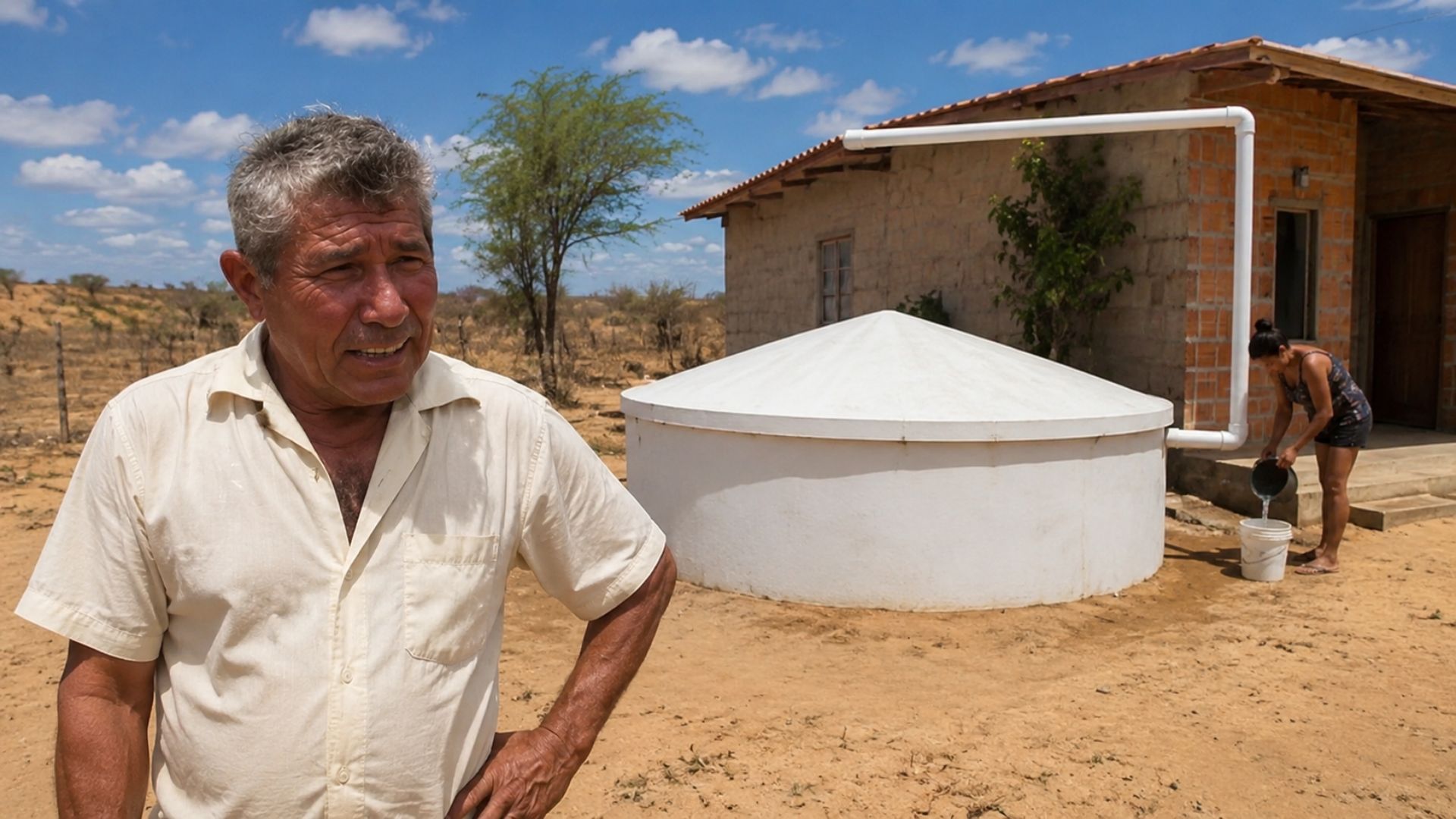


Manoel Apolônio de Carvalho, known as Nel Carvalho, developed on his own the pre-molded cement plate cistern, capable of providing water for a family of five for up to eight months. The invention became the basis of the One Million Cisterns Program, which brought the reservoir to more than one million homes in the northeastern semi-arid region.
The plate cistern that today dots the landscape of the Brazilian Northeast was born from the mind of an illiterate mason who fled the drought and, upon returning to the hinterland, forever transformed the way millions of families store rainwater. Manoel Apolônio de Carvalho, known as Nel Carvalho, is a native of Bahia, lives in Simão Dias, in the interior of Sergipe, and was the inventor of this simple reservoir that changed the history of the semi-arid region.
According to Globo Repórter, the model developed by him consists of a pre-molded cement plate cistern, capable of storing 16,000 liters of rainwater, enough to supply a family of five for up to eight months during the driest period of the year. The invention became the basis of the One Million Cisterns Program, an initiative of the Semi-Arid Articulation in partnership with the federal government that has already brought this type of reservoir to more than 1 million homes in the drought-stricken Northeast.
From the hinterland drought to the discovery of cement in São Paulo

Born in the 1930s in Jeremoabo, Bahia, Nel Carvalho shared his childhood with 10 siblings amidst the difficulties of a family without access to water at home. The scarcity in the hinterland was such that taking a bath became a rare luxury, and the family’s absolute priority was just to quench their thirst.
-
How to Prevent Brown Recluse Spider Bites: Common Hiding Spots and Free Tips to Reduce Risks

-
Natto: The Unusual Japanese Superfood Gaining Popularity on Social Media and Driving Record Exports
-
Brazilian Mayor Goes Undercover as Homeless for 24 Hours to Assess Public Services

-
15-Year-Old Entrepreneur Malu Lira Publishes 20 Children’s Books on Financial Education, Earns $500,000, and Expands Her Project to the Amazon Rainforest




“I suffered a lot from the lack of water, I am a witness to that. I carried water on a donkey nine kilometers from my house. The next day my brother would take turns. My mother struggled so much to bathe us that we didn’t take baths,” Nel said in an interview with Globo Repórter.
He took the same path as so many other Northeasterners fleeing the drought: he hit the road to São Paulo in search of work. Illiterate and without any experience, he got a job as a mason’s assistant in the construction of a swimming pool at a São Paulo club, an occasion when he saw cement for the first time in his life.
The idea that came inside a pool

Cement was a revelation for the young man from the hinterland. Until that moment, the houses he knew in the hinterland were all made of mud, and he didn’t imagine that there was a material capable of turning into stone when mixed with sand and water.
It was while helping to build the club’s pool in São Paulo that the idea came up. If a pool could hold so much water without leaking, why not build something similar in the hinterland to store the rainwater that was lost every year during the dry season?
Nel Carvalho was fired by the owner of the São Paulo construction, who according to public records said “he didn’t want a dreamer as an employee”. With the dismissal, he returned to the Northeast taking with him the knowledge of cement and the dream of building a different pool, not for swimming, but to solve the water problem in the hinterland.
How the plate cistern invented by Nel works


The model developed by Nel Carvalho is a simple yet powerful engineering feat. The reservoir is constructed with pre-molded cement plates that are produced on the ground, in molds, and then raised to form the cylindrical structure of the cistern.
The water that falls on the house’s roof is directed by gutters into a pipe that leads the liquid into the reservoir. During the dry season, just activate a pump or use a rope with a bucket to retrieve the stored water.
The original version created by Nel stores 16,000 liters, enough to supply a family of five in the hinterland for up to eight months. Larger models, derived from the same technique, can store up to 60,000 liters of rainwater and serve larger rural properties in the Northeast.
The invention that became public policy in the Northeast
The breakthrough of Nel Carvalho’s invention happened when civil society organizations saw the cistern model as a practical response to the chronic drought problem in the semi-arid region. The Brazilian Semi-Arid Articulation adopted the technology as the basis for a large-scale program.
The One Million Cisterns Program, known by the acronym P1MC, was born from this perception. The initiative, which combined the efforts of civil society organizations and the federal government, has already delivered over 1 million cisterns to families in the Northeast, transforming these people’s relationship with water in the heart of the backlands.
The cost of each reservoir is low compared to alternatives like water trucks, and the technology can be taught to local masons in each community. This replicable nature was decisive for the cistern invented by Nel Carvalho to leap from an individual solution to a structured public policy to combat the effects of drought.
The recognition that came late, but arrived
For decades, Nel Carvalho charged only “two merréis” per cistern built, a symbolic amount that showed the inventor’s emotional connection to the work. Institutional recognition was slow to appear and only came when the One Million Cisterns Program was already transforming the Northeast.
In 2014, Nel Carvalho was the first civilian in Brazil to be honored by the Ministry of Agrarian Development for his overall contribution to life in the backlands. The tribute recognized the illiterate mason as the creator of one of the most successful social technologies in recent Brazilian history.
The inventor’s reaction to the news of the recognition was recorded in an emotional phrase that spread across the country:
“Miss, did someone recognize what I did? My eyes fill with tears because I am sure I did something of great authority for humanity.”
The human impact of each cistern in the semi-arid region
A cup of water may seem trivial to those living in urban areas with regular supply. In the backlands, obtaining clean and safe drinking water has always required sacrifice, long walks of kilometers, and reliance on water trucks during critical drought periods.
The arrival of a cistern at a family’s home completely changes this scenario. The reservoir eliminates the need for long walks in search of water, reduces dependence on contaminated sources, and restores dignity to the daily life of those living in the backlands.
In many cases, the presence of the cistern frees women and children who previously spent hours of the day carrying water. This extra time returns in the form of study, work, and family care, generating a social impact that goes far beyond ensuring potable water in the Northeast.
An invention that still saves lives in the semi-arid region
Decades after the first cistern was built by Nel Carvalho, the model remains alive and continues to be replicated throughout the semi-arid region of the Northeast. Local masons learn the technique in training sessions, new families receive the reservoir each year, and the cycle of transformation is renewed.
The technology also inspired regional variations. There are now cisterns adapted for agricultural production, models aimed at rural schools, and versions designed for quilombola and indigenous communities spread across the Brazilian hinterland.
The common thread of all these variations remains the simple and inexpensive engineering developed by the Bahian mason who saw cement for the first time in his life in a pool in São Paulo. The invention showed that, in Brazil, powerful solutions to structural problems do not always originate in universities or laboratories, but can arise from the direct experience of those who have lived the problem firsthand.
Nel Carvalho’s journey is a powerful reminder of how keen observation and experience can produce solutions that directly engage with the reality of those who need it most. The cistern that today supplies millions of families in the Northeast was born from the concrete experience of drought and the desire to see no one else go through the hardships he himself endured.
And you, were you aware of this story? Do you think inventions born from the people receive the recognition they deserve in Brazil? Do you know of other social technologies that have changed lives in poor regions of the country? Leave your comment, share your opinion, and tag someone who needs to know the story of Nel Carvalho.








Great recognition, moved to the northeast from Scotland where I am amazed at the way people adapt to the challenges
I’m totally lost as to what he invented. It’s a rainbarrel.