






 Portuguese
  Spanish


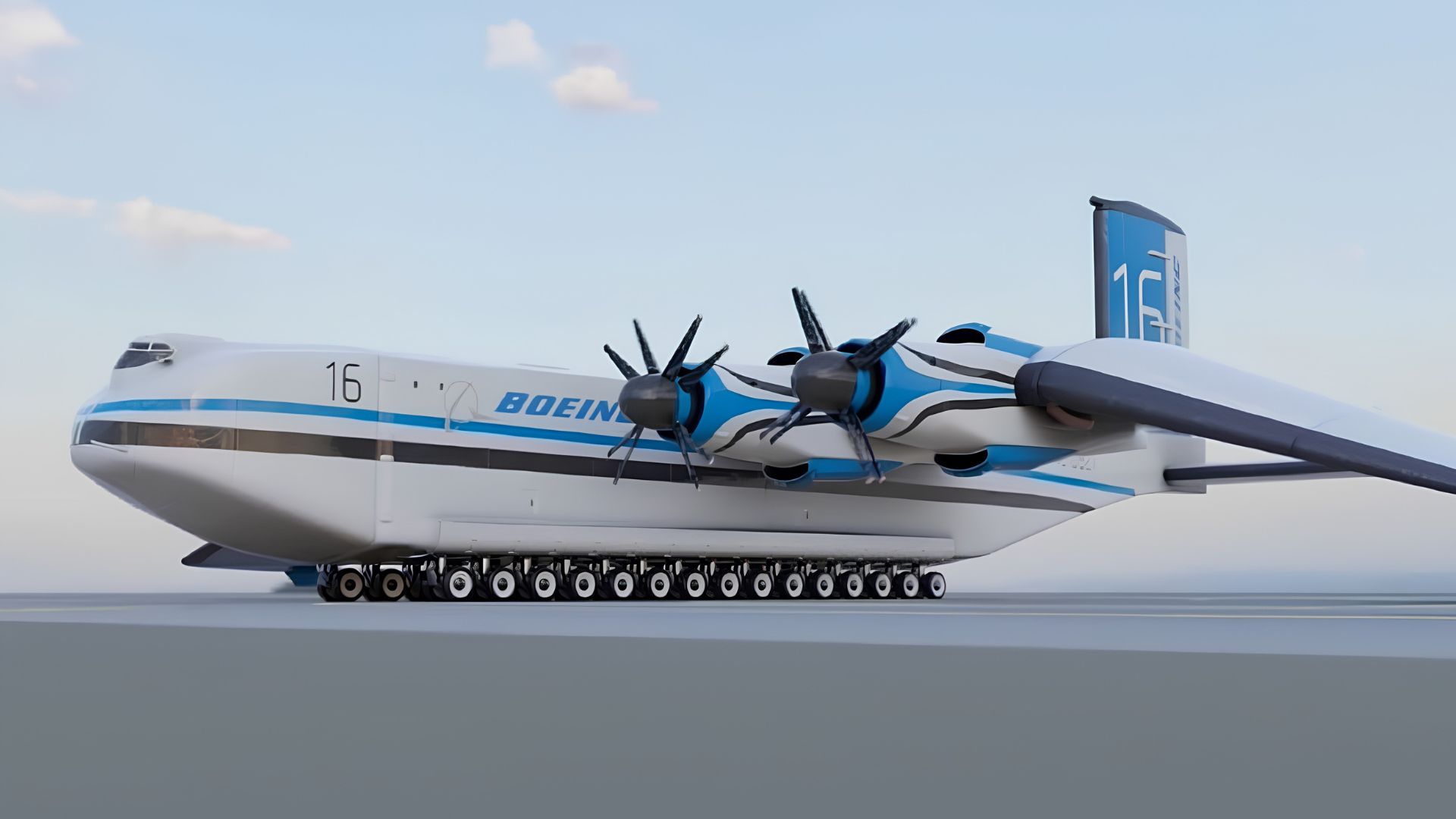


Boeing Pelican was designed to transport up to 1,270 tons flying low over oceans using ground effect.
In the early 2000s, engineers at Boeing Phantom Works studied a machine so far outside traditional aviation standards that it seemed closer to science fiction than a real cargo plane: the Boeing Pelican ULTRA, a ground-effect aircraft concept designed to cross oceans flying at low altitude over water. According to FlightGlobal, in a report from September 24, 2002, the Pelican was detailed as a very high-capacity freighter capable of using the ground effect to extend transoceanic range, combining strategic aircraft logic with high-speed maritime transport ambition.
The concept was impressive due to its numbers. Technical material presented at MIT on March 11, 2004, signed by Bob Liebeck, described the Pelican ULTRA as a WIG ground-effect aircraft with a 500-foot wingspan, about 152 meters, 400 feet in length, approximately 122 meters, a maximum takeoff weight of 6 million pounds, and a maximum payload of 2.8 million pounds, equivalent to about 1,270 tons.
FlightGlobal also cited a wing of over 150 meters, up to 38 landing gear sets, capacity to transport up to 17 M1 Abrams tanks in a single trip, and operation over land up to 20,000 feet, reinforcing why the project made it onto the list of the most extreme ideas ever studied by Boeing.
-
Entrepreneur Who Started at 13 Delivering Flyers by Bike in São Paulo Now Runs a 4,000 m² Culinary Complex in Brazil

-
In China, Workers Use VR Goggles and Body Sensors to Train Humanoid Robots for Tasks Like Folding Clothes and Stocking Stores
-
12-Year-Old Math Prodigy from Brazil Wins Two Gold Medals and Aims for Elite IMPA Tech
-
Magnet Weighing Over 360 Kilograms, Designed for Cardiac Surgery Machine and Valued at $100,000, Retrieves Sawed-Off Shotgun with Scratched Serial Number from Sea During Magnetic Fishing


Boeing wanted to create a freighter capable of moving entire armies quickly
The Boeing Pelican ULTRA emerged in a very specific strategic context. Following the military conflicts of the 1990s and early 2000s, interest grew in the United States for systems capable of rapidly transporting enormous quantities of military equipment to any part of the planet.
Cargo ships have large capacity but are slow. Military aircraft are fast but limited in cargo volume and weight. The Pelican concept attempted to unite these two worlds: transporting loads equivalent to those of ships, but at much higher speeds.
According to studies released at the time, the project could carry tanks, armored vehicles, containers, and heavy equipment on a gigantic scale.
Ground effect was the secret behind the project’s absurd efficiency
The central principle of the Pelican was the so-called ground effect. This phenomenon occurs when an aircraft flies very close to the surface, usually a few meters above water or land. In this condition, the compressed air between the wing and the surface reduces aerodynamic drag and increases lift.
In practice, the aircraft “glides” on a kind of invisible cushion of air. This effect allows for transporting much larger loads with relatively less energy consumption than in conventional high-altitude flights.

This was precisely what made the Pelican so different from a traditional airplane. It would not rely solely on conventional aerodynamic lift at high altitudes, but would exploit a layer of efficiency close to the ocean.
152-meter wingspan would place the aircraft among the largest ever conceived
The numbers predicted for the Pelican continue to impress even decades later. Studies associated with the project mentioned a wingspan of about 500 feet, approximately 152 meters.
For comparison, this is almost double the wingspan of an Airbus A380, which has about 79.8 meters. The gigantic structure was necessary to generate enough lift for an estimated payload of up to 1,270 tons.
This would place the Pelican in a practically isolated category within aviation history.
Landing gear with 76 tires attempted to distribute colossal weight
Another extreme detail of the project was the landing gear. According to technical studies related to the concept, the aircraft would use 76 tires to adequately distribute the gigantic weight during landings and takeoffs.
The objective was to allow operation on existing runways without immediately destroying the pavement due to excessive ground pressure.


Even so, the infrastructure required to receive a machine of this size would be extremely complex. The Pelican was not just a large airplane. It was an entire logistical system that would require airports, maintenance, and operation on an unprecedented scale.
Much higher speed than ships would change the logic of strategic transport
One of the most attractive advantages of the concept was the combination of gigantic capacity and relatively high speed.
Cargo ships take days or weeks to cross oceans. The Pelican could make much faster movements without depending on the limitations of a conventional air freighter. This was especially interesting for military operations and heavy international logistics.
Furthermore, the aircraft could theoretically operate over oceans for long distances by utilizing ground effect to save energy.
Project envisioned low flight over oceans and higher altitude near land
The original concept envisioned two main modes of operation. Over the ocean, the aircraft would fly very close to the water, exploiting the ground effect. Near urban areas, obstacles, or terrestrial regions, it could ascend to higher altitudes like a conventional airplane.
This would require extremely sophisticated control systems. Flying low over the ocean in a colossal aircraft involves severe challenges related to turbulence, waves, stability, and aerodynamic control.
Visually, the Pelican partially resembled the Soviet ekranoplans developed during the Cold War. These machines used ground effect to fly close to the water at high speed. However, Boeing’s project took the concept to a much larger scale.
The aircraft would have enormous wings, a gigantic fuselage, and an appearance closer to a futuristic flying ship than a traditional airplane.
Costs and complexity helped keep the project only on paper
Despite its technical and visual impact, the Pelican never advanced to actual construction. Several factors contributed to this.
Estimated costs were extremely high. Furthermore, operating an aircraft of this size would require specialized infrastructure, complex training, and unprecedented operational control systems.

There were also doubts about practical economic viability compared to existing maritime freighters and military aircraft.
Another challenge would be the certification and operational safety of a vehicle so far outside traditional civil aviation standards.
Even canceled, the concept continues to influence extreme transport studies
Although the Pelican was never built, it continues to be frequently cited in discussions about super-heavy cargo transport and the modern use of ground effect.
The concept also helped keep alive interest in hybrid aircraft capable of combining maritime and aerial characteristics.
In recent years, companies and governments have resumed studying ground effect vehicles for military, logistical, and even regional transport applications.
This shows that, even without leaving the drawing board, the Pelican left an important mark on the imagination of aerospace engineering.
The Boeing Pelican remains one of the most absurd ideas ever studied by modern aviation
Few projects have managed to bring together so many extreme numbers in a single machine. An aircraft with a 152-meter wingspan, 76 tires, a capacity for 1,270 tons, and operation close to the ocean using an invisible air cushion seems impossible even by modern aeronautical industry standards.
But the fact that the concept was seriously studied by Boeing shows how far engineering can go when trying to solve logistical problems on a global scale.
Today, the Pelican remains one of the most impressive examples of how the boundary between airplane, ship, and experimental machine can become almost indistinguishable when the goal is to transport gigantic loads across entire oceans.




This is based on the Russian Ekranoplan that flew on the Caspian sea in 1987 until 1990
Make peace, not war and take your time doing it.
Son