






 Portuguese
  Spanish


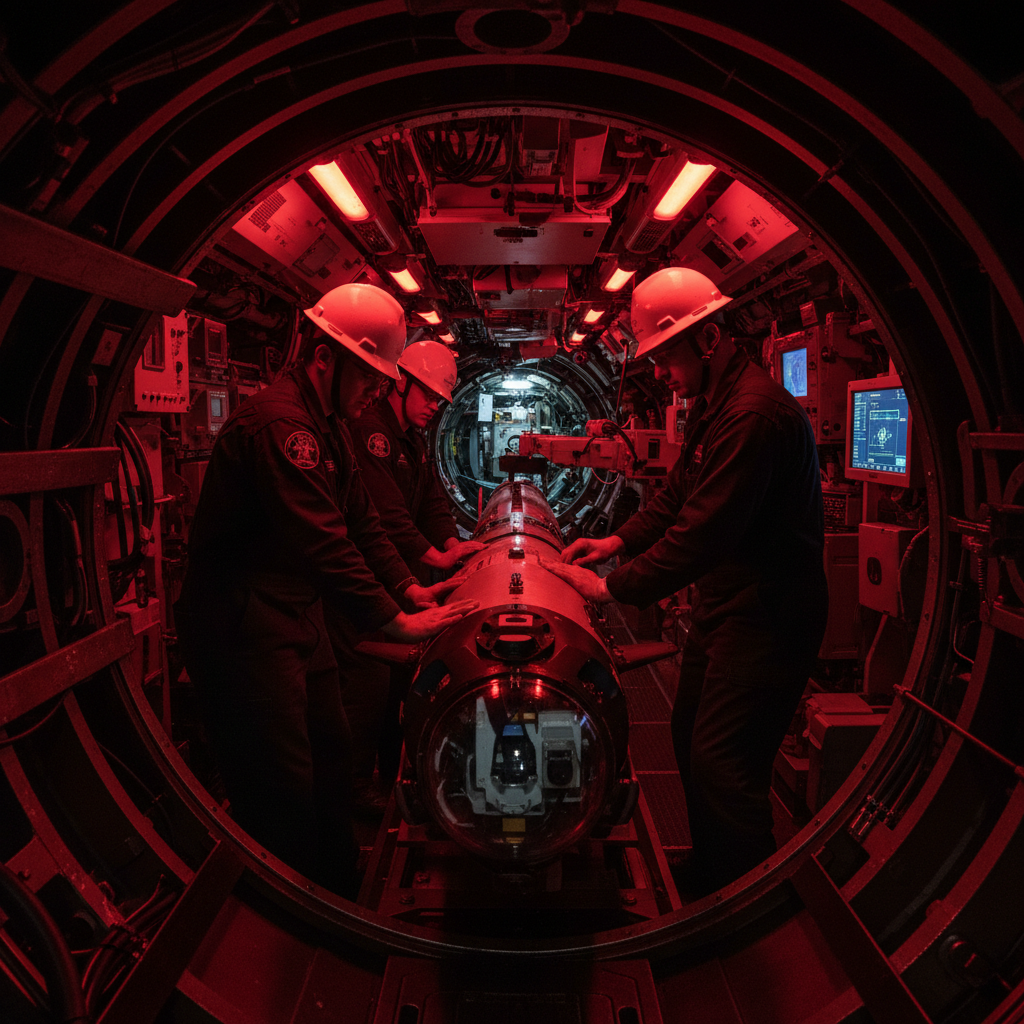
On March 25, 2026, L3Harris received a contract from the Defense Innovation Unit to equip US Navy submarines with a system that transforms torpedo tubes into autonomous drone launchers — and the drone that exits through the same torpedo port can surface and relay everything the submarine sees on the ocean floor
A submarine’s torpedo tubes have always had a single function over more than a century of submarine warfare: launching lethal weapons against enemy ships and other submarines.
Now, they will launch autonomous eyes and ears.
L3Harris Technologies received a contract on March 25, 2026, from the US Department of Defense’s Defense Innovation Unit (DIU) to provide the US Navy with the Torpedo Tube Launch and Recovery system.
-
Young Innovators from Brazil Turn Discarded Plastic into Eco-Friendly Bricks Using Coconut Fiber, Offering a Sustainable Alternative for Construction

-
Brazilian Scientists Among Team Proposing to Turn Ocean Depths into Giant Gravity Battery Using Cargo Ships and Subsea Cranes

-
Chile’s Plan for a 20,000 km Undersea Cable to Hong Kong Halted by U.S. Pressure, Highlighting the Silent Data Control Battle in Latin America
-
In Somaliland’s Desert, Greenhouse Uses Sun and Seawater to Grow Lettuce, Cucumbers, and Tomatoes Without Rain: 1-Hectare Project Cools Crops, Desalinates Water, and Converts Brine into Commercial Salt




The system uses the Iver4 900 autonomous drone, designed to fit inside a standard 21-inch torpedo tube — the same one used to launch Mark 48 torpedoes since the 1970s.
In practice, without modifying any submarine hardware, the tubes gain a completely new function: launching and recovering autonomous underwater vehicles.

How it works in practice — from the seabed to satellite
The process is ingenious in its operational simplicity.
The submarine uses its long-range, high-fidelity acoustic sensors to detect threats, map the ocean floor, and collect intelligence data.
This information is transmitted to the drone via a fiber optic cable strong enough to connect the submerged vehicle to the surface even in strong ocean currents.
The drone then ascends to the surface and interfaces with real-time satellite gateway technologies.
This way, the submarine can share intelligence with the entire fleet — surface ships, patrol aircraft, other submarines, and land-based command centers — without needing to approach the surface.
This is revolutionary because, until now, a submarine that wanted to transmit data needed to ascend to a shallow depth and use an antenna mast, risking detection by enemy radars, satellites, and sonars.
With the intermediary drone, the submarine remains invisible on the ocean floor while communicating with the world.
The Iver4 900 — small but extremely capable
The Iver4 900 is manufactured by L3Harris and represents the company’s newest generation of compact UUVs (Unmanned Underwater Vehicles).
It fits inside a 21-inch torpedo tube (about 53 cm in diameter) — the standard size for US Navy Virginia-class submarines.
Despite its compact size, the drone is equipped with sonar, cameras, oceanographic sensors, and autonomous navigation systems that allow independent operation for hours.
It can perform missions of reconnaissance, seabed mapping, mine detection, and surveillance of enemy ships — all without direct human intervention.
After completing its mission, the drone can return to the submarine and be recovered through the same torpedo tube from which it was launched.

From tests to operational combat submarines
The DIU contract marks a fundamental paradigm shift in American submarine warfare.
Until now, autonomous underwater drones were in the research, development, and controlled demonstration phases in test environments.
The contract signals the transition to direct integration into operational frontline submarines — the Virginia-class, which are the backbone of the US Navy’s nuclear attack fleet.
In practice, when integration is complete, each Virginia submarine will have the capability to operate as a command center for a network of autonomous sensors that greatly expand its surveillance and intelligence capabilities.
Distributed submarine warfare — the concept behind it
The military concept driving this development is called “distributed maritime operations”.
Instead of a submarine operating alone and isolated as a solitary hunter, it becomes the brain of a network of underwater robots that cover a much larger ocean area than the submarine could alone.
Drones can be sent to explore dangerous areas — minefields, proximity to enemy ports, hostile shipping lanes — while the submarine remains at a safe distance.
If a drone is detected and destroyed, the loss is material, not human.
The submarine remains safe, anonymous, and ready to launch another drone through the same tube.
It’s a fundamental change: the submarine ceases to be a solitary warrior and becomes an invisible commander of a fleet of disposable robots.
The global context — allies in the same race
The L3Harris contract does not happen in isolation.
In March 2026, a French Suffren-class nuclear submarine successfully launched and recovered an American Razorback drone for the first time, off Toulon in the Mediterranean.
The British Royal Navy tested the CAPSTONE drone in anti-submarine operations.
And China is heavily investing in autonomous underwater drones, with Chinese devices having been found in the waters of several Asia-Pacific countries.
Therefore, the race for underwater autonomy is global — and whoever masters this technology first will have a decisive advantage in any future naval conflict in the world’s oceans.

Caveats
The contract is for development and integration, not for immediate mass production of thousands of drones.
Operation in real combat conditions — with enemy countermeasures, unpredictable currents, and degraded communications — still needs to be extensively validated.
Underwater drones face communication limitations: fiber optic transmission has limited range, and satellite communication requires the drone to surface, potentially revealing the submarine’s general area of operation.
Still, the decision to integrate autonomous drones into Virginia-class torpedo tubes signals that the submarine warfare of the future will increasingly be fought by machines — commanded by humans who remain safe, hundreds of meters below the ocean’s surface.





-

-

-

-

-

-

35 people reacted to this.