Portuguese
  Spanish


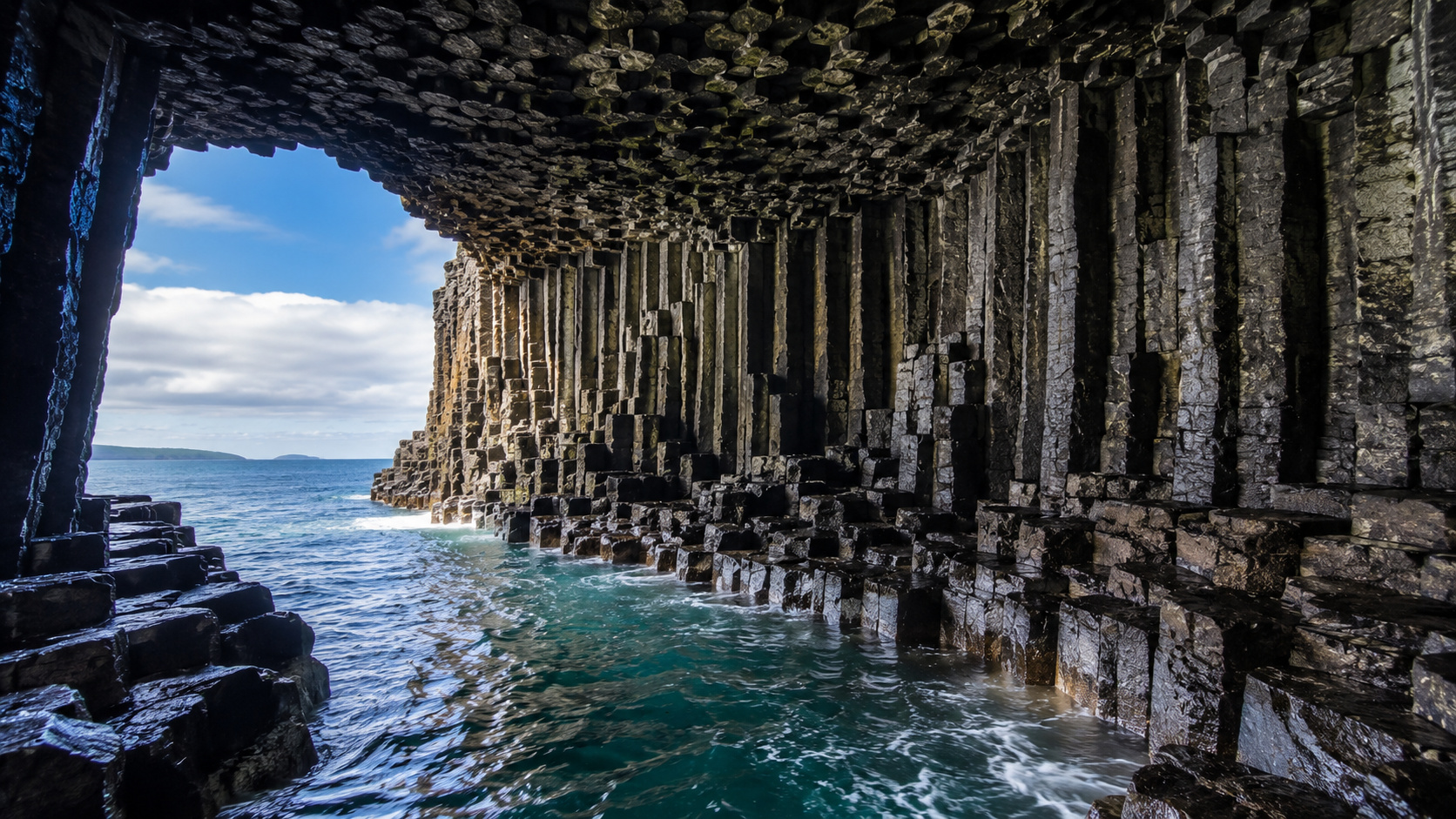

Fingal’s Cave, located on the island of Staffa, features geometric basalt walls, echoes produced by the sea, and records of volcanic activity in the North Atlantic
Fingal’s Cave draws attention for its unusual combination of natural geometry, volcanic history, and sound effects produced by ocean waves.
Located on the small uninhabited island of Staffa, in the far west of Scotland, the formation has large basalt columns that appear to have been carefully sculpted.
However, the entire structure naturally emerged approximately 60 million years ago.
-
Goodbye, soda! Discover the carbonated drink made with tea, sugar, and natural fermentation that has gained a place in meals for being good for health.

-
A doctor graduated from UFSC at the age of 28, Bruno Eulálio Santos created a “pocket” study method with 1,300 handmade flashcards that ensured his acceptance into Medicine, got him through the six years of his degree, and is now taught to college applicants throughout Brazil.

-
Agribusiness has become the engine of the Brazilian economy: the sector already accounts for more than a quarter of everything Brazil produces and generated more than 3 trillion reais in 2025.

-
Family farming is a silent powerhouse that fills the plates of Brazilians: it puts a large portion of the food on the country’s table, employs millions in the countryside, and on its own would already be among the ten largest food producers in the world.


Ancient lava flows, gradual cooling, and rock contractions created the predominantly hexagonal columns that now line the cave.
Additionally, the elongated shape of the cavity transforms the sound of the waves into deep echoes, similar to the sounds produced inside a cathedral.
Volcanic activity created Fingal’s Cave millions of years ago
The origin of Fingal’s Cave dates back to the Paleogene, a period marked by intense volcanic activity in the northern Atlantic Ocean.
At that time, enormous volumes of basaltic lava covered areas that now belong to Scotland, Ireland, and other nearby regions.
Subsequently, the lava began to cool and solidify.
During this process, the rock lost volume and accumulated internal stresses.
Consequently, the basalt began to crack through a phenomenon known as thermal contraction.
The fractures gradually advanced through the hardened lava and formed long geometric columns.
Among the main characteristics of the formation are:
- Estimated age of approximately 60 million years;
- Origin related to ancient basaltic lava flows;
- Columns formed during the cooling of the rock;
- Predominance of six-sided structures;
- Similarity to the Giant’s Causeway in Northern Ireland.


Why do basalt columns have a hexagonal shape?
At first glance, the walls of Fingal’s Cave seem to have been manually constructed.
However, the geometry arose due to natural forces present during the cooling of the lava.
When the basalt began to lose heat, the rock shrank in size.
Thus, the contraction opened cracks capable of distributing the accumulated stresses in the material.
The hexagonal shape became predominant because it can divide these forces efficiently.
Even so, not all columns have six sides.
Some structures have five, seven, or even eight faces.
Therefore, the regularity observed in Staffa represents one of the most well-known examples of geometry spontaneously created by nature.

Sea waves create acoustics similar to a cathedral
The internal structure of Fingal’s Cave also arouses interest because of its acoustics.
The cave is about 22 meters high and approximately 70 meters deep.
Its narrow and elongated shape allows sound waves to travel through the cavity.
At the same time, the rigid basalt walls reflect the noises produced by the sea.
Consequently, each wave that enters the cave generates deep and prolonged echoes.
The sound effect resembles the environment found inside large religious buildings.
For this reason, the formation also became known as a kind of natural cathedral of the Atlantic.
Visit by German composer occurred in 1829
The acoustics of Fingal’s Cave have impressed visitors, scientists, and artists for over two centuries.
In 1829, the German composer Felix Mendelssohn visited the island of Staffa and came into contact with the sounds produced by the waves.
Subsequently, the experience helped inspire the orchestral overture The Hebrides, also known as Fingal’s Cave.
The work contributed to increasing the fame of the cave among travelers, musicians, and admirers of natural landscapes.
Formation bears resemblance to the Giant’s Causeway
Fingal’s Cave also bears a great resemblance to the Giant’s Causeway, located in Northern Ireland.
Both formations have extensive basalt columns created by the cooling of ancient lava flows.
Additionally, both are related to the period of intense volcanic activity that altered different areas of the North Atlantic.
However, the structures were formed by distinct volcanic events.
Even so, the geological proximity and similar appearance help explain why the two landscapes are often compared.
According to the National Trust for Scotland and the Geological Society of London, Staffa preserves an important record of the volcanic processes that transformed the region millions of years ago.
Thus, Fingal’s Cave continues to be observed as a striking example of how heat, cooling, and contraction can produce natural structures of great regularity.
Did you imagine that the cooling of lava could create such regular columns and transform a cave into a true natural cathedral?