






 Portuguese
  Spanish


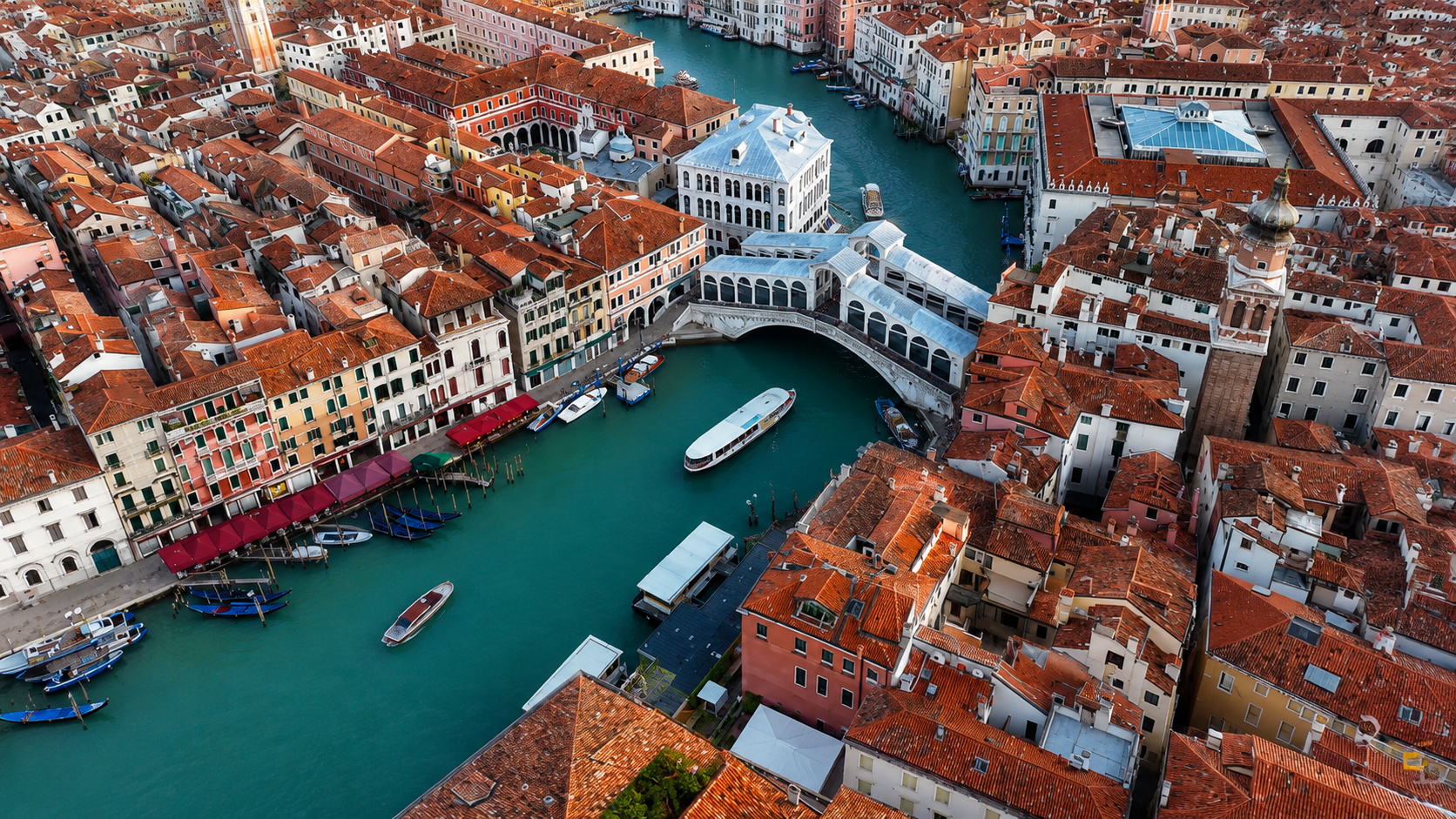

Venice was built on swampy ground with submerged stakes, wooden platforms, resistant stones, canals, and reservoirs capable of storing rainwater
Venice seems to float on water, but its structure reveals a much more complex solution. The city was built on countless wooden stakes, driven into the unstable soil of the lagoon and covered by platforms capable of supporting stone and brick buildings.
According to UNESCO, the first permanent settlements emerged in the 5th century. During that period, mainland residents sought protection on the lagoon islands during invasions that affected the Roman territory.
Gradually, the refuges were expanded. Later, small islands were consolidated, canals were organized, and increasingly larger constructions began to occupy the flooded land.
-
With 166 meters and 18,000 m³ of sand per trip, the giant dredger, made in China, is on its way to Santa Catarina to widen Gravatá Beach by up to 70 meters, in a project costing R$ 31.5 million that will operate 24 hours a day and leave the beach closed.

-
New York clears almost 500,000 m³ of earth, raises a park equivalent to 26 football fields by up to 3 meters, and hides a 2.4 km wall inside to protect 110,000 people from the advancing water.

-
Couple lifts the floorboards in the living room to replace a simple heater and discovers a secret 3-meter abyss hidden for over 100 years beneath their own house.
-
Chinese engineers rotated a 46,000-ton bridge in the air by 52.4 degrees in just 68 minutes, fitting it over one of the country’s busiest railways without interrupting the trains passing right below.


UNESCO reports that Venice spread over 118 small islands and became an important maritime power during the 10th century.
Venice’s foundations transformed unstable mud into a base for palaces and churches
The first challenge for builders was to create stability in an environment made up of water, clay, sand, and sediments.
Initially, wooden stakes were driven side by side into the lagoon bed. These pieces compacted the upper layers and distributed the weight of the constructions.
Next, horizontal boards were placed over the stakes. Subsequently, layers of stone formed a more rigid platform to receive walls, columns, and floors.
The wood remained submerged with little contact with oxygen. Consequently, its deterioration occurred differently from that observed in structures exposed to air.
Research identified alder, larch, oak, pine, elm, and fir woods in Venetian foundations. However, studies also found different levels of degradation, dispelling the simplified idea that all stakes had been completely mineralized.


Istrian stone created a resistant barrier between the water and the bricks
Above the foundations, the Venetians used materials capable of withstanding constant humidity.
The Istrian stone, a white limestone with low absorption, was mainly used in the lower areas of the buildings. In this way, the material separated the wooden foundations from the brick walls.
Additionally, its compression resistance helped support high loads. Its use in the lower parts of Venetian constructions became common from the 14th century onwards.
The bricks, in turn, allowed for the construction of relatively light walls. Meanwhile, the mortars helped the structures accommodate small ground movements.
Rialto Bridge required approximately 12,000 wooden pillars
The Rialto Bridge is one of the most well-known examples of this technique.
The current stone structure was completed in 1591. To support it, about 6,000 piles were installed on each side of the Grand Canal.
Approximately 12,000 pieces of wood formed the base of the bridge.
A study published in 2019 in the scientific journal Construction and Building Materials indicated that the piles are about 3.5 meters long.
The pieces were deeply inserted into the mud and distributed over an area of about 700 square meters on each bank.

Canals and tides became part of the city’s daily functioning
The canals were not only used as transport routes.
The movement of the tides helped renew part of the water and transport waste. However, this process did not represent a perfect sanitation system.
Venice also faced another problem: the lack of natural sources of drinking water.
Therefore, more than 600 public wells and cisterns were used to collect rainwater. The water passed through filtering layers and was then stored in underground reservoirs.
Venetian engineering was born from the adaptation between city, wood, stone, and water
The survival of Venice does not depend on a single invention.
In reality, stakes, platforms, stones, bricks, channels, tides, and cisterns worked as parts of the same urban system.
This combination allowed the transformation of swampy islands into a lasting city.
Recognized by UNESCO as a World Heritage Site in 1987, Venice remains an example of how medieval engineering adapted heavy constructions to a water-dominated environment.
Which of these solutions used in the construction of Venice seems most impressive to you?


