





 Portuguese
  English
  Spanish
  6 min of reading
  0 comments


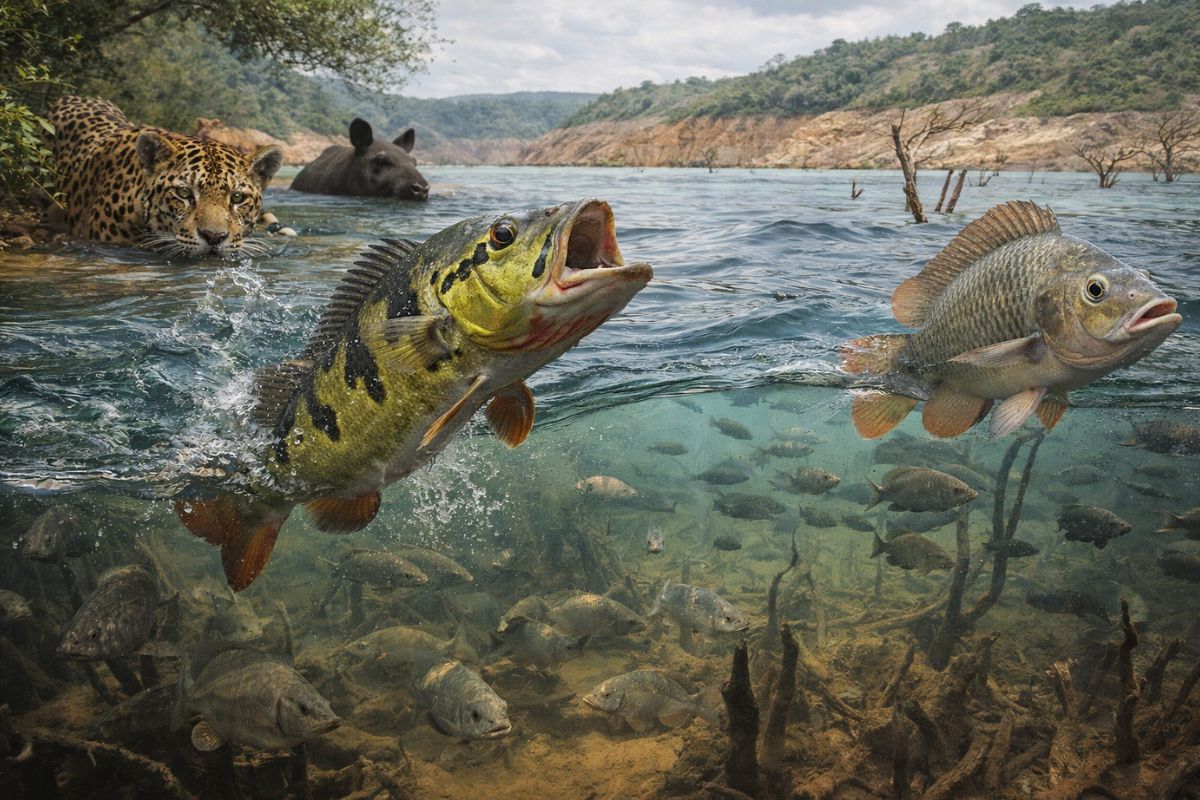
Furnas Lake, the largest freshwater reservoir in the Southeast, houses 65 species of fish, but 14 are invasive. Researchers from Unifal and UFLA warn that terrestrial and aquatic fauna are undergoing a decline that favors generalist species and threatens original biodiversity.
The Furnas Lake, in Minas Gerais, is a giant of 1,440 km² that reaches 34 municipalities and encompasses two of Brazil’s most important biomes: the Cerrado and the Atlantic Forest. It is home to about 350 species of birds and iconic mammals such as the maned wolf, the giant anteater, and the jaguar. But behind these still significant numbers, researchers identify a silent process of decline that has already eliminated sensitive species and is transforming the lake and its surroundings into an environment dominated by generalist and invasive animals. The jaguar and the tapir, which once inhabited the region, have locally disappeared.
In the water, the scenario is equally concerning. Of the 65 species of fish cataloged in the lake, 14 are exotic, meaning they did not originally exist in the region. This proportion of over 20% of invasive species is already considered a serious indicator of environmental degradation, according to Professor Paulo dos Santos Pompeu from the Federal University of Lavras. Fish such as the peacock bass and tilapia, which found favorable conditions in the still waters of the reservoir, have come to dominate the environment, while native migratory species like the catfish, the piracanjuba, and the pirapitinga have practically disappeared from the lake.
What happened to the terrestrial fauna around Furnas Lake
According to the G1 portal, the region where Furnas Lake was formed was originally an area of high biodiversity, with cascading rivers, preserved riparian forests, and continuous stretches of Cerrado and Atlantic Forest. The construction of the hydroelectric plant and the formation of the reservoir, combined with the expansion of agriculture, deforestation, and hunting pressure, caused the local disappearance of species that needed extensive and preserved areas to survive. The jaguar and the tapir are the most emblematic cases, but not the only ones.
-
Children from the 1980s and 1990s who spent hours playing in the street until dark naturally developed spatial intelligence, which today has become the subject of expensive courses, cognitive training, and modern methods of child and adult learning.

-
Without bombs, without electricity, and without drilling the ground, villages in southwestern Morocco have discovered how to extract water directly from the air using only polymer nets, wind, and the humidity of the Atlantic amidst the advancing desert.

-
Son of a Brazilian, a 20-year-old young man defies extreme pressure, wins the world rodeo championship, and takes home a million-dollar prize of nearly R$ 5 million.
-
The largest freshwater aquarium in the world is in Brazil, impressing with 5 million liters, 380 species, and will host a national congress that brings together specialists in biodiversity, animal conservation, and unprecedented research with more than 100 species bred in captivity.



Professor Vinícius Xavier da Silva from the Federal University of Alfenas explains that “these animals have been disappearing over time due to hunting pressure, habitat loss from agricultural expansion, and fragmentation of natural areas.” Species such as the maned wolf and the giant anteater are still seen, but with increasingly lower frequency. In contrast, more adaptable animals, such as the crab-eating fox and the opossum, have become more common. The result is what researchers call biotic homogenization: a fauna that, although still diverse in absolute numbers, is being progressively leveled down.
How Furnas Lake lost its most valuable fish species
Before the formation of the lake, the environment consisted of rivers with rapids, waterfalls, and stretches of calm water, a mosaic of habitats that supported dozens of specialized species. With the flooding, this diversity of environments was replaced by a large homogeneous reservoir, which favors fish adapted to still waters and harms migratory species that depend on long stretches of rivers to complete their life cycles.
Fish such as the catfish, the piracanjuba, and the pirapitinga, which were common in the Rio Grande basin, have ceased to occur within the lake and have begun to concentrate in stretches below the dam or in still-preserved tributaries. “We eliminated an environment that took millions of years to form and that supported a highly specialized biodiversity”, says Professor Pompeu. The lake today hosts a reduced number of species, with a predominance of the more generalist ones, those that adapt to any condition and compete advantageously against the natives.
The advance of invasive species that dominate the waters of the lake

The presence of 14 exotic species among the 65 cataloged in Furnas Lake is not accidental. These fish arrived at the reservoir through three main avenues: sport fishing, which often deliberately introduces species; aquaculture, with accidental escapes of fish raised in net pens; and improper disposal of aquarium fish. Once established, these invaders compete with the local fauna and, in some cases, create new ecological relationships that alter the entire food chain.
The peacock bass, a typical fish from the northern region of Brazil, is one of the most concerning examples. As a top predator, it reduces populations of native species and intensifies the imbalance within the lake. The tilapia, more adapted to still waters, found ideal conditions to reproduce and dominate. There is also the presence of organisms from other regions, such as shrimp from the Amazon and Pantanal, according to a study coordinated by Professor Marcos Calisto from UFMG in partnership with Axia Energia. “Whenever a new species enters, the local community needs to restructure, and this can even lead to the disappearance of native species,” warns Pompeu.
The fragmentation that isolates animals and reduces genetic diversity around the lake
In addition to direct degradation, the fragmentation of vegetation is another factor that compromises the fauna around Furnas Lake. Continuous areas of forest have given way to small isolated patches that function as refuges but prevent the movement of animals between different populations. This isolation reduces genetic diversity, increases vulnerability to diseases, and accelerates the process of decline that researchers describe as biotic homogenization.
Professor Rogério Grassetto Teixeira da Cunha from Unifal summarizes the problem: “We do not know the health status of these populations, whether they are viable in the long term. These animals are managing to survive out there.” As a solution, researchers highlight the creation of ecological corridors and the preservation of vegetation areas around the lake, measures that would allow connection between fragments and give animals a real chance to maintain healthy populations in the long term. Even domestic animals, such as dogs and cats, have a direct impact on birds and small mammals, a problem that is rarely included in conservation discussions.
What can still be done to protect the biodiversity of Furnas Lake
The Serra da Boa Esperança State Park is one of the areas considered strategic for conservation, serving as a refuge for various animals. But even there, some species have already disappeared, and the conservation unit alone cannot reverse the process of decline affecting the entire surroundings of the lake. There are also non-institutional initiatives, such as private reserves and NGO projects aimed at protecting remnants of forest, but the future scenario depends on broader and coordinated actions.
Biologist Wagner Martins Santana Sampaio, the technical manager of the NGO Idesa, acknowledges that the impact of the formation of the lake is irreversible, but emphasizes that there is still room to reconcile conservation and economic use. “Furnas today is an environment of multiple uses, important for energy, tourism, and supply. The challenge is to ensure that this use is done consciously, preserving what remains of biodiversity”, he states. If nothing is done, the trend is continuous decline. If there is care and preservation, some species may still recover. But time to act is running out.
Furnas Lake has already lost the jaguar, the tapir, and dozens of native fish. Do you know the region? Do you think it is possible to reconcile the economic use of the reservoir with the preservation of biodiversity? Leave your opinion in the comments.







-

-

2 people reacted to this.