






 Portuguese
  Spanish


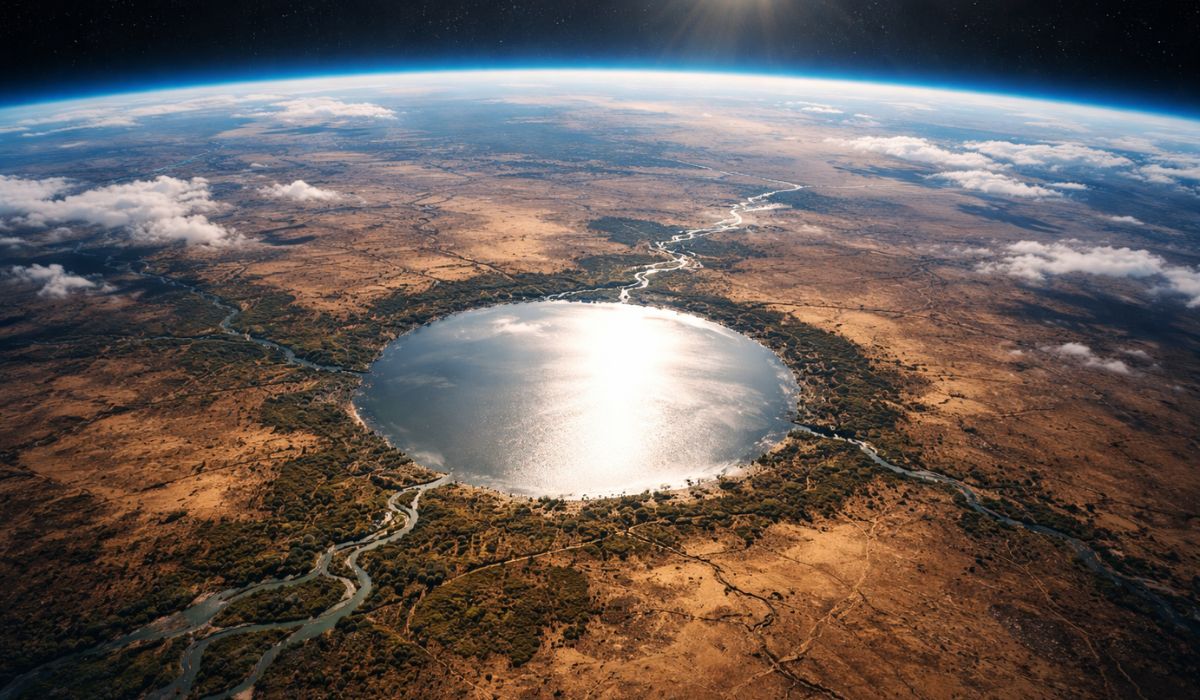
Record made from space highlights a rare optical effect over Lake Iro in Chad and draws attention again to a geological structure that is still under scientific analysis in the African Sahel region.
A record made by an astronaut aboard the International Space Station showed Lake Iro in southern Chad, appearing like a silver mirror amidst the African Sahel.
The effect seen in the image does not indicate a change in the water or photo editing.
According to NASA, it is an optical phenomenon called sunglint, which occurs when sunlight reflects off the surface and returns almost directly to the observer in space.
-
Couple Sold Everything to Restore a 300-Year-Old Abandoned Mansion, Uncovering Ancient Books and Untouched Rooms

-
Couple Builds Sustainable Home from Straw Bales, Wood, and Clay in Brazil
-
At 64, Grandma Sônia Turned Homemade Recipes into a Family Business, Growing Casa de Bolos to Over 600 Locations and Expanding to Portugal

-
Brazilian Couple Builds Underground Bunker in Santa Catarina Amid Fears of Crises and Shortages, Spending $10,000 and Learning Construction from Scratch, Videos Go Viral


The photograph was taken on December 21, 2024 and was later highlighted by NASA as an example of how this type of reflection can reveal rivers, lakes, and other bodies of water observed from Earth’s orbit.
In the scene, Lake Iro appears with intense brightness, while sections of the surrounding river system also reflect light and take on a metallic appearance.
Locally known as Lac Iro, the lake is about 12 kilometers in diameter and stands out for its almost circular shape in southeastern Chad.
In the image, parts of the surface appear lighter than others, which, according to NASA, is consistent with reflections of clouds over the water.
How sunglint appears in satellite and ISS images
Sunglint depends on a specific alignment between the Sun, the reflective surface, and the observation point.
Therefore, the phenomenon is often more noticeable in records made from space.
According to NASA, astronauts can frequently capture this effect because they can better adjust the observation angle relative to the target.
In addition to its visual impact, the phenomenon also has scientific utility.
Under certain conditions, it helps highlight the outlines of rivers, channels, and flooded areas that may be less visible in other lighting situations.
In the case of Lake Iro, this reflection makes clearer the connection between the lake and nearby watercourses in an area where hydrological dynamics vary with the seasons.
Lake Iro in Chad and the Bahr Salamat system
The area depicted is in a portion of the Sahel marked by seasonal changes in the rainfall regime.
According to the description published by NASA, Lake Iro is part of a system fed by the Bahr Salamat, a watercourse that divides and spreads through the region before reaching flooded areas.
In the image, two arms of this system appear with different levels of brightness.
One exhibits a more intense reflection, while the other shows partial sunglint.
According to NASA, the flow observed in this sector continues southwest.
The record also shows smaller meanders and wider curves, associated with earlier phases of the river’s behavior.
This contrast helps researchers observe how the river system has been shaped over time, with changes in water discharge and sediment transport.
The region where the lake is located acts as a transition zone between the Sahara Desert and the wetter areas of Central Africa.
In this type of environment, the water levels can fluctuate significantly throughout the year in response to rainfall and dry periods.
Potential impact structure in Lake Iro
The scientific interest in Lake Iro is not limited to the optical effect recorded from orbit.
For years, the site has also appeared in geological studies due to the shape of the basin and the configuration of the surrounding terrain.
In an article published in 2024 in the Journal of African Earth Sciences, researchers classified Lac Iro as one of the most promising potential impact structures in Chad.
The study points out that the area has geomorphological and geological characteristics that support the hypothesis of an ancient impact structure.
According to the authors, the presence of the lake “cannot be readily explained by any process other than impact.”
In the same work, the researchers state that the investigation of the site should be prioritized due to the size of the structure and the potential for preserving geological records.
However, the hypothesis is not treated as a definitive conclusion.
The scientific debate surrounding Lake Iro indicates that the site remains a promising candidate, but still without formal confirmation as an impact crater.
What is needed to confirm the origin of the structure
In planetary geology, confirming an impact crater requires specific evidence.
Among them are unequivocal signs of shock in minerals and rocks, as well as more detailed field investigations.
In the case of Lake Iro, the 2024 study supports that the circular shape of the area, the morphology of the terrain, and the relationship with the Bahr Salamat system reinforce the impact hypothesis.
Still, these elements alone do not conclude the discussion.
Previous reviews of impact structures in Africa have already mentioned the lake as a case that deserved in-depth analysis.
There is also reference in geological surveys and recent reports to the existence of crystalline materials in nearby areas, which has contributed to keeping the site on researchers’ radar.
So far, however, the most precise classification remains that of a potential impact structure.
Rare optical phenomenon and scientific investigation
The photograph of Lake Iro has drawn attention because it combines, in the same frame, a rare optical phenomenon and an area of geological interest still under study.
On one hand, sunglint depends on exact observation conditions and may last only briefly.
On the other hand, the landscape recorded is associated with much longer natural processes related to the evolution of the relief, drainage, and sediments.
According to NASA, this type of image helps identify features of the Earth’s surface that do not always stand out in other angles or lighting conditions.
In Lake Iro, the reflection reinforces the understanding of the water system and, at the same time, brings back into focus a structure that may still provide relevant information about the geological history of the region.
The result is a scene of strong interest for Earth observation.
More than highlighting the shine over the water, the image shows how orbital records can contribute to studies on relief, hydrology, and possible unconfirmed impact structures.




Be the first to react!