






 Portuguese
  Spanish
  3 min of reading
  0 comments


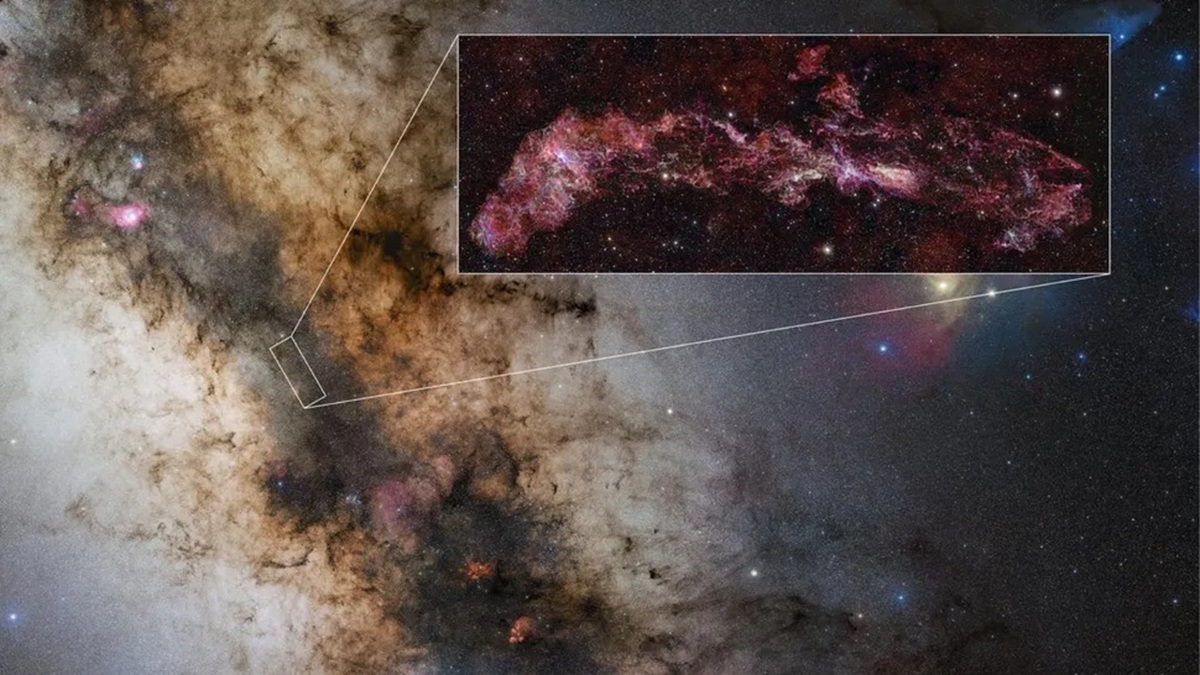
With 66 Antennas Installed in the Atacama Desert, Chile, the ALMA Radio Telescopes Produced the Largest Image Ever Recorded of the Central Molecular Zone, a Region 650 Light-Years Away in the Heart of the Milky Way, Revealing Cold Gas, Dozens of Molecules, and Areas of Star Formation Near Sagittarius A
Using the largest array of radio telescopes in the world, the Atacama Large Millimeter/submillimeter Array, ALMA astronomers mapped in detail the Central Molecular Zone with a diameter of 650 light-years, producing the largest image ever obtained by the instrument with radio telescopes.
Radio Telescopes Reveal Cold Gas in the Central Molecular Zone with Unprecedented Accuracy
The image of the Central Molecular Zone represents the first time that the cold gas in this region has been fully explored in great detail. The area, which is 650 light-years in diameter, is located in the heart of the Milky Way and houses the supermassive black hole Sagittarius A.
According to the team, this is the largest image ever captured by ALMA. The survey is expected to help scientists investigate how stars are born and die in the extreme environment around Sagittarius A, located at the galactic center.
-
Man creates ingenious hack with pipes buried 2.4 meters deep and transforms snow into a tropical fruit greenhouse; system created by a retired mailman uses ground heat, produces oranges and lemons in Nebraska’s winter and has already turned into more than 700 kits sold.

-
An African fish is terraforming lakes by altering sediments, increasing turbidity, and changing the food chain: the silent advance of the tilapia Oreochromis niloticus

-
In the USA, thousands of people are being paid to wash dishes and clean the house with body cameras, every movement turning into data to train robots to imitate humans, in a new “digital gig” that could redefine the future of domestic work.
-
At 22 years old, a young person from Recife creates an artificial intelligence startup with a team barely over 25, serves giants like Bayer and Ipiranga, earns millions without taking a cent from investors, and transforms a young company into a national AI phenomenon.




Ashley Barnes, a member of the European Southern Observatory, stated that the location is invisible to the human eye but has now been revealed in extraordinary detail. She highlighted that it is the only galactic nucleus close enough to Earth to be studied with such precision.
Extreme Structure of the CMZ Challenges Models and Expands Use of Radio Telescopes
The Central Molecular Zone is formed by an intricate network of dense, cold gas that flows along filaments. These filaments often collapse into clusters capable of forming stars.
Although this process also occurs at the edge of the galaxy, it is described as much more extreme in the CMZ. The region concentrates intense conditions that directly influence the cycles of star formation and death.
According to Steve Longmore, head of ACES and a researcher at John Moores University, the CMZ is home to some of the most massive stars known in the galaxy. Many have short lifespans, dying young and ending the cycle in supernovae and even hypernovae.
ACES Survey with Radio Telescopes Identifies Dozens of Molecules
As part of the ALMA CMZ Exploration Survey, ACES, the team determined the chemical composition of the molecular gas. Dozens of different molecules were detected.
Among them are complex organic molecules like methanol and ethanol, as well as simple molecules such as silicon monoxide. The identification enhances the understanding of the components of the galactic center environment.
Longmore stated that studying how stars are born in the CMZ also provides a clearer view of how galaxies grew and evolved. He added that the region shares characteristics with galaxies from the early universe.
ALMA Radio Telescopes Form Mosaic with 66 Antennas in the Atacama Desert
The Central Modulation Zone is approximately the size of three full moons in the night sky. Even ALMA, composed of 66 antennas spread across the Atacama Desert, could not capture it in its entirety at once.
The final image was composed from smaller individual observations, forming a large mosaic. It represents the largest area ever observed by ALMA to date.
Katharina Immer, an astronomer at ALMA, stated that the team anticipated a high level of detail when designing the survey. However, she expressed genuine surprise at the complexity and richness revealed in the final result.
The ACES survey was published on Wednesday, February 25, in the Monthly Notices of the Royal Astronomical Society. For scientists, this is just the beginning of new investigations into the central region of the galaxy, expanding the role of radio telescopes in the study of the cosmos.





Be the first to react!