Portuguese
  Spanish


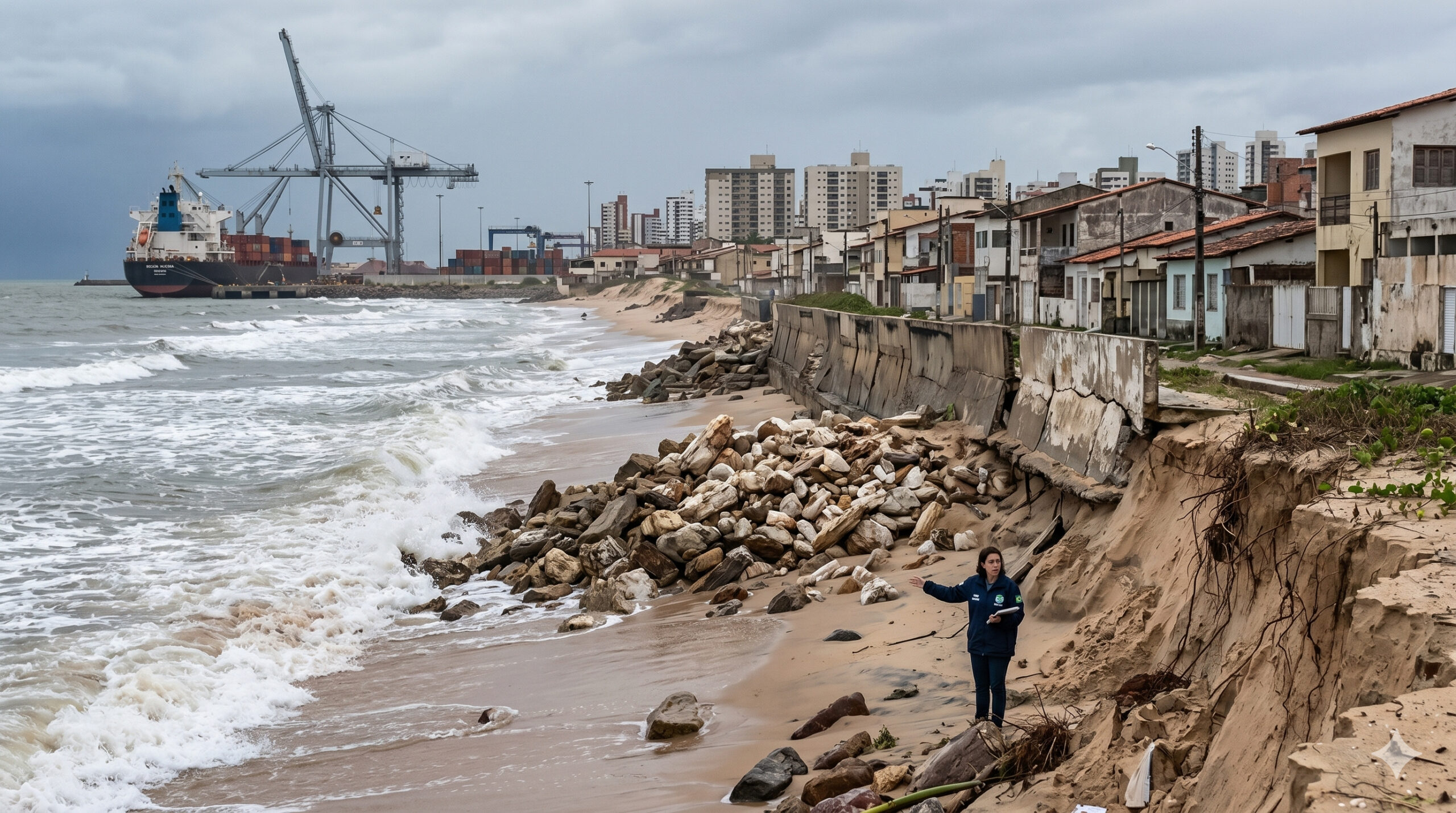


Study warns that almost half of sandy beaches could disappear by 2100, while 20% already suffer intense, severe, or extreme erosion worldwide, driven by sea-level rise, coastal urbanization, and the destruction of natural dunes.
According to FAPESP Agency, Uruguayan marine scientist Omar Defeo, a professor at the University of the Republic of Uruguay, presented a conclusion that brings together decades of coastal monitoring in one sentence at the FAPESP Day Uruguay symposium in Montevideo in November 2025: “Almost half of the beaches will disappear by the end of the century.” This projection is not new. Studies published in Nature Climate Change in 2020 already pointed in this direction, with an analysis of 35 years of satellite data, 82 years of climate projections, and over 100 million storm event simulations.
What has changed now is the convergence of evidence. A study published by Defeo and Brazilian collaborators in Frontiers in Marine Science evaluated 315 beaches worldwide and found that one-fifth of them already exhibit intense, extreme, or severe erosion, not as a future prediction, but as a current condition.
Coastal erosion threatens beaches in Brazil, Uruguay, Argentina, and other regions of the world
Beaches are not waiting for sea levels to rise to disappear. They are already retreating under the combination of coastal development, dune removal, urbanization that interrupts the natural flow of sediments, and more energetic waves in a warmer ocean.
-
World Cup Ball Chip Uses Technology to Detect Invisible Touches, Confirms Offside, Secures Portugal’s Victory Over Croatia

-
36-Meter Hydrogen-Powered Superyacht Arrives in Brazil to Debut German Engines and Showcase Future of Clean Navigation

-
Indian Students from Jaipur Win Top Prize at World’s Largest Science Fair with EcoFog, an Affordable Mesh to Harvest Fog Water Without Energy

-
Italy Sinks Massive 11-Story Concrete Structures in the Ligurian Sea to Create a 6.2 km Barrier, Clearing the Way for 400-Meter Ships in Genoa



“Almost half of the beaches will disappear by the end of the century,” said Defeo. “We in Uruguay, Brazil, and Argentina share these resources. Therefore, we must work in partnership with Brazilian scientists to manage and conserve coastal ecosystems.”
The statement places the South American coastline within a global crisis. Sandy beaches, coastal dunes, and surf zones form connected natural systems, and the loss of one of these parts compromises all coastal protection.
What is a beach and why is this dynamic system losing balance
To understand why beaches are disappearing, it is necessary to understand what a beach truly is from a geomorphological perspective. It is not a fixed strip of sand, held in the same place by a permanent force.


A beach is a dynamic system in constant equilibrium between forces that deposit sand and forces that remove sand. Sediments arrive via rivers, cliff erosion, coastal dunes, and circulation along the coastline.
Sand is also removed by waves during storms and by longshore drift, which transports sediments along the coast. When this natural balance is interrupted, erosion begins to outweigh replenishment, and the beach starts to disappear.
Coastal dunes function as natural sand reservoirs against storm surges and storms
Under natural conditions, the input and output of sediments balance over decades. Beaches may temporarily retreat during winter or after storms and recover in the following season.
The dune, a sand formation above the high tide level covered by vegetation, functions as a sediment reservoir. When a storm surge removes sand from the beach, the dune yields part of this material, and the subsequent calm helps to restore the system.
Researcher Guilherme Corte, from the University of São Paulo, explained that the wind carries sand from the dry area to the surf zone, while waves return sediment to the beach. The dune acts as a natural buffer, but this mechanism breaks down when constructions remove dunes and coastal vegetation.
Sea-level rise and coastal squeeze accelerate the disappearance of beaches
The study by Defeo and collaborators identified two main mechanisms acting together in beach erosion. The first is sea-level rise caused by global warming.
When sea level rises, the beach’s equilibrium position shifts inland. According to Bruun’s Rule, each centimeter of sea level rise can produce a horizontal retreat of the coastline 50 to 100 times that value, depending on the beach’s slope.

The second mechanism is coastal squeeze, when the sea advances and encounters boardwalks, hotels, highways, and houses instead of dunes and vegetation. Without space to migrate inland, the beach is squeezed between the ocean and the city until it disappears.
One fifth of the world’s assessed beaches already suffer intense, severe, or extreme erosion
The most impactful data presented by Defeo was that 20% of the 315 beaches assessed worldwide already show intense, extreme, or severe erosion. This means that the crisis is not restricted to the future: it is already underway.
Intense erosion represents a coastline retreat of between 1 and 3 meters per year. Severe or extreme erosion indicates losses above 3 meters per year, a rate capable of eliminating beaches in years or a few decades.
For comparison, Copacabana beach in Rio de Janeiro has an average width of about 70 meters. A retreat of 3 meters per year could eliminate a beach of this size in less than 25 years, if there were no engineering intervention.
Coastal urbanization, groynes, dredging, and mechanical cleaning reduce sand replenishment
The study points out that human activities play a significant role in erosion, especially on reflective and intermediate beaches. The construction of piers, breakwaters, and groynes alters the circulation of sediments along the coast.
These works can deprive downwind beaches of their natural sand supply. The dredging of port and access channels also retains sediments that should continue circulating along the coast.
Another problem is the mechanical cleaning of tourist beaches, done to remove algae and organic waste. This practice improves immediate appearance but removes organic matter that feeds intertidal zone organisms and harms biodiversity.
Beaches and dunes protect coastal cities against storm surges, cyclones, and sea encroachment
The loss of beaches does not only mean the loss of tourist destinations. It removes a natural coastal protection infrastructure that benefits millions of people, including those who almost never set foot on the sand.
Beaches with developed dunes act as barriers against storms, cyclones, storm surges, and storm tides. They absorb part of the wave energy before the water reaches built-up areas.

When dunes are removed by urbanization or erosion, wave energy directly impacts streets, infrastructure networks, properties, and coastal communities. What was once free natural protection now requires expensive coastal engineering works.
Brazil has 7,400 kilometers of coastline exposed to erosion, sea encroachment, and salinization
For Brazil, the problem is particularly relevant. The country has about 7,400 kilometers of coastline, with cities like Recife, Fortaleza, Salvador, Rio de Janeiro, and Santos directly exposed to sea encroachment.
The island of Marajó, in Pará, already appears as one of the regions most vulnerable to coastal erosion and aquifer salinization due to marine encroachment in Brazil. On the northern coast of São Paulo, research by Defeo and Brazilian collaborators indicates accelerated erosion associated with intense tourism and sea level rise.
Brazil’s coastal crisis combines environmental, urban, economic, and social risks. It’s not just about losing sand, but about compromising housing, tourism, infrastructure, biodiversity, and protection against extreme events.
Biodiversity of sandy beaches disappears even before being noticed by most visitors
Beyond coastal protection and tourism, sandy beaches support a biodiversity invisible to most visitors. This life is one of the first to be destroyed when the beach disappears or is altered by urbanization.
The intertidal zone, the strip between high tide and low tide, harbors barnacles, crabs, mollusks, polychaetes, crustaceans, and echinoderms that live buried in the wet sand. These organisms form the base of the coastal food chain.
Migratory birds depend on these communities for food during journeys of thousands of kilometers. Coastal fish also use shallow beach areas as nurseries for larvae and juveniles.
Beaches replaced by concrete have less chance of natural recovery
What can no longer be easily recovered are beaches completely replaced by boardwalks, walls, highways, and foundations. In these locations, the space for the beach to migrate simply ceased to exist.
Defeo used the word “squeezing” to describe this process. The beach is compressed between the advancing sea and the city that does not retreat.
The disappearance of these beaches does not occur solely by natural force, but by development choices made without understanding what was being sacrificed. The question now is how many coastal cities will still treat dunes and sand strips as empty spaces, when they are part of the natural defense against sea-level rise.