Portuguese
  Spanish


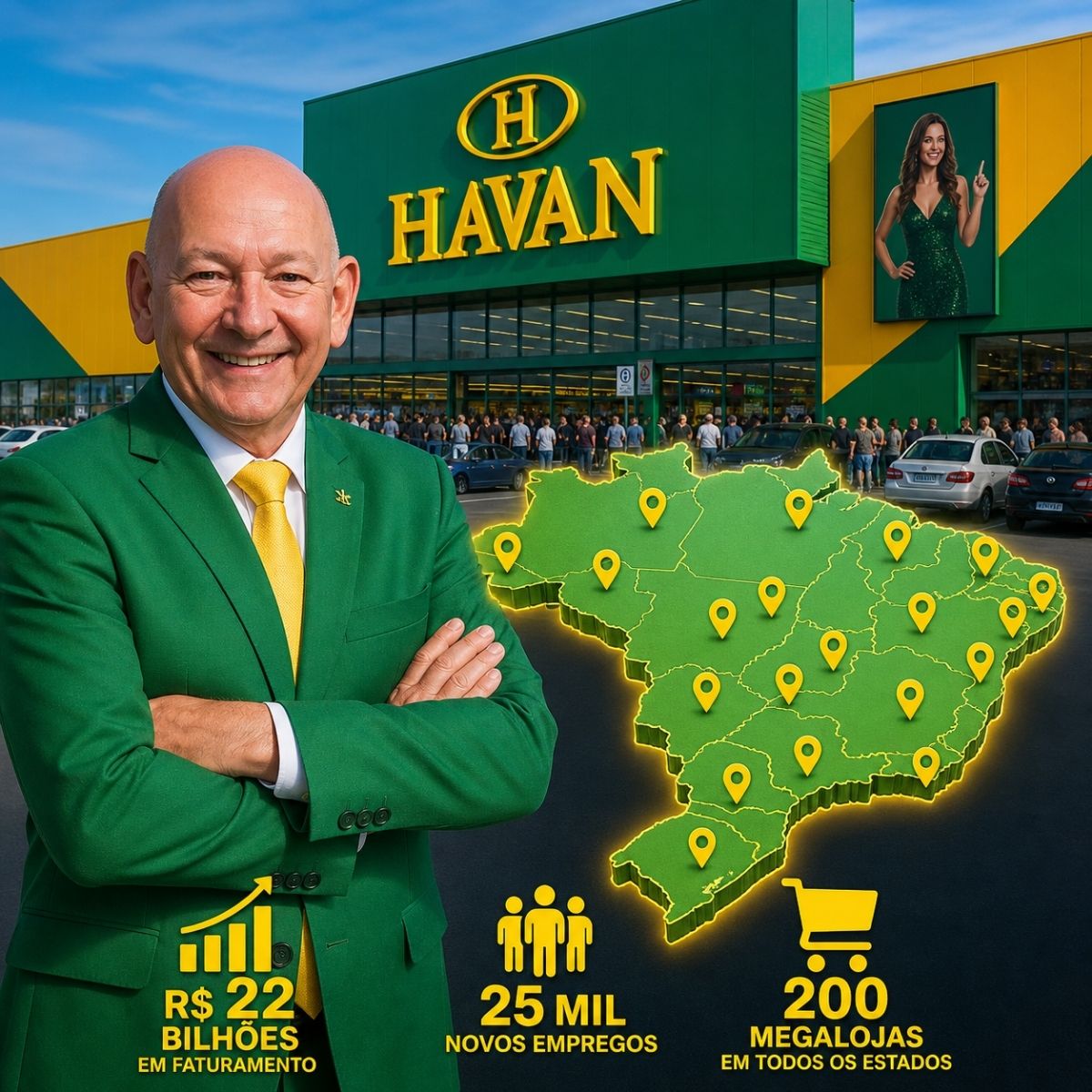

Luciano Hang set a goal for 2026 to create 25,000 jobs, achieve R$ 22 billion in revenue, and expand Havan to 200 megastores in all Brazilian states, with inaugurations in Fortaleza, Boa Vista, and Macapá in the year the company celebrates 40 years.
Luciano Hang, the businessman known as Véio da Havan, announced an expansion plan for 2026 that puts the retail chain on an aggressive growth path even in an economic scenario that most competitors treat with caution. The goal is to generate up to 25,000 new jobs in Brazil throughout the year, a number directly linked to the opening of new megastores that should bring Havan to the mark of 200 units spread across all Brazilian states, national coverage that Luciano Hang’s chain does not yet have but intends to achieve with confirmed inaugurations in Fortaleza, Boa Vista, and Macapá. The projected revenue of R$ 22 billion reinforces the scale of the challenge the businessman proposes to face precisely in the year the company completes four decades of existence.
The decision to expand with such intensity while Brazilian retail faces pressures is not trivial. Luciano Hang bets that Havan’s growth depends on physical presence in regions where the brand has not yet arrived, a strategy that reverses the logic of companies that retreat in times of uncertainty and positions the chain to capture market while competitors hesitate. The opening of stores in Northern capitals like Boa Vista and Macapá is a sign that the plan is not limited to reinforcing presence in already consolidated areas: Luciano Hang wants Havan to be a retail option available from Oiapoque to Chuí, literally.
What it means to generate 25,000 jobs at the pace Luciano Hang proposes
The goal of 25,000 new jobs in a single year requires a hiring speed that few Brazilian companies can sustain. For Luciano Hang, this number is a direct consequence of the expansion plan: each new Havan megastore employs hundreds of employees including salespeople, cashiers, stock clerks, security, cleaning, and administrative teams, and multiplying this workforce by dozens of inaugurations planned for 2026 produces a volume of hires that impacts local labor markets where the stores will open. Job creation is not an isolated promise but a structural part of the plan that only works if hiring keeps pace with inaugurations.
-
Half of Brazilians Prefer Lower Taxes with Private Health and Education, While 44% Opt for Higher Taxes for State-Provided Services, Datafolha Survey Reveals

-
Brazil’s Most Expensive Toll Rises to R$ 40.60 on Route from São Paulo to the Coast, Nearly Matching Bus Fare to Santos

-
As Brazil Expands Social Welfare, Survey Reveals 40% Blame Poverty on Laziness, While 58% Cite Lack of Opportunities

-
China Tightens Control on Antimony, Driving Prices from $22,000 to Nearly $40,000 per Ton as U.S. Rushes to Bolster Strategic Reserves



The impact is especially relevant in smaller cities where the arrival of a Havan megastore transforms the commercial dynamic. In municipalities that receive units of the size Luciano Hang projects, the volume of direct and indirect jobs noticeably moves the local economy: in addition to store employees, service providers, nearby restaurants, transport, and neighboring businesses experience an increase in demand that accompanies the customer flow. The goal of surpassing 25,000 employees shows that for Havan, job creation is not a byproduct of growth: it is an essential part of the strategy that Luciano Hang articulates from the planning of each new inauguration.
Why Luciano Hang wants 200 megastores spread across all states
The ambition to be present in all Brazilian states with 200 megastores goes beyond corporate vanity. For Luciano Hang, complete national coverage guarantees Havan negotiation scale with suppliers that reduces costs, brand visibility that negates proportional investment in advertising, and logistical capillarity that allows stores to be supplied in any region without depending on distribution centers concentrated in a few points. Each state without Havan’s presence is a market the chain does not serve and that competitors occupy without dispute, a scenario that Luciano Hang’s plan aims to eliminate by completing the national operating map.
The inaugurations in Fortaleza, Boa Vista, and Macapá are the missing pieces to complete this coverage. Fortaleza represents access to the Northeast consumer market with a population that justifies a megastore of the size Havan operates, while Boa Vista and Macapá bring the brand to Northern capitals where large-scale organized retail is scarcer and where repressed demand can generate surprising results. For Luciano Hang, entering unexplored markets is an opportunity Havan cannot miss while the brand has the momentum and capital to execute the plan.
What R$ 22 billion in revenue reveals about Luciano Hang’s Havan
The projection of R$ 22 billion in revenue for 2026 dimensions the size Havan has reached under the command of Luciano Hang. This volume positions the chain among the largest retailers in Brazil and demonstrates that the megastore model with a wide mix of products, ranging from clothes to home appliances, passing through decor items and food, has found a loyal audience that sustains a large-scale operation that few competitors replicate. The projected revenue is not just a financial goal: it is the fuel that enables 200 megastores, 25,000 jobs, and expansion into states where the brand does not yet operate.
Achieving R$ 22 billion in an economic scenario considered challenging is a bet that divides opinions. Optimists see in Luciano Hang an entrepreneur who finds opportunity where others see risk, while more cautious analysts question whether the speed of expansion is sustainable when high interest rates, restricted credit, and persistent inflation reduce the purchasing power of the population that frequents the stores. The answer will come throughout 2026, and Havan’s quarterly numbers will show whether Luciano Hang’s plan is a sound business vision or excessive optimism at a time that called for prudence.
What Havan’s 40 years mean for Luciano Hang’s plans
The year 2026 marks four decades since the company’s founding, and Luciano Hang treats the anniversary as an additional justification for the plan’s ambition. Completing 40 years by expanding instead of consolidating is a declaration that Luciano Hang’s Havan has not entered a conservative maturity phase but maintains the appetite of a young company that believes it has room to grow, a stance that in Brazilian retail is more the exception than the rule among chains that reach four decades. The temporal milestone gives symbolic weight to the goals of 200 stores and 25,000 jobs, transforming numbers into a narrative of a company that celebrates its anniversary by investing instead of celebrating.
For employees and communities that will be impacted, the 40 years matter less than what happens in the next 12 months. If Luciano Hang fulfills the plan, thousands of Brazilians will have new jobs, dozens of cities will receive stores that boost local commerce, and states like Roraima and Amapá will have access to a retail chain that until now only existed as a distant reference. If the plan falls short of its goals, Havan will still have grown in a difficult year, and Brazilian retail will have another case to study about the limits between ambition and reality.
And you, do you think Havan can open 200 megastores and create 25,000 jobs by 2026? Is Luciano Hang’s plan boldness or risk? Leave your opinion in the comments.