Portuguese
  Spanish


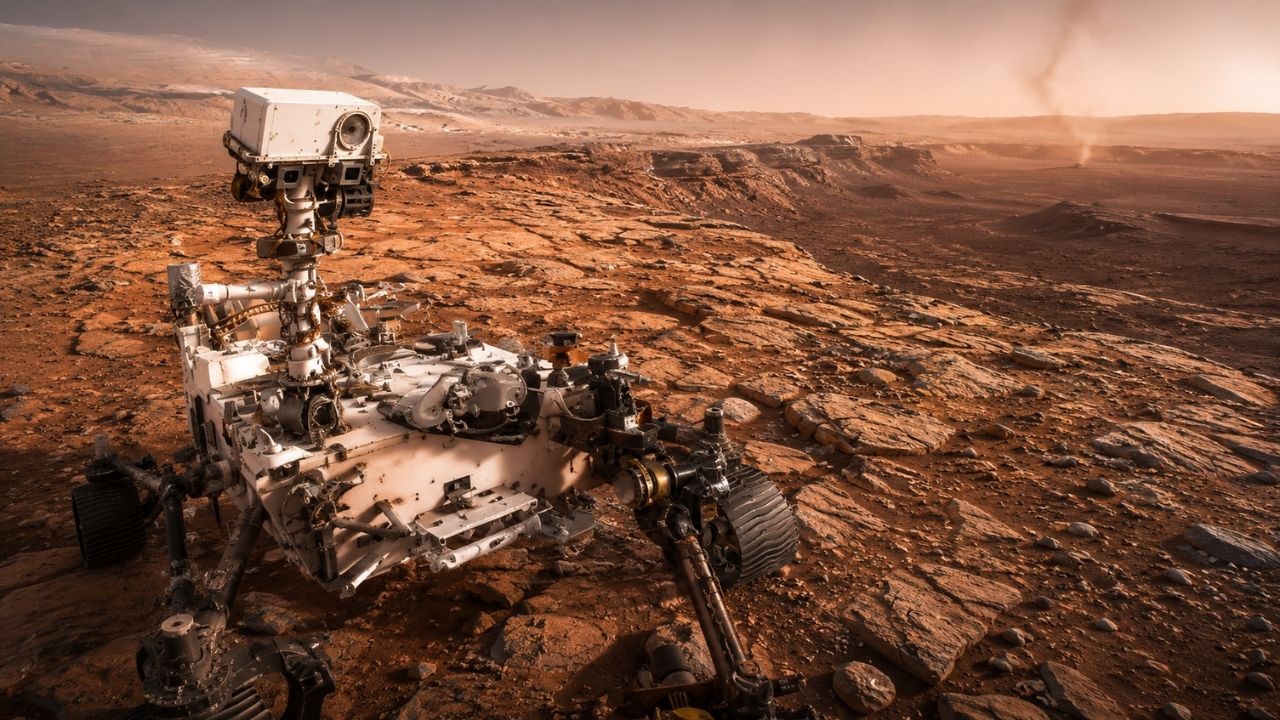

Mars appears in new selfie from the Perseverance rover, released by NASA in 2026, as the vehicle completes five years of mission on the red planet and investigates ancient rocks near the edge of Jezero Crater, in search of geological signs that help understand if there was habitability in the remote Martian past.
Mars returned to the spotlight in 2026 after NASA released a rare selfie of the Perseverance rover, made from 61 images taken in March. The vehicle, which landed on the red planet in 2021, completes five years of exploration on the Martian surface.
With information from the channel Olhar Digital, the image was taken near the edge of Jezero Crater, in a region called Lac de Charmes, where the rover investigates ancient rock formations. The scientists’ goal is to better understand Mars’ geological past and look for clues about conditions that could have made the planet habitable in the past.
Rare selfie shows new phase of the mission on Mars

The selfie released by NASA is not just a curious image of the rover on Martian soil. It marks a new stage of the Perseverance mission, which advanced to regions near the edge of Jezero Crater, beyond the area where it landed in 2021.
-
Sixth-grader in Miami wins Lemelson Young Inventor Prize for creating water-absorbing concrete using discarded oyster shells and charcoal.

-
Brazilian Researchers Develop Portable, Painless, Radiation-Free Breast Cancer Tracker Using Microwaves, Costing Around $200 and Potentially Replacing $240,000 Mammograms
-
Beer as a Vaccine? Scientist Develops Experimental Method with Live Yeasts, Tests Own Brew, and Publishes Results on Zenodo

-
Brazilian Researchers Develop ‘Rapha’ Device Using Natural Latex and LED Light to Heal Diabetic Foot Ulcers and Prevent 50,000 Annual Amputations


The portrait was created by combining 61 images, taken by the WATSON camera, installed at the end of the vehicle’s robotic arm. The process required dozens of precise movements to position the camera and form the final composition.
According to NASA, this is only the sixth selfie taken by Perseverance since its arrival on Mars. This makes the record rarer, as this type of image requires time, planning, and careful maneuvers of the robotic arm.
The new selfie also shows the rover in an area nicknamed “Old West,” as it represents the farthest point west visited by the vehicle since landing. For the mission, this advance indicates that Perseverance has entered a broader phase of exploration.
Jezero Crater continues to be a key piece of the scientific search
The Jezero Crater is one of the most important sites of the mission because it was chosen precisely for its geological potential. The region may hold clues about ancient environments that, in the past, could have gathered conditions favorable to habitability.
The Perseverance landed there in 2021 to investigate rocks, sediments, and formations capable of telling part of Mars’ history. Each movement of the rover helps scientists to create a more detailed map of the red planet.
Now, with exploration near the edge of the crater, the mission begins to observe materials that may have deeper or older origins. This is relevant because different layers of rock can hold records of distinct periods of Martian evolution.
The Lac de Charmes region gained importance for being associated with rock formations that can reveal more about the planet’s past. NASA also used images of the area to plan the rover’s next movements.
Ancient rocks may reveal clues about habitability
Besides the selfie, the Perseverance photographed a region called Arbele, within Lac de Charmes. In this case, a mosaic formed by 46 images was used, created to help scientists better analyze the terrain and plan the vehicle’s route.
These images reinforced the interest in structures known as megabreccias. They are large rock blocks that may have been ejected by meteorite impacts billions of years ago.
Some of these rocks may hold information about the deep layers of the Martian crust. For researchers, studying this material is a way to investigate the early history of Mars, including violent impact processes and geological transformation.
The analysis can also help understand if the planet once had a magma ocean and what conditions existed before Mars became the dry and cold environment known today. The search is not for direct life at this stage, but for signs of environments that could have supported life in the past.
Perseverance completes 5 years of exploration on the red planet
The Perseverance mission has already spanned five years since its arrival on Mars. During this period, the rover traversed the surface, captured images, analyzed rocks, and helped expand knowledge about the Jezero Crater.
The prolonged stay of the vehicle is one of the strengths of the mission. The longer it operates, the more regions it can explore and the more data it sends to scientists on Earth.
The rover also allows for comparison of different areas of the Martian terrain. This helps identify which rocks are older, which may have been displaced by impacts, and which regions deserve more detailed studies.
Even with the mission’s progress, each new stage requires caution. The terrain of Mars can present obstacles, inclines, loose rocks, and regions difficult to navigate, making route planning an essential part of the work.
Technology transforms images into decision maps


The photos taken by Perseverance are not just for public release. They are also used by scientists to study the terrain, assess risks, choose analysis targets, and decide the rover’s next steps.
The mosaic of 46 images of the Arbele region is an example of this. The wide image allows observing details that a single photo would not show, helping the team interpret the Martian landscape more accurately.
The Mastcam-Z camera, used for this type of recording, allows for detailed images of the environment. Meanwhile, WATSON, on the robotic arm, plays an important role in close-up images and compositions like the selfie.
This combination of cameras makes Perseverance a mobile laboratory and also a geological observer. It not only traverses Mars; it transforms each visited section into scientific information.
What the new stage can reveal about Mars
The rare selfie of Perseverance shows more than a robot on Mars. It symbolizes a mission that remains active, five years after landing, now focused on ancient rocks near the edge of Jezero Crater.
The great interest lies in the past of the red planet. If the deep rocks and megabreccias reveal clues about water, heat, impacts, and ancient environmental conditions, scientists may better understand if Mars was ever a potentially habitable place.
There is still no conclusion about life on the planet, but the investigation advances on a central question: Did Mars ever have conditions capable of allowing more life-friendly environments?
Do you believe that missions like Perseverance can find decisive clues about Mars’ habitable past, or do you think the red planet will keep this mystery for a long time? Leave your opinion in the comments.