Portuguese
  Spanish


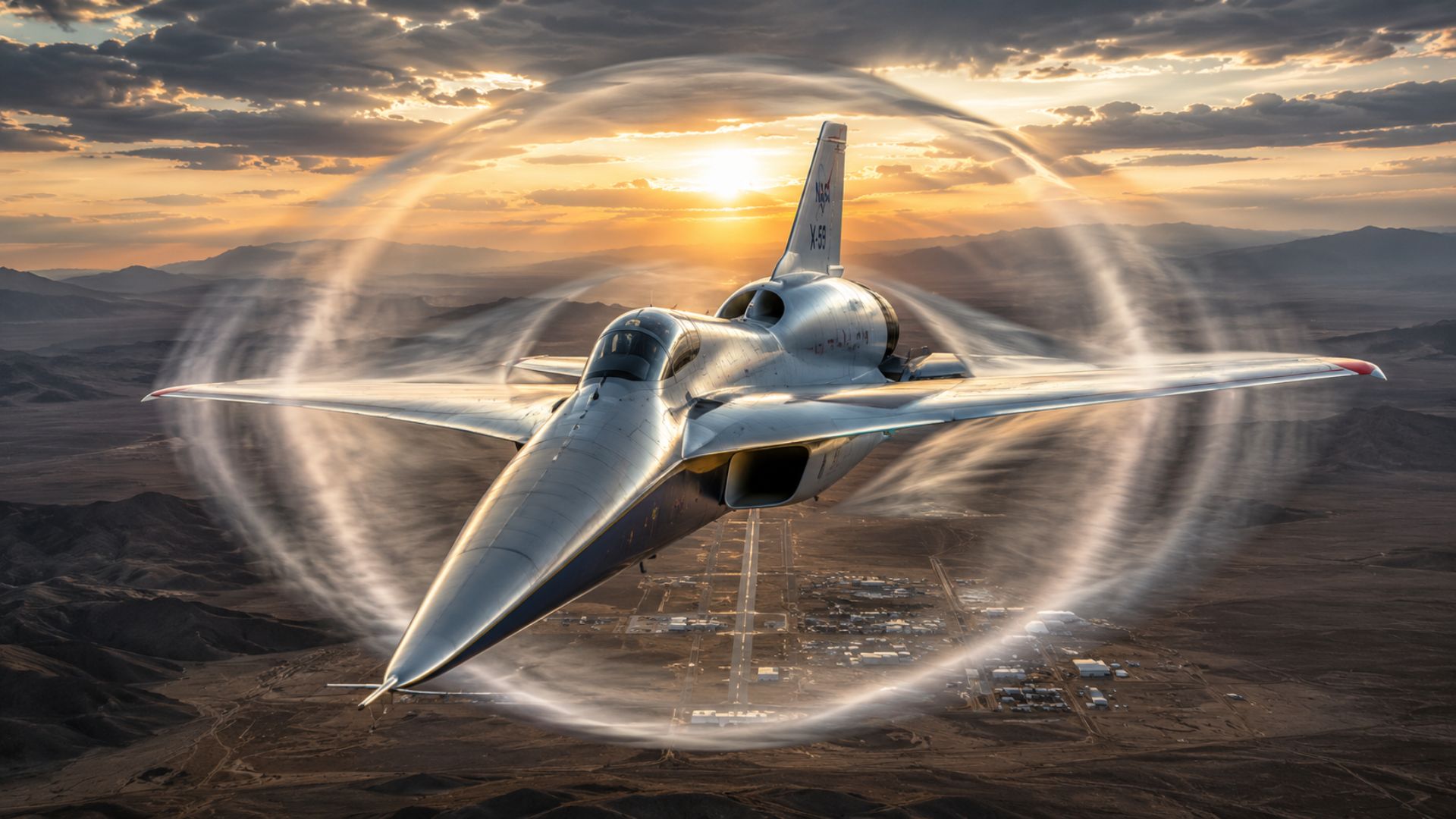


Accelerated testing pace puts the X-59 in a new phase of NASA’s mission, with silent supersonic flights increasingly closer to changing commercial aviation rules over land areas and expanding the debate on the future of high-speed air transport.
NASA conducted, for the first time, two test flights of the X-59 on the same day, marking an important milestone for the Quesst mission, a project aimed at enabling commercial supersonic aircraft over land areas with less sound impact.
The tests took place on April 30, at the Armstrong Flight Research Center in Edwards, California, during the 11th and 12th flights of the experimental aircraft developed to reduce the sonic boom to a sound more like a “soft thump.”
According to the American space agency, the X-59 achieved different technical objectives at altitudes between 12,000 and 43,000 feet and speeds of 528 to 627 mph, a range equivalent to approximately Mach 0.8 to Mach 0.95.
-
UFG’s Innovative Use of Air Conditioner Drip Saves 400 Liters of Water Daily in Brazilian Public Building

-
China Builds Underwater Wall After Discovering Technology That Could Shift Military Balance in the Pacific, Study Reveals Why the Asian Power Reacted Now

-
After Over 8 Months in a Simulated Mars Habitat in Houston, 4 NASA Volunteers Communicate Almost Silently and Will Exit in October
-
Natural Phenomenon Turns Black Sea Turquoise Blue Due to Billions of Microscopic Organisms


Quesst Mission accelerates tests of NASA’s supersonic aircraft
The increase in flight pace is part of the stage where engineers and pilots gradually expand the so-called flight envelope, a process used to understand how an experimental aircraft behaves at different speeds, altitudes, and maneuvers.

By conducting two sorties on the same day, the team was able to gather more data in less time, without compromising the safety procedures that guide the silent supersonic jet’s test campaign.
NASA states that the performance helps maintain the plan to complete, by the end of 2026, the first two phases of the Quesst mission: the expansion of the flight envelope and acoustic validation.
These stages are considered essential because they precede overflights in selected communities in the United States, where residents will be consulted about their perception of the sounds produced by the aircraft.
How the X-59’s double flights work
The so-called double flight days involve two separately planned missions, with a break between them for refueling, inspections, and preparing the aircraft for the second takeoff.
This model had already been tested on the ground during taxi tests conducted last summer in the Northern Hemisphere, when the team verified that it could perform two evaluation cycles in the same day.
“The team did an incredible job meeting the planned weekly flight rate,” said Cathy Bahm, manager of the Low Boom Flight Demonstrator project, responsible for NASA’s low-boom demonstrator.
She also stated that the taxi tests had already indicated this operational possibility and said she was proud to see the team meet the challenge of conducting two flights in a single day.
X-59 technology attempts to reduce sonic boom


The X-59 is the centerpiece of the Quesst mission, an initiative by NASA’s Aeronautics division aimed at demonstrating that supersonic flights can occur over land without producing the intense booms associated with aircraft faster than sound.
The proposal is not to completely eliminate the physical phenomenon caused by breaking the sound barrier, but to reduce its intensity to a level that can be evaluated by communities and, later, by regulatory authorities.
The aircraft has an elongated design and aerodynamic solutions aimed at distributing shock waves differently, reducing the noise perceived on the ground during supersonic flight.
With the data collected, NASA intends to provide evidence to regulators in the United States and other countries, who will be able to evaluate new rules for commercial supersonic flights over populated areas.
What the tests represent for commercial aviation
Although the progress is significant, the April flights are still part of an experimental campaign, not a commercial or passenger transport stage.
The immediate goal is to prove the aircraft’s behavior in controlled conditions, validate systems, measure performance, and prepare the acoustic phase, which will play a decisive role in the public analysis of the project.
NASA will also need to record human responses to the sounds generated by the X-59, as social acceptance of the noise is one of the central points for any regulatory change.
Currently, restrictions on supersonic flights over land exist precisely because of the impact of sonic booms, which have historically limited the use of this type of aircraft on civil routes.
X-59 could pave the way for a new generation of aircraft
The X-59 was not designed to operate as a commercial aircraft, but as a technology demonstrator capable of producing technical and acoustic data for future decisions.
Based on these results, manufacturers, authorities, and research institutions will be able to assess whether next-generation supersonic aircraft can fly over continents with acceptable noise levels.
The milestone of two flights on the same day shows that the campaign has entered a more intense pace and that the team is aiming to achieve a sequence of objectives before the more visible phases of the mission.
NASA considers that the accelerated data collection is important to efficiently reach the main test points, keeping safety as a central requirement at each stage of the operation.