






 Portuguese
  Spanish
  5 min of reading
  0 comments


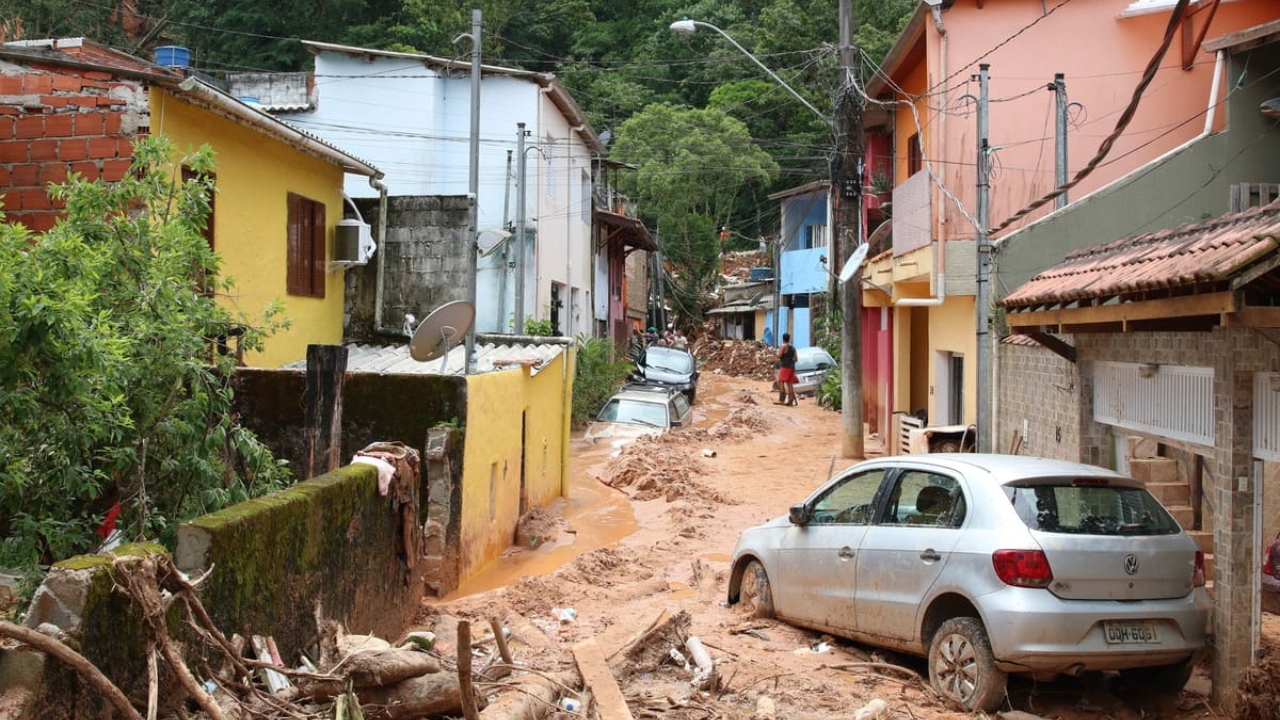
Brazil already has 1,041 municipalities classified with high or very high risk of landslides, a number that raises a national alert about how the country occupies slopes, hills, and fragile urban areas. In practice, this means that almost one in five Brazilian cities already appears in a concerning zone of vulnerability.
The data was released from the AdaptaBrasil panel, by MCTI/Inpe, and shows a scenario that goes far beyond isolated events of heavy rain. According to a survey published by Exame, of the 1,041 municipalities on alert, 830 are at high risk and 211 at very high risk.
The most alarming data, however, is in the projection. If nothing changes significantly in adaptation policies, urban infrastructure, and prevention, the number of cities in critical situations could jump to about 1,800 municipalities by 2030. This would place approximately one-third of Brazil within the danger zone.
-
Survivor of 1966 SS Daniel J. Morrell Shipwreck in Lake Huron Recounts 38-Hour Ordeal in Extreme Cold

-
The Greatest Hoax in World Cup History? The Film That Denied Brazil’s 1958 Victory and Exposed How Fake Evidence Can Seem Convincing on TV
-
Fake South Korean Online Stores Offer Shopping Thrill Without Spending Money or Receiving Products
-
Helicopter Drops 180 Tons of Sand and Gravel on Swedish River to Revive Ecosystem Damaged by Decades of Exploitation



The risk of landslides is no longer a local problem
For a long time, tragedies involving slopes were seen as problems concentrated in mountainous cities, peripheral neighborhoods, or regions hit by extreme rains. But the new survey shows that the risk of landslides has spread on a much larger scale.
The alert is now national. Small, medium, and large municipalities may be exposed when they combine vulnerable terrain, unplanned occupation, insufficient drainage, and housing built in fragile areas.
This means that the danger does not arise only from rain. Rain can be the trigger, but the disaster is often prepared over years by unplanned urbanization, lack of preventive works, and the growth of neighborhoods in places where the soil does not offer safety.

More than 1,000 cities already appear on the danger map
The number of 1,041 municipalities draws attention because it turns a threat often invisible into official statistics. It is not a distant forecast nor a hypothetical scenario for the coming decades. The risk already appears now, in 2026, on the map of hundreds of Brazilian cities.
The AdaptaBrasil platform crosses climate indicators, exposure, and vulnerability to identify risks related to the impacts of climate change. In the case of landslides, this involves factors such as intense rainfall, terrain, urban density, hillside occupation, and municipalities’ adaptation capacity.
Therefore, two cities exposed to similar volumes of rain can have completely different risks. A city hall with drainage, slope containment, monitoring, and structured civil defense tends to be less vulnerable than another marked by irregular growth and little infrastructure.
The advancement of cities over hillsides worsens the scenario


One of the most serious points is that Brazil continued to expand urban areas over naturally unstable regions. In many cities, families began to occupy hillsides due to a lack of housing alternatives, pushed by inequality and the price of urban land.
This process created entire neighborhoods in areas with high slope, vulnerable soil, and limited access to containment works. When heavy rain arrives, the risk increases rapidly, especially where there are irregular cuts in the terrain, lack of drainage, and water accumulation in the soil.
The problem, therefore, is not just climatic. It is also social, urban, and historical. Landslides are not just natural phenomena: they are often the direct result of decades of urban expansion without sufficient control.
One-third of the country may enter the risk zone by 2030
The projection that almost 1,800 municipalities may reach high or very high risk by 2030 is the most explosive point of the survey. In a few years, Brazil could move from an already serious situation to a scenario where one-third of the cities are under high alert.
This advancement would indicate that the country is facing a race against time. Drainage works, slope containment, preventive removal of families in critical areas, and monitoring of new occupations cease to be isolated measures and become part of a national urban survival strategy.
Without these actions, the risk tends to grow exactly where the population is most vulnerable: in the outskirts, on occupied hillsides, in communities without adequate infrastructure, and in municipalities with little financial capacity to respond to emergencies.

The danger is not only in the rain, but in the way cities have grown
Brazil experiences intense rains every year, but the impact of these rains depends on the structure of the cities. When there is drainage, planning, and monitoring, the chance of tragedies decreases. When there is housing in unstable areas, the risk multiplies.
That is why the issue is so concerning. The combination of climate change, an increase in extreme events, and irregular occupation creates a scenario where disasters can become more frequent and more severe.
The central question is no longer just “where will it rain more?” but becomes: which cities are prepared to withstand the rain that is already coming?
The alert is national and requires a response before the tragedy
The new portrait of landslides in Brazil shows that the country needs to act before the disaster appears in the headlines. Mapping risk areas, strengthening civil defenses, installing alert systems, and preventing new occupations on unstable slopes are urgent measures.
It is also necessary to treat housing as a prevention policy. As long as thousands of families are pushed into dangerous areas, the risk will continue to grow, even with official alerts and increasingly accurate forecasts.
The number of 1,041 municipalities at high or very high risk is more than a statistic. It is a warning. If Brazil does not tackle the combination of disordered urbanization, social vulnerability, and extreme climatic events, the projection of a third of the cities in danger zones may cease to be a future scenario and become a reality on the country’s map.


Be the first to react!