






 Portuguese
  Spanish


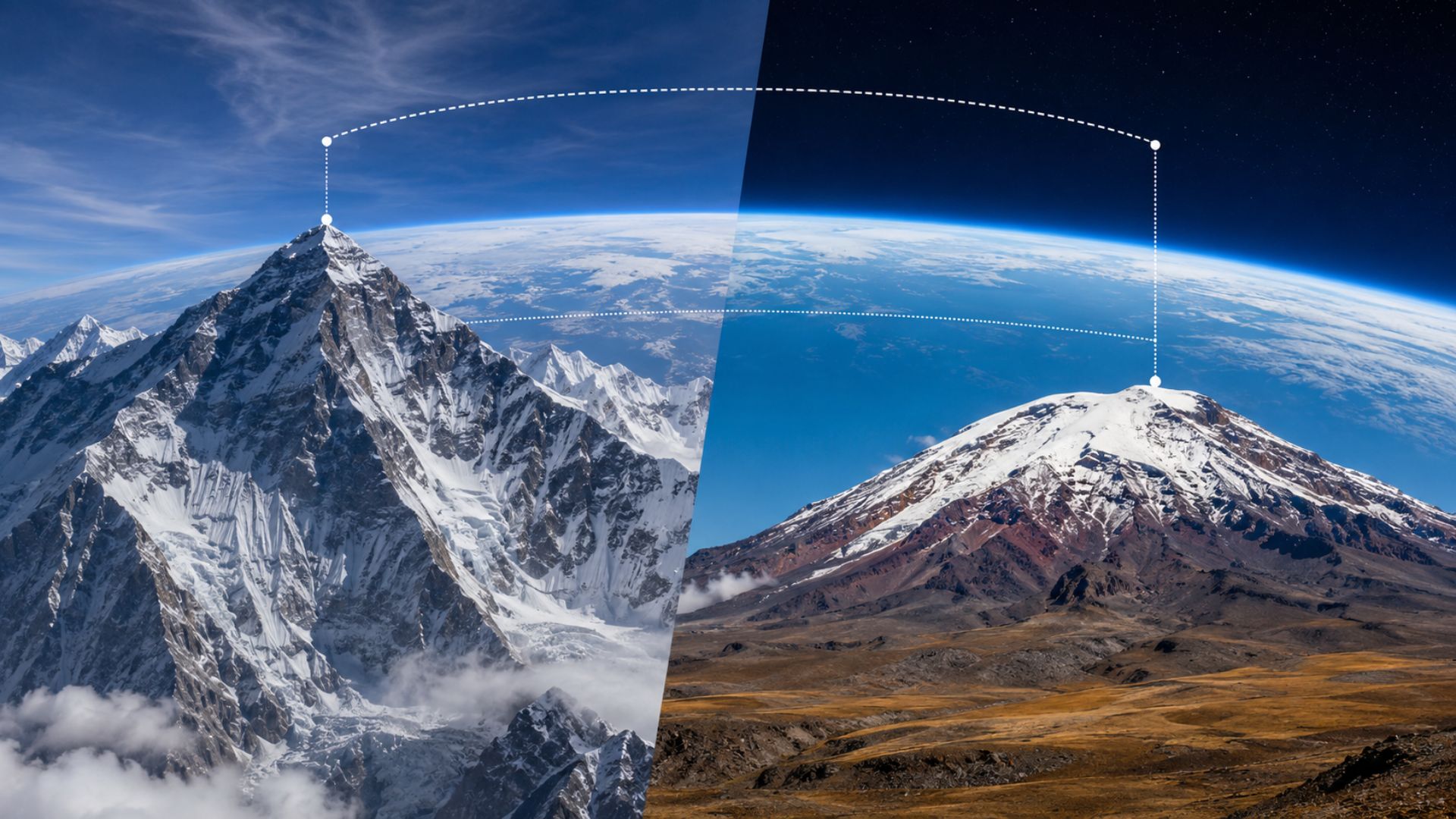

The secret is not in the mountain, but in the shape of the planet. As the Earth is flattened at the poles and wider at the Equator, any point on the equatorial line is already born further from the core. The Ecuadorian volcano only needed to add its height to this geographical advantage to surpass the Asian giant.
Mount Everest is the highest mountain above sea level, but it is not the point on Earth closest to space. Because of the bulge of our planet at the Equator, it is the summit of the Chimborazo volcano in Ecuador that is about 2 kilometers further from the center of the Earth, even though it is much lower than the Himalayan peak. The scientific curiosity resurfaced in May 2026.
The explanation lies in the shape of the planet, and the numbers are precise. Everest, on the border between Nepal and China, has an official altitude of 8,848.86 meters above sea level, agreed upon by the two countries in 2020. Meanwhile, Chimborazo, a dormant volcano in the Ecuadorian Andes, reaches about 6,263 meters in altitude, almost 2,600 meters lower. Still, measured from the planet’s core, it is the volcano that wins the contest, as confirmed by the United States National Oceanic Service.
Why a Lower Volcano Beats Everest

Due to rotation, the planet is flattened at the poles and more “swollen” in the Equator region, in a shape scientists call an oblate spheroid. This means that any point on the equatorial line already starts further from the center than a point of the same altitude near the poles.
-
Scientists warn that melting ice is triggering an alarming chemical transformation in preserved areas, and the first signs are already concerning researchers worldwide.

-
China placed 198 robotic legs under a 7,600-ton school and made the building walk 62 meters in 18 days, rotating the historic structure as if a concrete structure had gained feet to escape demolition.

-
Distributor confirms the premiere of ‘Dark Horse’, Bolsonaro’s film, in 650 cinemas with 99% of copies dubbed.
-
9-year-old boy who could only hold a plank for 6 minutes in physical education class trained alone for 6 months, without needing encouragement from his parents, until he broke the world children’s record with 61 minutes and 5 seconds.


Chimborazo is about one and a half degrees south of the Equator, right on top of this bulge, while Everest is almost 28 degrees north. Measuring from the center of the Earth, the summit of Chimborazo is approximately 6,384.4 kilometers from the core, compared to about 6,382.3 kilometers for Everest. In other words, the volcano wins by about 2.1 kilometers, despite being much lower in altitude.
The bulge is the true star

The sea level at the Equator is about 21 kilometers farther from the Earth’s center than the sea level at the poles, a difference ten times greater than the 2 kilometers that separate Chimborazo from Everest. In numbers, the equatorial sea level is about 6,378 kilometers from the center, compared to 6,357 kilometers at the poles.
This shows that the competition between the two mountains is almost a footnote compared to a much larger effect. Most of Chimborazo’s advantage doesn’t come from the mountain itself, but from where it is located. The equatorial base from which the volcano rises is already farther from the center, and it merely adds its height to this privileged starting point. Not surprisingly, Chimborazo isn’t even the highest peak in the Andes, and at least two dozen other summits are also farther from the center than Everest.
“Closer to space”: what is true and what is exaggerated


Here it is necessary to separate the scientific fact from the exaggeration that often accompanies it. Claiming that Chimborazo is the point “closest to space” is only defensible under a specific definition: that the summit is the point on the Earth’s solid surface that projects the farthest outward, or in other words, has the greatest radius in relation to the center. It is a statement about distance from the core, not about altitude or the atmosphere.
The stronger versions of the story do not hold up. The idea that being on Chimborazo places a person closer to the Sun or the stars is false: the distance from Earth to the Sun varies by about 5 million kilometers throughout the year, more than a million times the 2-kilometer difference between the mountains, and both the Sun and the stars move across the sky. If we consider that space begins at a fixed altitude above sea level, which is the most common convention, then Everest, being much taller, is the one that is closer. Both statements are true, but they answer different questions.
The expedition that measured the Earth’s bulge
The curious thing is that this bulge was not precisely known and was the target of one of the most ambitious scientific expeditions of the 18th century. The French Geodesic Mission, which worked precisely in the Chimborazo region in the 1730s and 1740s, was sent to measure the length of a degree of latitude near the Equator and to find out if the Earth was flattened at the poles or elongated. The results confirmed the flattened and bulging shape.
There is a beautiful irony in this: the expedition went to the foot of Chimborazo to prove that the Earth has a bulge at the Equator, and it is exactly this bulge that today gives the volcano its title. For a long time, Chimborazo was even considered the highest mountain in the world. The naturalist Alexander von Humboldt climbed it in 1802 still under this impression, a belief that only fell when the Great Trigonometric Survey of India measured Everest and its neighbors, a result consolidated in 1856.
And there’s still the tallest mountain from base to peak
To complete the collection of curiosities, it is worth remembering that “tallest” can have yet another meaning. If the measurement is from base to peak, the title of the tallest mountain on Earth belongs neither to Everest nor to Chimborazo, but to Mauna Kea, a volcano in Hawaii that rises from the bottom of the Pacific Ocean and elevates over 10,000 meters, most of which is submerged.
These cases show how an apparently simple question, what is the highest point on Earth, can have different answers depending on where we start measuring: from sea level, from the center of the planet, or from the mountain base. Each is correct in its own way, and together they provide a great lesson on how the shape of our planet holds surprises even in questions that seemed to have ready answers.
The story of Chimborazo versus Everest is one of those facts that challenge what we thought we knew about the world. Everest remains, by far, the highest mountain above sea level, but the Ecuadorian volcano, thanks to the planet’s bulge at the Equator, is the piece of solid land that is furthest from the center of the Earth. More than a contest between mountains, the curiosity is a lesson about the real shape of our planet and about the importance of precisely defining what we are measuring before claiming any record.
And you, did you know that Everest is not the point on Earth furthest from the center of the planet? Were you surprised to discover that a lower volcano holds this title thanks to the Earth’s shape? Leave your comment, tell us what impressed you most about this curiosity, and share the article with that friend who loves geography, science, and surprising facts about our planet.


