






 Portuguese
  Spanish
  3 min of reading
  0 comments


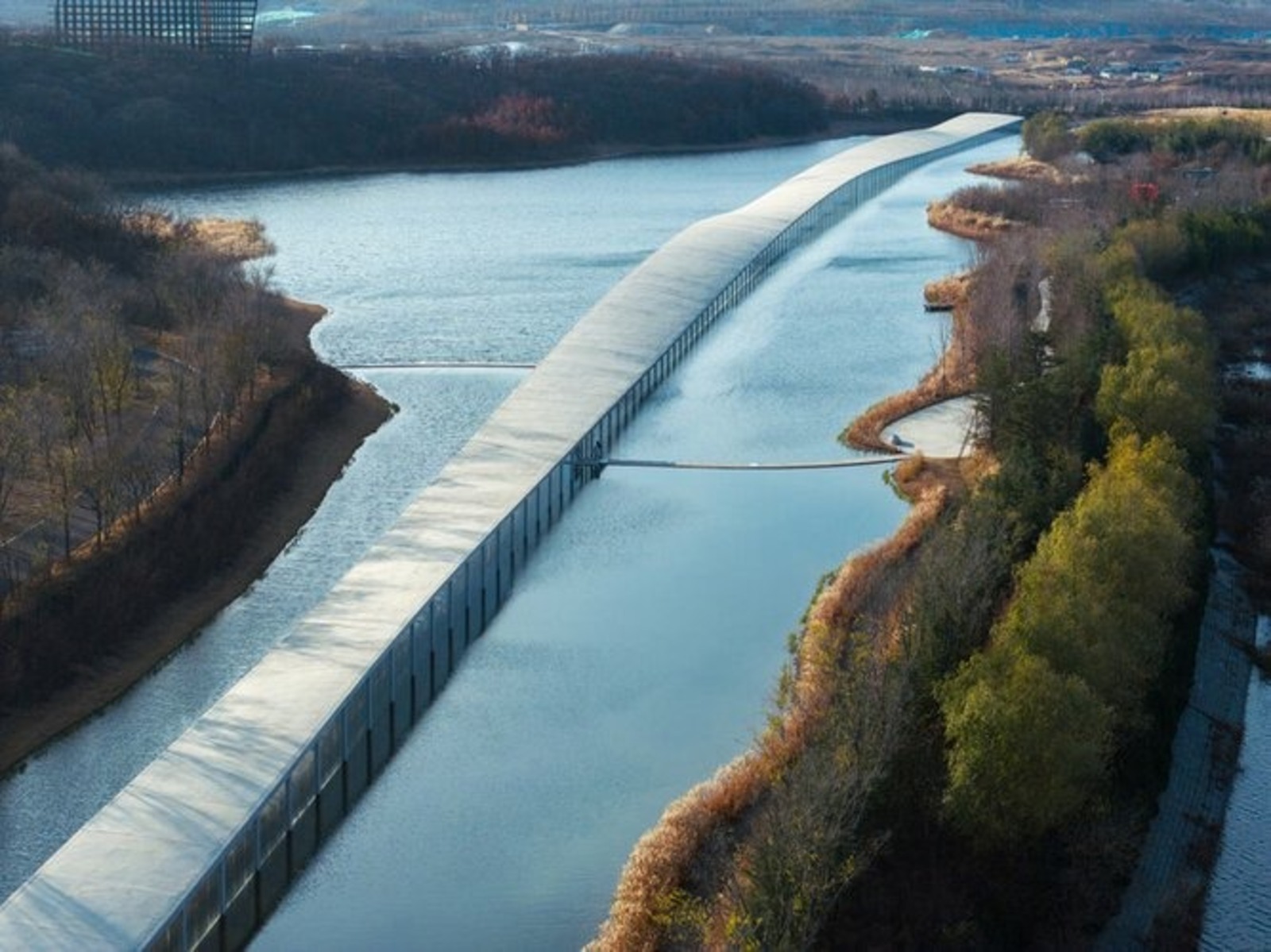
With One Kilometer in Length, the Zaishui Art Museum Integrates Concrete, Glass, and Water in an Artificial Lake, Redefining Cultural Architecture, Urban Landscape, Public Circulation, Regional Tourism, and New Relationships Between Built Space and Nature
Not long ago, China inaugurated the Zaishui Art Museum in Rizhao, Shandong, a one-kilometer structure surrounded by an artificial lake, completed after four years, attracting attention for its scale, landscape integration, and innovative architectural proposal.
Elongated Museum Redefines Architectural Presence in Aquatic Landscape
Located in Rizhao, the Zaishui Art Museum stands out for having one kilometer in length and for being completely surrounded by water from an artificial lake.
The construction draws attention for its architecture that mimics wave curves, creating the visual sensation that the building gently floats on the water’s surface.
-
Survivor of 1966 SS Daniel J. Morrell Shipwreck in Lake Huron Recounts 38-Hour Ordeal in Extreme Cold

-
The Greatest Hoax in World Cup History? The Film That Denied Brazil’s 1958 Victory and Exposed How Fake Evidence Can Seem Convincing on TV
-
Fake South Korean Online Stores Offer Shopping Thrill Without Spending Money or Receiving Products
-
The War of Jenkins’ Ear: How a Severed Ear Sparked One of the 18th Century’s Most Unusual Conflicts


The work was conceived by the firm of architect Junya Ishigami, whose Tokyo office is known for internationally recognized projects in contemporary architecture.
Concrete Structure Invests in Visual Lightness and Continuity
The museum was built with reinforced concrete and steel, a solution that allowed for the creation of a thin, undulating, and visually light covering throughout its length.
With approximately 20,000 square meters, the building spans almost the entire diameter of the lake, connecting one shore to the other in a continuous form.
The support for the roof is provided by 300 parallel columns, distributed along the route, reinforcing the sense of rhythmic repetition and spatial fluidity.
Glass, Water, and Submerged Floor Integrate Interior and Exterior
Between the columns, glass panels were inserted, allowing visitors to observe the landscape while moving through the interior of the museum.
The project includes intentional openings where the floor meets the water of the lake, allowing the liquid to invade parts of the ground.
Even during winter, when the lake freezes on the surface, the water remains liquid and continues flowing into the building’s interior.
Concept Seeks New Relationship Between Architecture and Natural Environment
According to Junya Ishigami, the space creates an environment where the interior follows the exterior, forming a continuous landscape within the architectural piece.
The architect stated that the goal was to show that Chinese architecture does not need to be distanced from the environment, as cited by Dezeen.
He argues that buildings should not appear isolated or abandoned, but rather integrated in a more friendly way with the surrounding nature.
Aquatic Inspirations Guided the Design of the Project
With a variable width between 4.5 and 20 meters, the museum is long and narrow, reinforcing the comparison with historical water channels.
The firm stated it sought inspiration from the canals of Venice, Italy, and from Chinese water cities such as Wuzhen.
The development of the project took four years to complete, respecting the technical limitations imposed by the undulating form.
Variable Ceiling Height of the Museum Creates Internal Visual Effects
The undulating roof causes the ceiling height to vary along the internal path of the museum.
In the higher areas, there is greater entry of natural light, while in the lower zones the water reflects on the ceiling.
This contrast creates striking visual effects, reinforcing the relationship between light, water, and architectural space.
Cultural, Commercial, and Touristic Use Broadens the Space Function
The museum was conceived to host temporary exhibitions, enhancing its flexibility as a cultural space.
Currently, there is an art exhibition whose main theme is chocolate.
In addition to the exhibitions, the building functions as a commercial center and houses a visitor center integrated into the complex.
Paths and Access Reinforce the Invitation for Strolling in the Museum
Alongside the museum, two walking paths have been created, each one kilometer in length, one on each bank of the building.
The proposal is to encourage strolls around the lake, expanding the use of the space beyond the internal areas.
The museum is located in Rizhao, with Qingdao airport being the nearest for those arriving by plane.
Round-trip tickets from Lisbon can be found starting at €696, with the final leg of the journey requiring a bus ride of just over two hours.
With information from Nit.





-

-

-

-

-

6 people reacted to this.