






 Portuguese
  Spanish




Northwestern scientists describe a process that produces methanol without high temperatures and pressures, with high selectivity and potential to reduce emissions in the natural gas chain
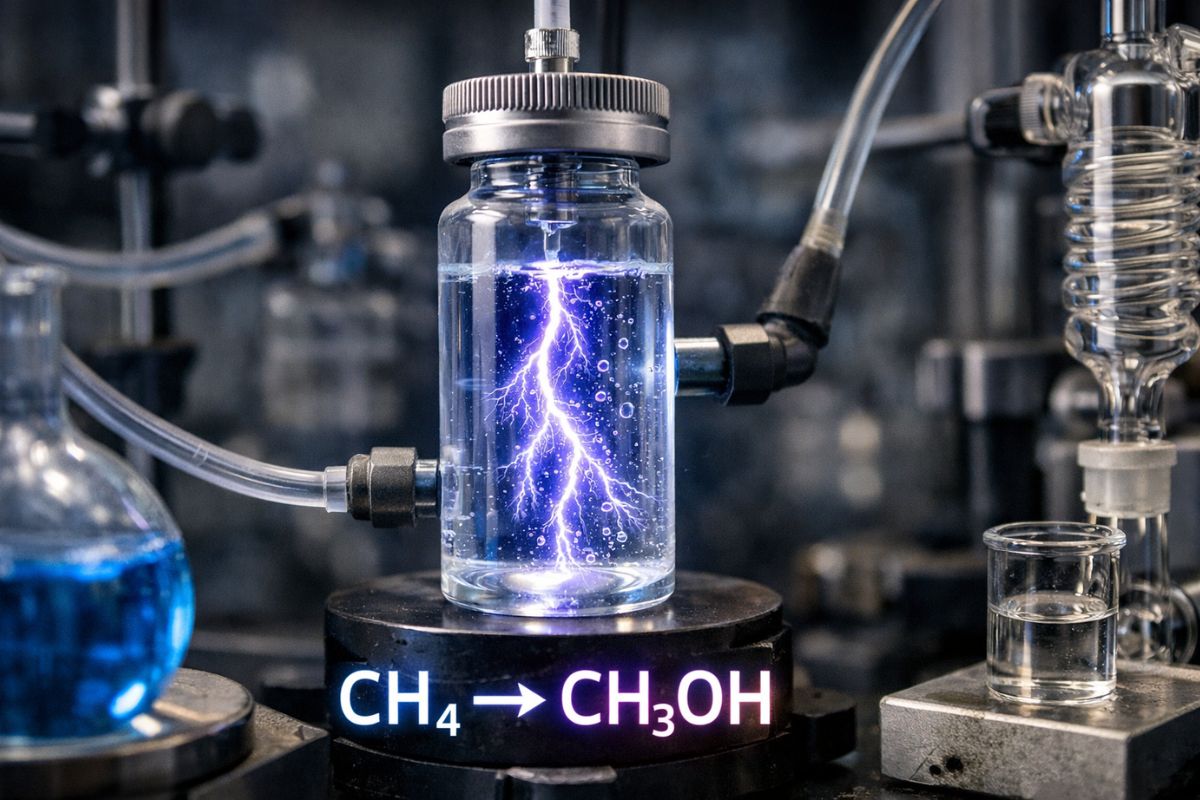
On April 15, 2026, scientists from Northwestern University announced a method that converts methane directly into methanol in a single step, using electric pulses that generate mini bursts of plasma inside glass tubes submerged in water, without resorting to the high temperatures and pressures typical in the industry.
The study, which will be published in the Journal of the American Chemical Society, describes how the team uses electricity, water, and a copper oxide catalyst to produce methanol with lower energy consumption and the prospect of creating cleaner routes for a chemical widely used in plastics, paints, adhesives, and also as a cleaner-burning fuel.
What is “bottled lightning” and why did it make news
The central idea is simple to visualize: high-voltage pulses generate mini “lightning” inside a reactor, creating plasma under conditions close to atmospheric pressure and without heating the entire system. This plasma acts as a chemical tool to break the bonds of methane and direct the formation of methanol.
-
China Develops Custom 140-Ton Electric Mining Truck with 770 kWh Swappable Battery, Deploys 290 Units in Xinjiang’s Largest Zinc Mine

-
Meta to Launch Arena, a New Prediction App Targeting 3.56 Billion Users, Competing with Polymarket and Kalshi

-
Scientist Challenges Famous Human Evolution Theory, Argues Homo Sapiens Evolved Gradually Over Thousands of Years
-
15-Year-Old American Builds Ocean Generator with PVC Pipe and 3D-Printed Propeller for $12, Wins National Prize, Presents at White House, and Makes Forbes 30 Under 30 List




Professor Dayne Swearer, corresponding author of the study, explains that the phenomenon resembles what occurs in a storm, but on a controlled scale within the reactor, using electrical energy to replace extreme heat and compression.
Why is methanol so valuable for industry and energy

Methanol is one of the most widely used chemicals in the world and appears as a key ingredient in high-volume industrial chains.
In addition, it has been gaining traction as a liquid fuel with cleaner combustion in applications such as ships and industrial boilers, as it generates lower emissions of sulfur and particulates compared to gasoline and diesel.
In practice, the interest is not just in manufacturing methanol, but in producing methanol more efficiently and with fewer associated emissions, especially in a scenario of pressure for decarbonization.
How methanol is produced today and why it is expensive in energy
Currently, the industry produces methanol in a multi-step process. First, methane undergoes steam reforming at temperatures above 800 degrees Celsius to become carbon monoxide and hydrogen.
Then, these gases are recombined under very high pressures, 200 to 300 times atmospheric pressure, to form methanol.
This pathway is reliable, but it consumes a lot of energy and generates carbon dioxide throughout the process. The new method aims to shorten the route by eliminating the extreme conditions that make traditional production so intensive.
Cold plasma in water and copper oxide catalyst at the center of the process
To tackle the challenge of breaking down a very stable gas while preventing the product from degrading, the team used cold plasmas, where the molecules remain close to room temperature, but the electrons are selectively energized.
The described reactor functions as a “bubble” plasma reactor: a porous glass tube coated with copper oxide catalyst receives a flow of methane while electric pulses generate plasma. This creates reactive fragments from methane and water, which then recombine to form methanol.
A crucial detail is that methanol immediately dissolves in the surrounding water, which helps to interrupt the reaction at the right moment and reduces the chance of the chemistry proceeding towards carbon dioxide.
The role of argon and the methanol selectivity numbers
To enhance performance, the study describes the dilution of methane with argon. Although it is a noble gas, when ionized in plasma, it begins to participate in the process, increasing electronic density and reducing unwanted byproducts.
Under optimized conditions with argon, the system showed a selectivity of 96.8% for methanol in the liquid mixture. Considering all products formed, both gaseous and liquid, about 57% were methanol. The work also mentions the formation of ethylene and hydrogen, as well as a small fraction of propane.
Why this could change the logic of utilizing methane in the real world
The researchers point out that if the system is scaled up, it could enable smaller, distributed facilities, using electricity to convert methane into methanol and other transportable liquid products.
An example cited is isolated resources, such as leaks in oil wells, where a common solution today is to burn methane to turn it into carbon dioxide.
The proposal is that a smaller-scale reactor could be brought to the site to convert methane into methanol, reducing waste and creating a higher value-added product.
Next steps to separate and recover methanol efficiently
The team claims it aims to optimize the system and explore ways to recover and separate methanol efficiently as a purified product, an essential step for any industrial application.
The study was funded by agencies and foundations mentioned in the statement, including the U.S. Department of Energy, the U.S. Army Research Office, and the David and Lucille Packard Foundation.
Do you think producing methanol in a single step with plasma in water has a real chance of moving from the lab to becoming an industrial solution in the coming years?





