






 Portuguese
  Spanish
  5 min of reading
  0 comments


New Train Connecting São Paulo to Sorocaba Will Bring Important Changes to Mobility, with Variable Fares, Modern Stations, and a Forecasted Operation Soon, Promising to Transform Passenger Transport Between the Capital and the Paulista Interior.
The Government of the State of São Paulo Announced an Important Initiative to Improve Mobility in the State: the Intercity Train Project (TIC) West Axis, Which Will Connect the Capital to the City of Sorocaba, in the Interior Region.
The news is eagerly awaited, especially by those who face increasingly chaotic urban mobility in the city of São Paulo.
The new train, which is expected to be a milestone in the state’s railway transport history, promises to make life easier for thousands of passengers.
-
Survivor of 1966 SS Daniel J. Morrell Shipwreck in Lake Huron Recounts 38-Hour Ordeal in Extreme Cold

-
The Greatest Hoax in World Cup History? The Film That Denied Brazil’s 1958 Victory and Exposed How Fake Evidence Can Seem Convincing on TV
-
Fake South Korean Online Stores Offer Shopping Thrill Without Spending Money or Receiving Products
-
Brazilian Joins Homeownership Consortium, Faces Decade of Dual Payments Totaling $141,000, Surpassing Traditional Mortgage


According to the state government, the public consultation on the project is already underway, and the concession auction, which will define the company responsible for operating the service, is expected to take place in 2025.
The commercial operation of the train, according to projections, will start in 2026.
What is the TIC West Axis?
The Intercity Train (TIC) Will Be a High-Quality Railway Line, Offering Two Service Modalities to Meet Different Passenger Transport Needs: the Express Train and the Local Train.
The express train will be the fastest service, with a direct route between Água Branca Station in the capital and Sorocaba.
Meanwhile, the local train, as the name suggests, will make intermediate stops along the way, allowing passengers to disembark at stations such as Brigadeiro Tobias, São Roque, Amador Bueno, and Carapicuíba.
This range of options aims to cater to both users who prioritize speed and those who prefer a more affordable option but do not mind making a few stops along the route.
How Will the Fare Work?
One of the major concerns of future users is the ticket prices.
The São Paulo government has already released some important information about the fares, although the values may be adjusted as the bidding process progresses and other economic variables come into play.
The fare for the express service will initially be R$ 45.00, with annual adjustments based on the variation of the IPCA, the Broad Consumer Price Index, which measures inflation in Brazil.
This means that the ticket price may experience annual increases, always linked to the inflation rate of the period.
On the other hand, the fare for the local service will be calculated proportionally to the distance traveled.
In other words, those using this service will pay an amount that varies depending on the departure and arrival stations.
For example, a trip between Sorocaba and São Roque (one of the intermediate routes) will cost about 41.52% of the express train fare.
The route from Água Branca Station to Sorocaba, which is the full trip, will represent 100% of the express train fare.
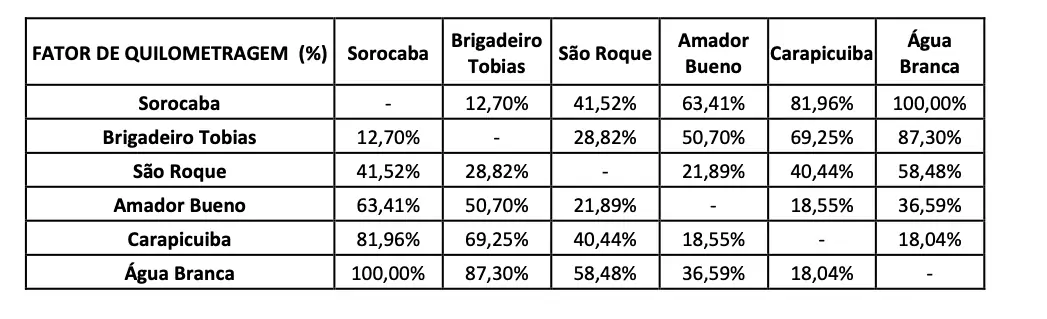
Flexibility in Fares to Improve User Experience
Additionally, the company responsible for operating the train may propose fare variations, based on a range of factors.
For any changes to be validated, ARTESP (Transport Agency of the State of São Paulo) will have to approve the proposed modifications.
Some of the factors that may influence the fares include the frequency of use by the same passenger, travel times, and advance purchase of tickets.
This means that passengers who purchase their tickets in advance or who travel frequently may access discounts, depending on the fare model chosen by the operator.
Moreover, special trains intended for cultural or tourism events may also have differentiated prices, further increasing the fare flexibility of the system.
This is an important point, as it aims to make the service accessible to everyone, while still meeting the needs of specific audiences, such as tourists or passengers who require extra comfort during the trip.
Projections for the Future of the TIC West Axis
The expectation surrounding the Intercity Train (TIC) West Axis is high, especially regarding the reduction of travel time between São Paulo and Sorocaba.
Currently, the car journey between the two cities takes an average of 1h30min to 2 hours, depending on traffic.
However, with the train operation, the travel time is expected to be reduced to less than 1h30min, which represents a significant improvement in the urban mobility of the region.
The modernization of railway transport and the pursuit of sustainable solutions are also part of the project’s objectives, aiming to relieve road traffic, alleviating the congestion that frequently affects São Paulo highways.
The arrival of the TIC West Axis also has implications for other cities in the region.
Sorocaba, which already boasts a large urban and economic structure, may become even more connected to the capital, facilitating the flow of people and goods while also boosting tourism and local commerce.
How the Project May Impact São Paulo’s Mobility?
Over the next few years, the Intercity Train project is expected to become an efficient transport model for the state of São Paulo, directly influencing other initiatives aimed at improving the railway and road systems.
In addition to the TIC West Axis, other train lines and intermunicipal transport are also being planned to facilitate the integration of various regions within the state.
With a more integrated and modern railway system, residents of São Paulo will experience faster and more efficient transport, contributing to reducing the environmental impact of long-distance travel and decreasing the demand for road transport.
The Future of Rail Transport in Brazil
This project also raises questions about the future of rail transport in Brazil as a whole.
Countries such as Japan, Germany, and France already have models of high-speed trains that connect cities in short timeframes.
In Brazil, the TIC West Axis is an initiative that could mark the beginning of a new era for rail transport, with the introduction of new technologies and strategies that enhance the passenger experience.
With this, the TIC West Axis is not just a transport project but also represents a milestone in the effort to modernize transport infrastructure in the country.
Expectations are high, and many wonder if this will be the first of many other train lines that could transform mobility in Brazil.





Be the first to react!