






 Portuguese
  Spanish


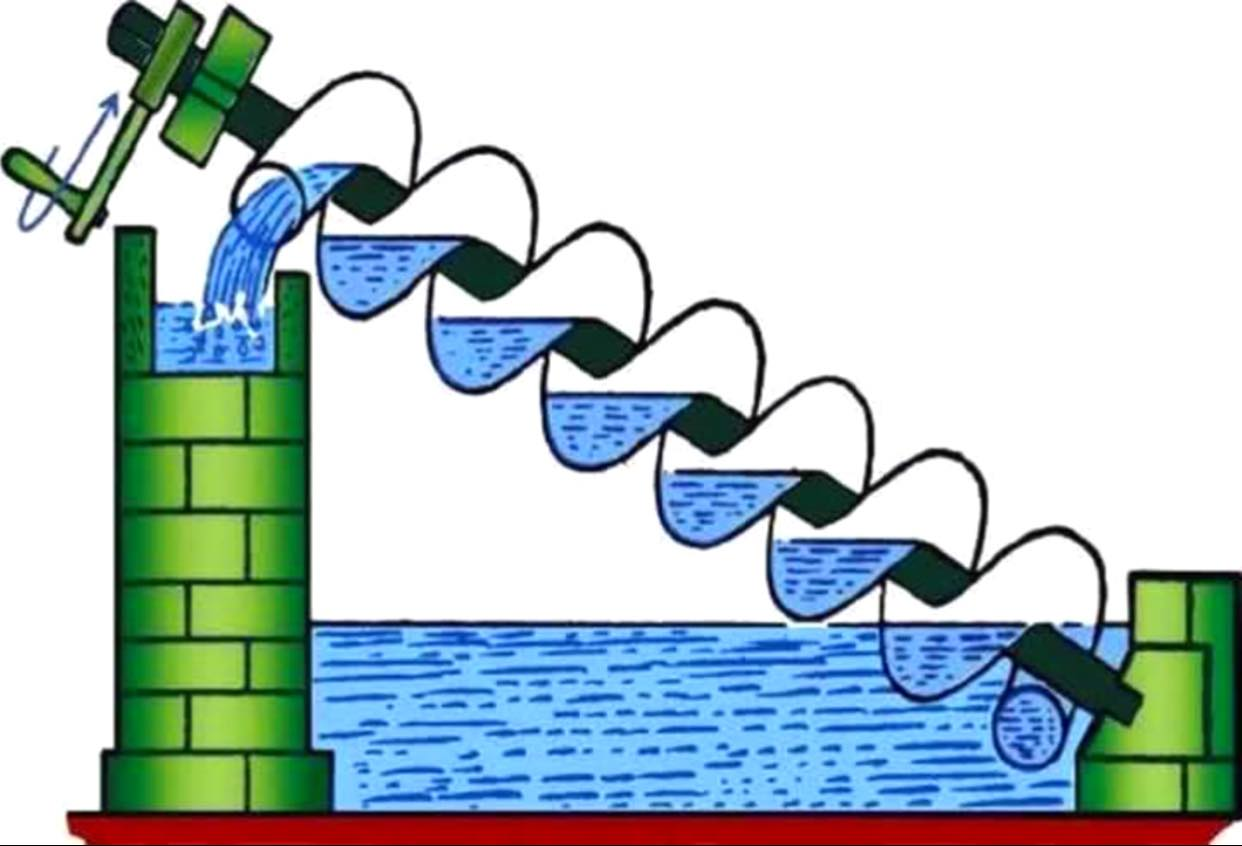


The Advancement of Engineering Has Always Been Linked to the Need to Solve Practical Problems. One of the Challenges of Ancient Times Was to Transport Liquids Efficiently, Which Led to the Development of the Archimedes Screw, an Ingenious Invention That Revolutionized Hydraulic Systems and Remains Influential to This Day.
Archimedes Solved One of the Greatest Challenges of Antiquity: How to Lift Liquids Simply and Efficiently. The Mathematician and Inventor Created a Device That Facilitates This Task: the Archimedes Screw.
The Structure Consists of a Large Screw in a Tube, Which Does Not Need to Be Completely Sealed. By Turning the Mechanism, the Liquid Is Captured and Transported in a Spiral to the Upper End, Where It Is Discharged.
The Force Needed for the Movement Can Come from a Manual Crank, Animals, Wind-Powered Blades, or Even Tractors.
-
Engineers Develop Jacket That Converts Air Humidity Into Drinkable Water, Producing Up to 900 ml Daily for Hikers, Campers, Rescuers, Rural Workers, and Military in Remote Areas

-
NASA Plans to Repurpose Mars Rover for Lunar Mission, Sending a 1-Ton Nuclear-Powered Vehicle to Explore the Moon’s South Pole Without Solar Dependence
-
Early Humans Made Beds Nearly 200,000 Years Ago in African Caves, Study Reveals

-
Japanese Smart Bike Detects Cyclist’s Intent to Turn and Potential Falls


The Historian Diodorus Siculus and the Writer Athenaeus Credit the Invention to Archimedes. However, Recent Research Indicates That the Idea May Have Emerged Earlier. It Is Believed That the Mechanism Was Used in the Irrigation of the Hanging Gardens of Babylon.
Influence on the History of Science
Archimedes Studied Physics and Mathematics with a Rigor That Influenced Generations. His Studies Had an Impact in Antiquity and Were Rediscovered During the Renaissance, Inspiring Scientists Who Shaped Modern Science.
One of the Greek’s Admirers Was Galileo Galilei, Who Analyzed the Functioning of the Archimedes Screw in His Work Le Meccaniche. He Described the Mechanism as “Wonderful and Miraculous”, Highlighting Its Efficiency.
The Importance of Archimedes Was Not Limited to the Study of the Screw. His Discoveries Are the Basis for Principles of Hydrostatics and Mechanical Engineering. His Legacy Remains Present in Scientific Studies and Current Technological Practices.
Modern Use of the Archimedes Screw
Despite Its Ancient Origin, the Archimedes Screw Is Still Used. The Technology Is Applied in the Transportation of Solid, Liquid, and Gaseous Materials. The Method Is Also Efficient in Areas with Water Level Differences, Allowing the Movement of Water from One Point to Another.
Additionally, the Mechanism Plays an Important Role in Generating Electric Energy. A System of Turbines Coupled to a Generator Uses the Screw’s Movement to Convert Mechanical Energy into Electrical Energy.
In This Process, Water Enters the System at a High Point and, with the Force of Gravity, Activates the Rotation of the Screw’s Shaft. The Energy Generated by the Movement Is Transferred to a Generator, Which Converts This Force into Electricity.
The Differentiator of This Technology Is Not in the Speed of Rotation but in the Force of the Impulse Generated by the Movement of the Fluid.
This Characteristic Makes the Archimedes Screw a Viable Option for Energy Capture in Regions with Moderate Waterfalls.
The Solution Created by Archimedes Has Traversed Centuries and Remains Relevant. Its Simplicity and Efficiency Ensure Applications in Various Sectors, Ranging from Irrigation to Sustainable Energy Production.


Essa ideia ficou registrada, mas quantas se perderam porque eram transmitidas apenas oralmente…