Portuguese
  Spanish


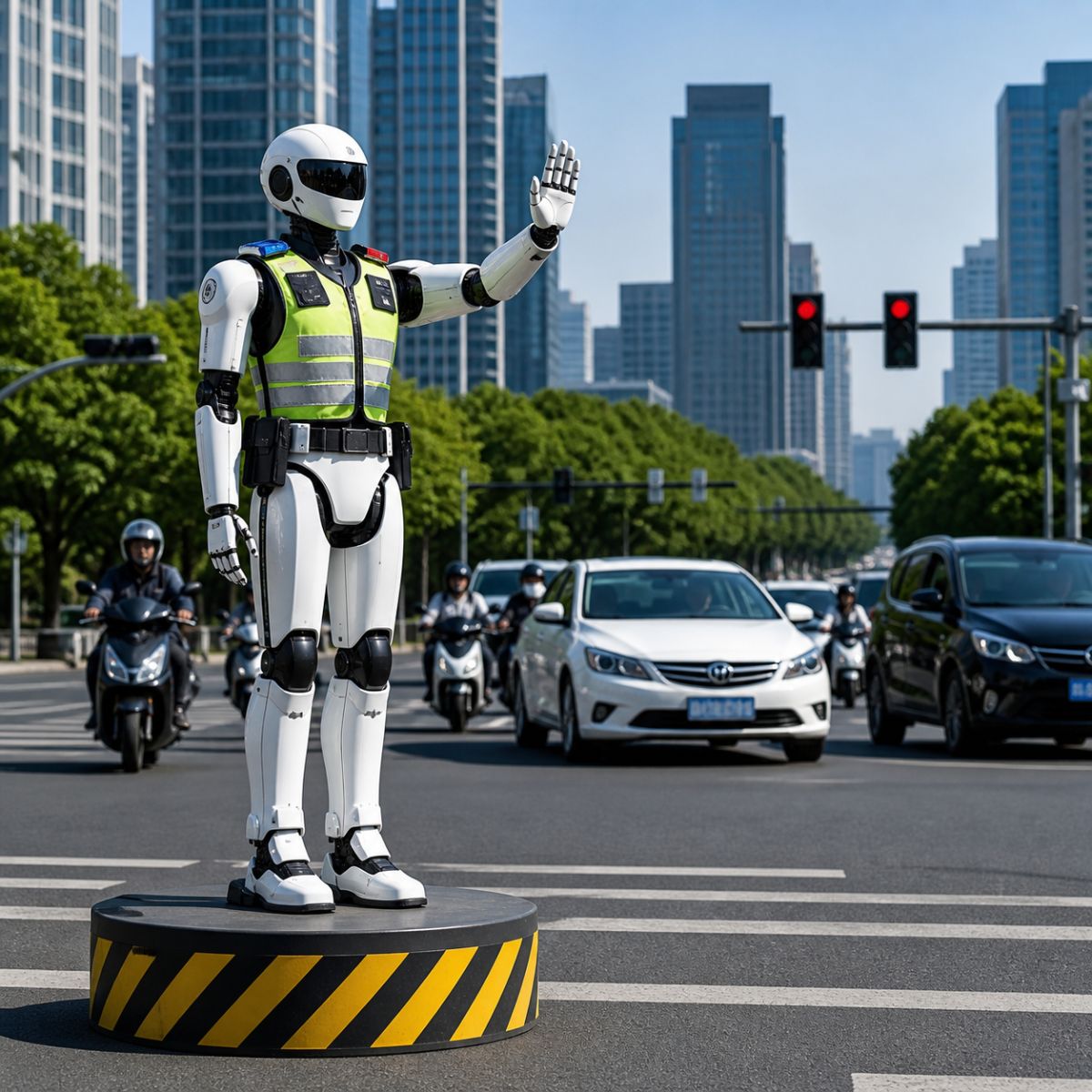

China deployed a squadron of 15 artificial intelligence robots at central points in Hangzhou during the Labor Day holiday, with additional units in Kashgar (Xinjiang) and Ordos (Inner Mongolia), totaling 18 machines across three cities. According to the state agency Xinhua, the robots manage pedestrian and vehicle traffic, identify infractions with computer vision, interact by voice with a language model, and operate for 8 to 9-hour shifts before needing to be recharged. Hangzhou was chosen as a showcase for being home to Alibaba, DeepSeek, and other AI hubs.
China deployed robots with artificial intelligence to monitor traffic in three cities during the Labor Day holiday, and the result is a scenario that seems straight out of science fiction but is a modest-scale pilot phase. There were 15 units in Hangzhou, the capital of Zhejiang province, two in Ordos (Inner Mongolia), and at least one in Kashgar (Xinjiang), totaling 18 machines operating at busy intersections assisting human police in traffic management, according to a report by the state agency Xinhua published on May 3.
The technical capabilities are impressive, even on a reduced scale. The robots have a language model for voice interaction with pedestrians and drivers, computer vision algorithms that identify infractions such as motor scooters crossing stop lines and riders without helmets, millisecond-scale synchronization with traffic lights, and a repertoire of eight standardized traffic gestures. The machines monitor 24 hours a day when on a rotation system, but each unit operates for 8 to 9 hours before needing to be recharged.
What the robots do on the streets of Hangzhou

The 15 robots were positioned at busy intersections and in the West Lake tourist area of Hangzhou, one of China’s most visited regions during the holiday. The machines manage pedestrian and non-motorized vehicle traffic, offer guidance to tourists by voice, and assist human police in enforcement, a model local authorities describe as “human-machine collaboration.”
-
Scientists Develop Needle-Free Insulin That Penetrates Skin, Reduces Glucose in Animals Within an Hour, Paving the Way for Diabetes Patches and Creams for Humans

-
After 40 Years of Research, Powdered Coconut Water to Be Produced in Brazilian Biorefinery, Aiming to Revolutionize Health for Children, Elderly, and Hospital Patients
-
Queen Guitarist Brian May Collaborates with ESA Scientists to Study Asteroids Bennu and Ryugu Using 3D Simulations
-
Largest Known Single-Piece Meteorite, Weighing 60 Tons, Puzzles Scientists with Its Intact Fall and Lack of Visible Crater



Chen Sanchuan, a traffic police officer in Hangzhou, told Xinhua that the introduction of the squadron significantly eased the workload of human police during the peak holiday traffic. In practice, the robots take on repetitive tasks such as directing pedestrians at crossings and enforcing low-complexity infractions, freeing up officers for situations requiring human judgment, such as accidents, conflicts between drivers, or emergencies.
Kashgar and Ordos: the other two pilot program cities
The deployment was not limited to Hangzhou. In Kashgar, in China’s far west Xinjiang region, at least one uniformed robot was positioned at a busy intersection with a high-definition camera on its head. In Ordos, Inner Mongolia, two units have been operating since May 1 on tasks of traffic direction, road safety education, and intelligent patrols.
Wu Qingyun, an Ordos police officer, told Xinhua that the deployment freed up human personnel and paved the way for more refined urban management. It is important to contextualize that Xinjiang, where Kashgar is located, has been the focus of international reports from organizations such as Human Rights Watch and Amnesty International regarding the use of large-scale surveillance technologies, questions that the Chinese government rejects. The use of AI robots in the region adds a layer to the debate.
Why Hangzhou was chosen as a showcase


Hangzhou is not just any city in China: it is the country’s technological capital outside Beijing and Shenzhen. The city is home to Alibaba, Ant Group, DeepSeek, NetEase, DeepRobotics, and Unitree Robotics, a concentration of AI and robotics companies that makes Hangzhou the natural laboratory for any deployment of advanced technology that the Chinese government wants to showcase.
The choice is symbolic and strategic. Hangzhou has over 12 million inhabitants and digital infrastructure that allows robots to be integrated into smart traffic light systems, monitoring cameras, and real-time traffic databases. The local technological ecosystem provides the components, talent, and infrastructure that enable the pilot, and its success there serves as an argument for expansion to other Chinese cities.
The real scale: 18 robots do not replace police officers
It is crucial to honestly dimension the deployment. Eighteen robots distributed across three cities, one of which has over 12 million inhabitants, are an experimental pilot, not a revolution in policing. China has about 2 million police officers, and 18 machines represent a statistically irrelevant fraction of the force.
What the case demonstrates is the direction, not the scale. China has been deploying robots in policing and security functions since 2017, when the “AnBot” was installed in airports, and the escalation in recent years indicates that the government plans to progressively expand the use of AI in urban governance. Jiang Lei, described by Xinhua as a researcher at a national robotics center, assessed that the deployment “marks a decisive moment” and predicts that more sectors will adopt automation.
The global debate on automated policing
Xinhua’s enthusiasm for police robots does not find unanimous echo in the international debate. Digital rights organizations worldwide, including Brazilian ones like InternetLab and Data Privacy Brasil, have warned about the risks of automated policing: algorithmic bias in computer vision systems that can discriminate against minorities, the absence of a clear accountability mechanism when a robot makes a mistake, and the potential for mass surveillance disguised as traffic management.
The question is not whether robots can monitor traffic, because technically they can. The question is who supervises the machines, how the captured data is stored and used, and what happens when the system makes a mistake. In a country where public debate about state surveillance is limited, these questions remain unanswered, and the Chinese model of “urban governance with AI” advances without the counterweight of independent scrutiny that exists in democracies.
Would you accept being monitored by a robot in your city’s traffic or do you think automated policing is a threat to privacy? Tell us in the comments what you think about China using artificial intelligence in policing and if you believe this model could come to Brazil.