






 Portuguese
  Spanish
  5 min of reading
  1 comment


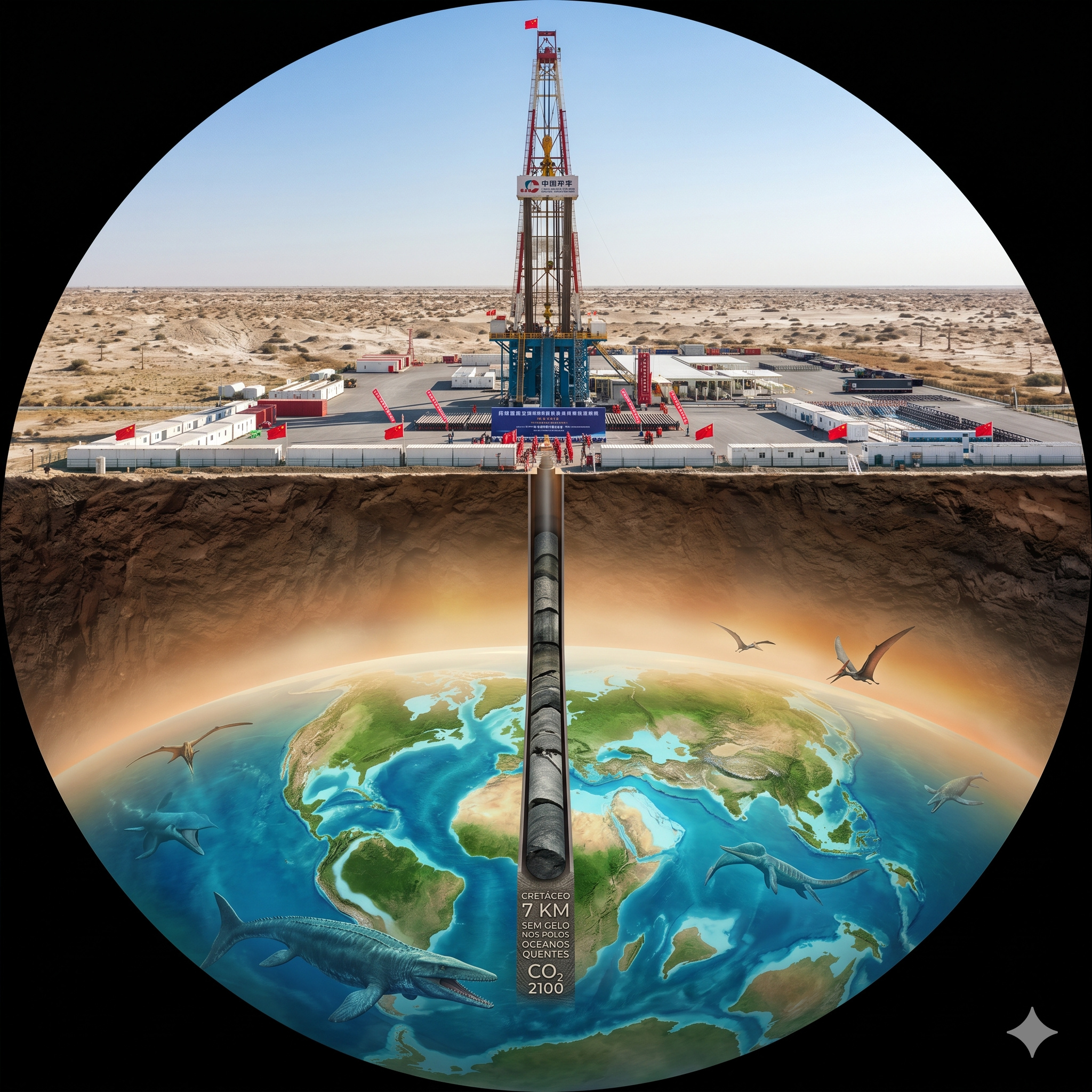


7 km Drilling in China Reveals Cretaceous Climate Without Ice at the Poles, with Warmer Oceans and CO₂ Similar to Projections for 2100.
Among the most ambitious projects in recent geology, the deep drilling in the Songliao Basin, in northeast China, has opened an unprecedented window into Earth’s climatic past. Led by Professor Wang Chengshan from the China University of Geosciences, within the International Continental Scientific Drilling Program, the work recovered about 7 kilometers of continuous sediment core.
This material records, with an unusual richness of detail, the environmental conditions of the Cretaceous period, which spans approximately between 145 and 66 million years ago. Unlike fragmented marine records, this continental core is considered unique for preserving a practically uninterrupted sequence of climatic events in a terrestrial environment.
It is one of the most complete natural archives ever obtained about a planet in a state of extreme greenhouse.
-
Helicopter Drops 180 Tons of Sand and Gravel on Swedish River to Revive Ecosystem Damaged by Decades of Exploitation

-
Brazilian Company Launches Retro Smartphone with 48 MP Camera, T9 Keyboard, and Privacy Features for Social Media-Free Use

-
Self-Taught Chinese Farmer Builds 5-Ton Submarine from Scrap, Launches It in Anhui River
-
Invisible Induction Technology Enables Wireless Power for Blenders, Coffee Makers, and Air Fryers, Reducing Countertop Cables




Cretaceous Reveals a Planet Without Ice at the Poles and Much Warmer Oceans
The period recorded by the drilling corresponds to a phase when Earth operated under conditions radically different from today. There were no ice caps at the poles, and the oceans had significantly higher temperatures.
Estimates indicate that ocean waters could have been up to 10 °C warmer than today, while the concentration of carbon dioxide in the atmosphere was between two and four times higher than pre-industrial levels.
These conditions created a warmer global climate system, with greater evaporation, changes in the hydrological cycle, and different distribution of ecosystems.
The planet functioned as a natural greenhouse system, without the thermal balance provided by polar ice masses.
Sediment Core Preserves Detailed Signs of the Hydrological Cycle and Biodiversity
Throughout the 7 kilometers of extracted material, scientists identified variations in sediments, microscopic fossils, chemical composition, and other indicators that reveal environmental changes over time.
These records allow the reconstruction of:
- patterns of rain and drought
- temperature variations
- changes in biodiversity
- chemical composition of the water
The continuous sequence is especially valuable because it allows observation of how these factors evolved without major interruptions.
Each layer functions as a direct record of environmental conditions at different times of the Cretaceous.
Giant Continental Lake Functioned as a Natural Climate Archive
During the Cretaceous, the Songliao Basin housed a vast continental lake that accumulated sediments over millions of years.
This lacustrine environment favored the continuous preservation of records, protecting the layers from erosion and allowing the material to accumulate relatively stably.
Unlike oceanic environments, where currents can mix sediments, the lake acted as a more controlled system. This explains why the recovered core is considered one of the most complete ever obtained for this period.
Data Help Understand How the Planet Reacts to High Levels of CO₂
One of the main objectives of the research is to understand how the climate system responds to high concentrations of carbon dioxide.


The levels recorded in the Cretaceous are comparable to projections made by climate models for the future, especially considering high emission scenarios by the end of the century.
By studying this period, scientists can observe:
- behavior of global temperatures
- ocean response
- changes in the water cycle
- impact on ecosystems
The past becomes a concrete reference for understanding possible future scenarios.
Climate models depend on past data to predict the future
Modern climate simulations need to be calibrated with real data to ensure greater accuracy. The Songliao Basin record provides exactly this type of information, allowing validation of models that project future changes.
Without this type of reference, models would rely solely on theoretical extrapolations. The core acts as a natural test to verify if climate predictions make sense given conditions already experienced by Earth.
Comparison with the present reinforces the magnitude of projected changes
By comparing the current climate with the Cretaceous, scientists observe fundamental differences, but also points of convergence.
Today, the planet still has ice at the poles and more moderate temperatures. However, the increase in CO₂ concentrations could lead the climate system to conditions closer to those recorded in the geological past.
This comparison does not indicate that the future will be identical to the Cretaceous, but it shows that there are natural precedents for high levels of greenhouse gases. What changes is the speed at which these conditions can be reached.
Continuous record allows observation of changes over millions of years
One of the greatest advantages of the Songliao core is the ability to track transformations over an extremely broad temporal scale.
While human historical records cover only a few thousand years, this archive allows analysis of processes that unfolded over millions of years.
This helps to understand:
- natural climate cycles
- extreme events
- periods of stability and transition
The temporal scale significantly broadens the understanding of how the climate system functions.
Research integrates global effort to reconstruct Earth’s environmental history
The project is part of an international network of studies that seek to map the evolution of climate in different regions and periods. These efforts combine data from:
- continental drilling
- oceanic sediments
- polar ice
- biological records
The integration of this information allows for a more complete picture of the planet’s environmental history.
The Songliao Basin plays a central role in this effort by offering a unique record of the continental Cretaceous.
What can a planet without polar ice reveal about the future?
With a 7-kilometer core that records a period when Earth operated under conditions very different from today’s, the research opens a rare perspective on the behavior of the climate system in extreme scenarios.
The Cretaceous shows that the planet can function without polar ice, with warmer oceans and elevated CO₂ levels — conditions that climate models consider possible in the future.
The direct question that arises is: to what extent can the study of this distant past help anticipate the limits and consequences of the climate changes unfolding for the 21st century?





Please keep me informed of the progress and finding and coud they go deeper