






 Portuguese
  Spanish
  5 min of reading
  0 comments


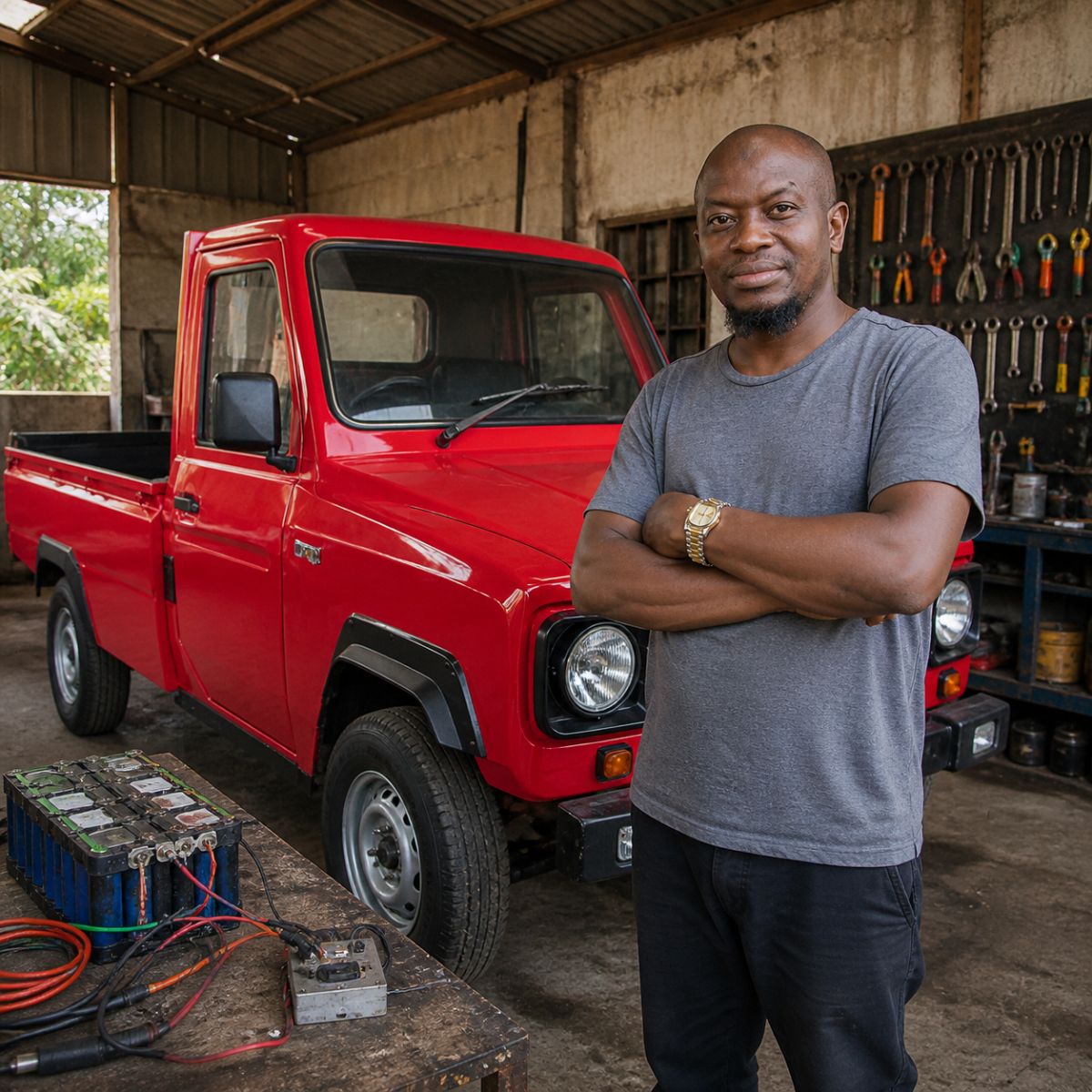
Ally Masoud, known by the nickname “Kipanya” (little mouse in Swahili), is a political cartoonist and founded Kaypee Motors in 2020 to build the first electric pickup truck manufactured in Tanzania. The updated KP A72E model promises a range of up to 160 km per charge, with an operating cost of about US$3 per day compared to US$20 for gasoline. The country already has about 10,000 electric vehicles in circulation, according to the Africa E-Mobility Alliance, and approved the National Electric Vehicle Policy Framework in December 2024.
In a small workshop in Dar es Salaam, the commercial capital of Tanzania, a political cartoonist decided he could draw more than just cartoons. Ally Masoud, known by the nickname “Kipanya,” built a handmade electric pickup truck in about 11 months of manual labor, as part of a project that spanned approximately two years since its conception in 2020. The vehicle, named KP A72 by Kaypee Motors, a company founded by Masoud himself, was unveiled in April 2022 at Mlimani City shopping mall and has since evolved into the KP A72E version, with a range of up to 160 kilometers per charge.
The most impressive fact is not the car itself, but what it does to the fuel bill. According to the Ministry of Energy of Tanzania, the average cost of travel per kilometer in gasoline or diesel vehicles is 200 Tanzanian shillings, compared to only 25 shillings in electric vehicles, an 87.5% reduction. Owners of the Kaypee electric pickup report that they went from US$20 per day on gasoline to US$3 per day on recharge, a saving that in a country where imported fuel weighs heavily on workers’ pockets can be the difference between profit and loss for small traders and delivery drivers.
Who is Kipanya and how a cartoonist became a car manufacturer

Ally Masoud was about 49 years old when he presented the first prototype and is known in Tanzania and parts of Africa for the sharp lines of his political cartoons, published under the pseudonym “Kipanya.” In addition to being a cartoonist, Masoud is a radio host and owner of the Kipanya Wear clothing brand, a serial entrepreneur profile that helps explain how someone without an engineering background decided to build a car from scratch.
-
Helicopter Drops 180 Tons of Sand and Gravel on Swedish River to Revive Ecosystem Damaged by Decades of Exploitation

-
Brazilian Company Launches Retro Smartphone with 48 MP Camera, T9 Keyboard, and Privacy Features for Social Media-Free Use

-
Self-Taught Chinese Farmer Builds 5-Ton Submarine from Scrap, Launches It in Anhui River
-
Invisible Induction Technology Enables Wireless Power for Blenders, Coffee Makers, and Air Fryers, Reducing Countertop Cables



The project started as an idea in 2013, became concrete action in July 2020, and faced delays caused by the Covid-19 pandemic. The chassis and body are manufactured locally in the Dar es Salaam workshop, while the motor and battery are imported from China, a production model that reduces costs and allows for artisanal assembly with industrial-quality components. Masoud told the Xinhua agency that “you don’t need to be an engineer to build a car — you need passion and coordination skills.”
The evolution of the KP A72 to the KP A72E

IMAGE: Kaypee Motors
The original version of the electric pickup truck, presented in 2022, had a range of 50 to 60 kilometers and took about 6 hours to fully recharge. The current version, named KP A72E on the official Kaypee Motors website, is described as an advanced variant with improved efficiency and promises the 160 kilometers of range that make the vehicle viable for daily commercial use in a city like Dar es Salaam.

image: Kaypee Motors
The target audience is low-income **traders** and **delivery drivers** who rely on utility **vehicles** for work and spend a disproportionate share of their income on **fuel**. **The compact electric pickup offers a cargo bed, dramatically lower operating costs, and simpler maintenance** than a combustion **vehicle**, a triad that positions the product as a work tool, not an aspirational consumer item. The initial **price** reported by the press in 2022 was around US$3,500, a value that needs confirmation for the current version.

Tanzania and its 10,000 electric vehicles
**Kaypee** Motors does not operate in a vacuum. **Tanzania already has about 10,000 electric vehicles in circulation, according to the Africa E-Mobility Alliance**, mostly consisting of **motorcycles** and tricycles (bajajis) with lead-acid batteries. This number places the country as a regional leader in East **Africa** in **electric** **mobility** adoption, ahead of neighbors like **Kenya** and Uganda.
In December 2024, **Tanzania** approved the National **Electric** **Vehicles** Policy Framework, setting integration goals between clean **mobility** and renewable **energies** and planning the construction of national **charging** infrastructure. **The country has an installed capacity of over 4,500 MW of electricity and grid access for 85.5% of the population**, according to the Ministry of **Energy**, a base that allows for scaling transport electrification without relying exclusively on fossil **fuels**.
The electric mobility ecosystem growing in Dar es Salaam
**Kaypee** Motors is the most visible company, but it is not the only one in the Tanzanian ecosystem. **TRÍ Tanzania produces electric tricycles and plans hundreds of units for Dar es Salaam**, Arusha’s E-Motion retrofits combustion engines to **electric** in safari **vehicles**, SPIRO launched a **battery** swap operation in the commercial capital in 2025, and DOW ELEF AUTO EV was inaugurated in March 2026. The scenario is one of a rapidly forming **market**.
The biggest bottleneck is **recharging** infrastructure. **Tanzania has only about 15 public charging stations, concentrated in Dar es Salaam**, which forces most **electric** **vehicle** owners to charge at home outlets. For the **Kaypee** **pickup**, which serves **delivery drivers** who travel dozens of **kilometers** per day, this limitation means carefully planning routes and ensuring a full **charge** overnight. The government’s goal is to reach 500 stations by 2030.
International interest and what Kipanya plans for the future


The project has attracted attention beyond **Tanzania**. **According to international reports, Kenyan President William Ruto and representatives from the Kingdom of Eswatini have shown interest in the Kaypee Motors electric pickup**, although details of these negotiations have not been confirmed by independent sources. For Masoud, regional interest validates that affordable **electric** **mobility** has demand across East **Africa**.
**Kaypee** Motors is already working on a new model and has orders in its portfolio. **Masoud stated that the goal is “to make electric vehicles accessible to everyone”**, an ambitious goal for an artisanal company competing in a **market** where Chinese automakers like BYD and Indian manufacturers already operate. For comparison, neighboring Ethiopia banned the import of combustion **vehicles** in 2024 and already has over 120,000 **electric** **vehicles** in circulation, showing that the continent’s potential goes far beyond what is imagined.
Would you buy a handmade electric pickup truck made by a cartoonist, or do you think this type of vehicle only works in markets without options? Tell us in the comments if you believe Brazil could produce a popular electric vehicle for US$3,500 and what you think about electric mobility in Africa.





Be the first to react!