Portuguese
  Spanish



Is It Possible to Fire a Gun in Space? Understand What Really Happens with the Gun and the Shooter.
Space travel has always aroused curiosity. In addition to scientific advancements, it reveals surprising details about how physics works outside of Earth. One of these unusual questions is: can you fire a gun in space?
The question may seem like something out of science fiction, but the answer involves real science. And yes, technically, it is possible to fire a gun in space. But it’s not that simple. Let’s understand why.
Do Guns Work in Space?
Yes, guns can work in space. This is because they do not depend on external oxygen to fire.
-
Tokyo Scientists Create First 18cm Biohybrid Hand Using Human Muscle, Capable of Scissor Gesture and Holding a Pipette

-
Brazil Faces Norway in World Cup at Stadium Linked to Jimmy Hoffa’s Mysterious Disappearance

-
Retired Woman Leaves French Public Housing Due to Fear, Lives in Van for Weeks, Prompting Response from Local Authorities and a Priest
-
9-Year-Old Fabio Isaac Wins Gold at Copernicus Math Olympiad in Singapore, Representing Peru Against Global Young Talents




The secret lies in the cartridge, which already comes with an oxidizing agent capable of igniting the gunpowder, as explained by the BBC Science Focus.
Another important detail: the bullet is loaded into the chamber by an internal spring, not by gravity.
In other words, even in the absence of weight, the firing mechanism continues to operate normally.
Can the Space Environment Affect the Gun’s Operation?
Here things get complicated. Space is an extreme environment, with severe temperature variations. In very cold places, the metal of the gun may contract and jam the mechanism. In high temperatures, overheating can compromise firing.
Furthermore, moving parts may wear out or jam more easily since there is no air to assist in cooling or lubrication. In other words, despite being theoretically functional, a standard gun could present serious failures outside of Earth.
What Happens to a Bullet Fired in Space?
This is one of the most fascinating parts of the question. On Earth, the bullet is quickly pulled by gravity and decelerated by air resistance.
In space, however, there is no air resistance or significant gravity, which means the bullet can travel in a straight line indefinitely—until it hits something.
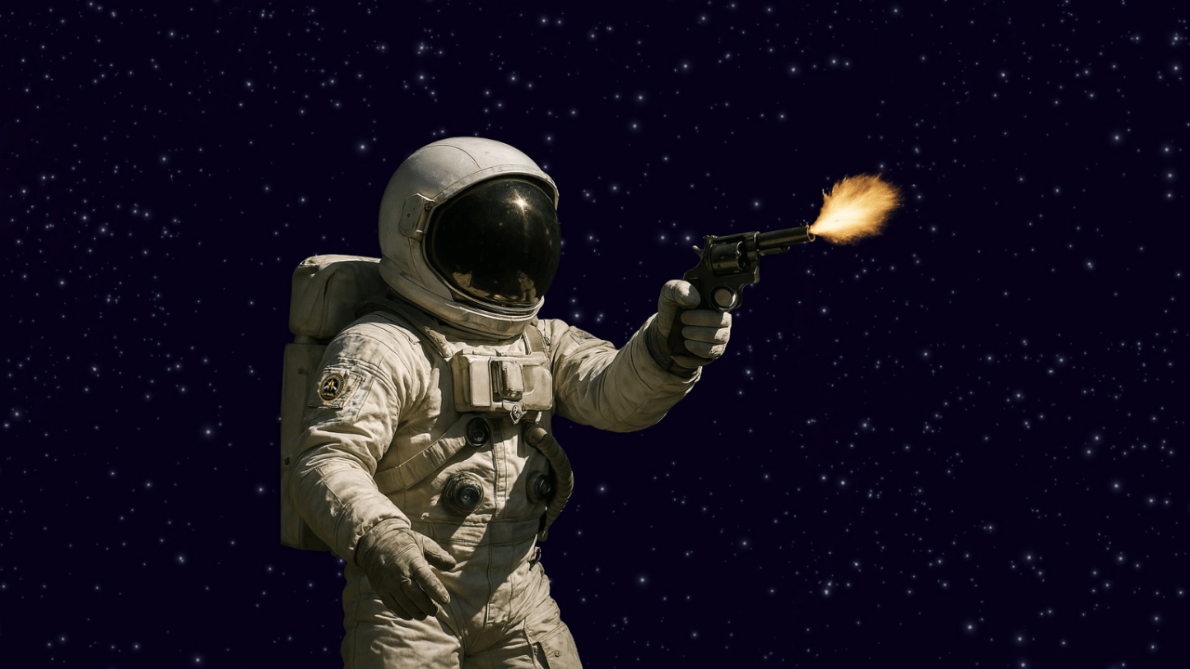
In other words, a bullet fired in space can travel for thousands of kilometers without stopping if it does not encounter an obstacle along the way.
And the Shooter? What Happens to Them?
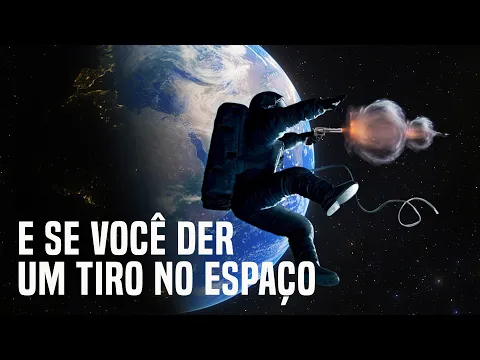
Now comes the applied physics: when firing a gun, there is the famous recoil—that “kick” we feel when pulling the trigger. On Earth, our feet planted on the ground absorb this force. But in space, without gravity and without a point of support, the shooter would be pushed backward with the same force as the shot.
This could cause them to float in continuous motion until they hit something or use thrusters to stabilize themselves. In short: in addition to the risk of the shot, there is also the risk of “flying” in space.
Has Anyone Ever Fired a Gun in Space?
Surprisingly, yes, this has happened. In 1975, during the Cold War, the Soviet Union equipped its Salyut-3 space station with a R-23M rapid-fire cannon. The objective? To test the defense of satellites against external threats.
According to historical records, the cannon was fired remotely and shot about 20 projectiles, which burned up upon re-entering the Earth’s atmosphere. To this day, this was the only shot officially fired in space.

Do Astronauts Take Guns to Space?
Surprisingly, some missions have taken guns, but not for military purposes. For years, Russian cosmonauts carried a TP-82 pistol as a survival item in case they landed in remote areas on Earth upon return.
However, the idea of taking guns for use in a space environment is rare and surrounded by ethical and practical debates. After all, it’s not the kind of thing one expects to need inside a space station.
The gun’s operation may be compromised by extreme conditions, the recoil could send the shooter flying away, and the bullet could travel aimlessly for an indefinite time.
Space continues to be an environment where the laws of physics manifest in surprising ways—and, as we have seen, even a simple shot becomes a complex and nuanced question.