






 Portuguese
  Spanish




New Oil Field Confirmed by Petrobras in Deep Waters of the Pre-Salt Santos Basin, Reigniting Billion-Dollar Expectations and Projecting a New Strategic Production Cycle for the Economy and Energy Matrix of the Country.
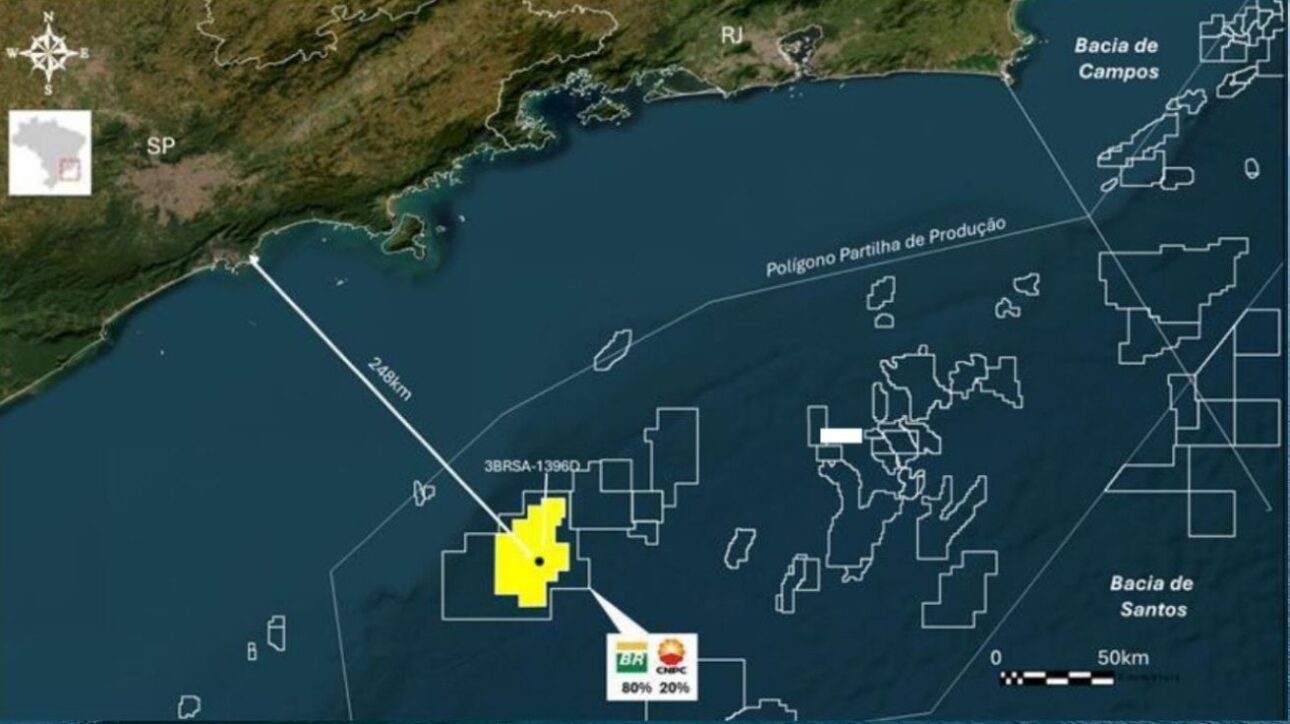
Petrobras confirmed the presence of light and contaminant-free oil in a new well in the Aram block, located in the pre-salt Santos Basin, approximately 248 kilometers off the coast of Santos (SP).
The drilling reached a depth of 1,952 meters in ultradeep waters, reinforcing the exploratory potential of the region.
Second Discovery in the Same Block in Less Than Three Months
On March 17, 2025, the state-owned company had already identified oil and natural gas in the well 4-BRSA-1395-SPS, located 245 kilometers from the São Paulo coastline and at a depth of 1,759 meters.
-
Bruno Guimarães, 28, Misses Crucial Penalty Against Norway in World Cup After Replacing Vinicius Jr.

-
Inspired by a school lesson on Africa’s water crisis, a young boy raised money through chores to fund a well that transformed a Ugandan community.

-
Brazilian Construction Worker Moves to France, Earns Up to €2,500 Monthly with Home Renovations, Gains Social Media Attention

-
US Navy Sinks USS Oriskany with 230 kg of C-4, Creating World’s Largest Artificial Reef in 37 Minutes





The two discoveries occurred in the same block, raising expectations regarding the volume and viability of exploration.
According to Petrobras President Magda Chambriard, the new results prove the effectiveness of the company’s exploratory plan.
She emphasized that, besides Aram, there have been other recent discoveries in the areas of Brava and Búzios, also in the pre-salt.
Discovery Evaluation Plan Continues Until 2027
Petrobras announced it will begin laboratory analyses to characterize the fluids and reservoirs found.
These stages are part of the Discovery Evaluation Plan (PAD), which also includes drilling two additional wells and conducting a formation test.
The completion of the PAD is scheduled for 2027, according to the timeline established with the National Agency of Petroleum, Natural Gas and Biofuels (ANP).
Aram Block and Consortium Structure
The Aram block was awarded in March 2020 during the 6th ANP bidding round, under the production sharing regime.
Petrobras leads the consortium with an 80% stake and acts as the operator, while CNPC (China National Petroleum Corporation) holds the remaining 20%.
The management of the contract is the responsibility of Pré-Sal Petróleo S.A. (PPSA), a company linked to the Ministry of Mines and Energy.
Quality of Oil Found Elevates Economic Attractiveness
The identified oil is light, with low contaminant levels, facilitating the refining process and adding greater market value.
Discoveries with these characteristics typically result in lower operational costs and high-quality derivatives, enhancing the competitiveness of national oil in the international market.
Production Potential and Operational Timeline
There are currently no official estimates regarding the total volume of oil and gas identified in the area.
Petrobras technicians reported that ongoing analyses will be crucial in determining the commercial viability of the block.
If confirmed, production may include the installation of FPSOs (floating production and storage units), with a capacity to extract up to 180,000 barrels per day.
If the project progresses as expected, production could start between 2030 and 2032, considering the average timeframes required for environmental licensing, technical structuring, and equipment procurement.
Importance of the Santos Basin in the Brazilian Energy Matrix
The Santos Basin is currently the main oil-producing province in Brazil, accounting for over 70% of national production in 2024.
Fields such as Tupi, Búzios, and Mero place the country among the largest global producers, and the Aram block emerges as yet another relevant asset in this strategy.
The existing infrastructure in the region—such as pipelines, support vessels, and platforms—reduces logistical and operational costs for future projects.
Reflections on Royalty Collection and Municipal Transfers
The advancement of production in the pre-salt directly impacts the revenue of states and municipalities.
In 2024, royalties and special participation payments in the Santos Basin exceeded R$ 80 billion, according to ANP data.
New discoveries may further increase this volume, especially for cities like Santos, Guarujá, São Vicente, and Itanhaém.
Oil Exploration and Energy Transition: Parallel Paths?
The discovery occurs amid discussions about the role of fossil fuels in the future energy matrix.
Despite the progress of renewable sources, the Brazilian government has reiterated that oil will continue to be a strategic asset in the coming decades.
Experts point out that Brazil needs to balance production growth with decarbonization and emission reduction goals.
New Cycle of Expansion in the Brazilian Pre-Salt
With the discoveries in the Aram block, Petrobras advances in its plan to replenish reserves and expands its portfolio of strategic assets for the long term.
Investment in technology, infrastructure, and geological analysis keeps the country at the forefront of offshore exploration.
In light of this scenario, one question arises: how should Brazil manage the development of new fields in the pre-salt without compromising its climate and social commitments?





