






 Portuguese
  Spanish
  4 min of reading
  0 comments


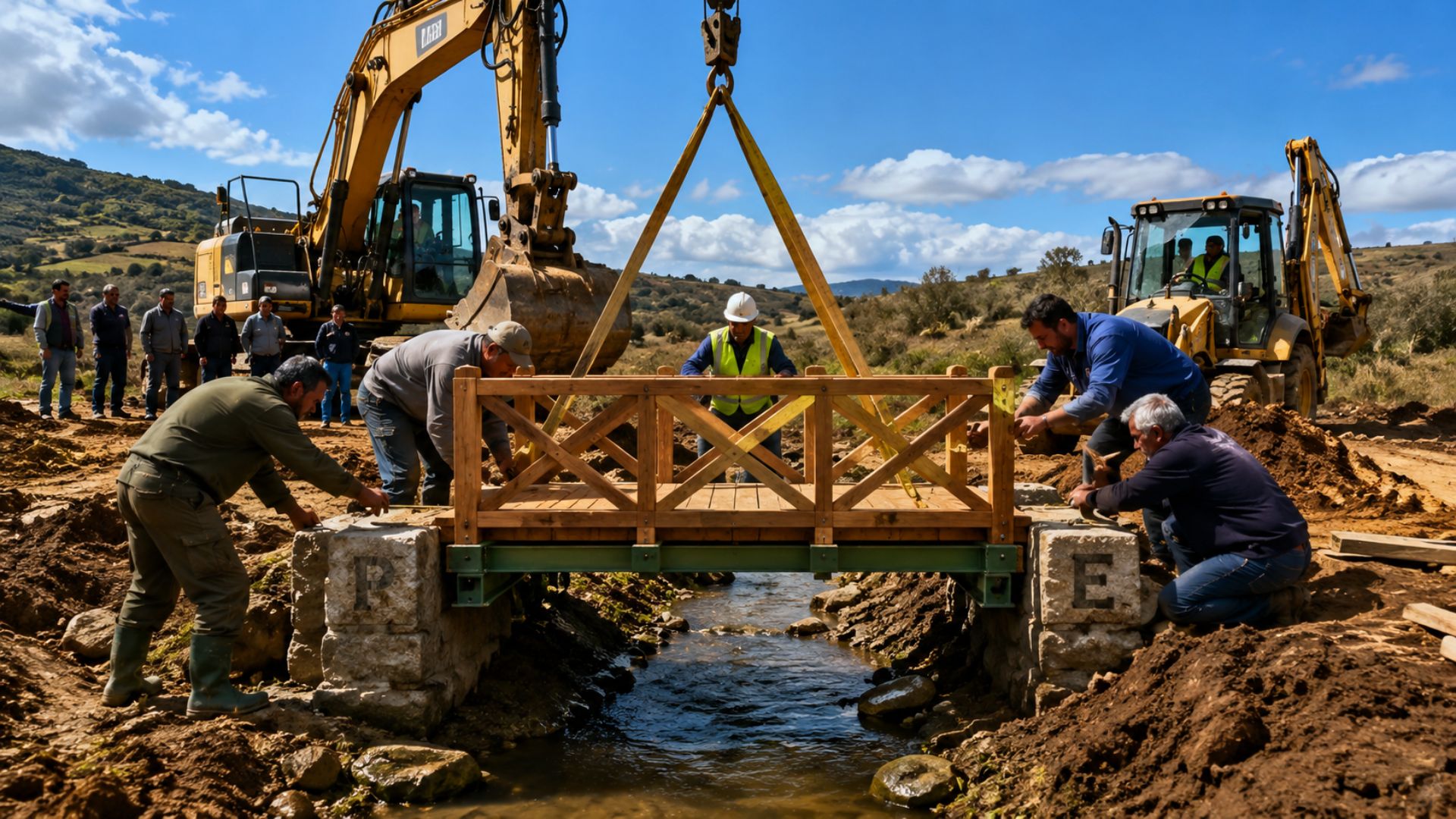
Wooden structure on the Iberian border became a tourist attraction for allowing a change of country and time zone in a few steps, in a crossing considered one of the smallest international connections on the planet and surrounded by historical and geographical curiosities.
On the border between Arronches, in Portugal, and La Codosera, in Spain, the El Marco Bridge became internationally known for connecting two countries in an extremely short crossing over the Ribeira de Abrilongo, a feature that turned the structure into a tourist curiosity of the Iberian Peninsula.
Built in wood, the passage is often pointed out as the smallest international bridge in the world, with about 3.2 meters in length and 1.45 meters in width in widely publicized tourist records, although some local references indicate larger dimensions for the current structure.
Bridge between Portugal and Spain draws attention due to its size
The small access connects the Portuguese locality of Marco to the Spanish village of El Marco, in a rural region marked by nearby villages, daily circulation of residents, and a historical coexistence typical of the so-called “raia” between Portugal and Spain.
-
Son finds father’s forgotten notebooks and helps scientists solve the mystery of a 55-million-year-old marine fossil that remained unanswered for almost three decades.

-
Sailor sails alone from Panama to Cuba carrying just over US$ 7,000 in food, medicine, and baby formula, spends hours at Santiago de Cuba customs, and delivers everything to Cáritas, linked to the Catholic Church, to distribute to the population.

-
In the middle of a forest in the USA, a couple transforms over 1,500 recycled tires, bottles, cans, and clay into an ecological mansion, builds 90% of the house with their own hands, and puts the nearly 7-acre self-sustaining refuge up for sale for $1.3 million.

-
Cutting board created in the Netherlands uses material made by microorganisms, measures 30 x 20 cm, and aims to eliminate microplastics that can end up in food during daily preparation.




Even with reduced dimensions, the bridge maintains a practical function for those living in the region, as pedestrians, cyclists, motorcyclists, and even animals cross the location daily without the need for a larger road structure or longer displacements.
Due to the limited width and narrow profile of the crossing, cars cannot circulate through the point, which remains mainly focused on the transit of people and small vehicles over the stream that divides the two territories.
Crossing even changes the time between countries

More than just a simple passage between two countries, the crossing also draws attention for the immediate change in time zone, as mainland Portugal follows Western European Time, while mainland Spain uses Central European Time.
With this, just crossing a few meters is enough to gain or lose an hour, depending on the direction of the movement, a situation that ended up turning the small bridge into a geographical curiosity known among tourists and residents of the region.
The identification of the sides of the border is made by stone markers.
On the Portuguese side, the letter “P” appears; on the Spanish side, the letter “E”, a simple indication that reinforces the territorial division in a landscape without major visible barriers.
Current structure replaced old wooden planks
The current bridge was built in wood and reinforced to better withstand the floods of the Ribeira de Abrilongo, a small watercourse that is part of the Gévora basin, a tributary of the Guadiana in the Badajoz region.
Before the current structure, residents used improvised planks to cross the stream.
These precarious crossings were often damaged or swept away by the force of the water during periods of heavier rain.
The renovation took place in 2008, with support from European resources and the participation of workers from both sides of the border.
The work transformed an improvised rural solution into a small stable bridge, with handrails and a reinforced base.
The simple design, with exposed wood and “X” shaped handrails, helps explain why the bridge became an attraction.
The structure does not impress with grandeur, but precisely because of the contrast between its minimal size and the symbolic importance of the international connection.
Tourist curiosity boosts border region
Ponte El Marco attracts visitors interested in unusual borders, small historical works, and curious geographical points.
The possibility of changing countries and time zones in a few steps has made the location popular in travel records.
The rural surroundings also reinforce the unique character of the crossing.
Instead of queues, customs posts, or major roads, the crossing appears in a tranquil area where the border is discreetly integrated into the local routine.
The bridge also refers to the history of coexistence between neighboring communities of Portugal and Spain.
For decades, residents circulated through the region for visits, work, trade, and daily activities, even when the crossing was made by simpler means.
With the current structure, the crossing gained safety and permanence.
Even so, it maintained the reduced scale that made it known internationally and preserved the rural aspect that differentiates the bridge from other connections between countries.
Smallest international bridge in the world became a local symbol
Although it is often called the smallest bridge in the world, the more precise designation is “smallest international bridge in the world”, as it connects two countries.
This distinction avoids confusion with even smaller crossings that may exist within a single national territory.
The exact dimensions appear divergently in consulted publications.
Some tourist sources mention 3.2 meters, while other references associated with local dissemination cite about 6 meters for the current bridge.
Even with this difference, the central characteristic remains the same: it is one of the smallest known international connections, mainly used by people on foot, on bicycles, or on two-wheeled vehicles.
The El Marco Bridge remains a curiosity of the Portuguese-Spanish border, where an almost minimal wooden structure sums up in a few meters a change of country, time zone, and administrative landscape.





-

-

-

4 people reacted to this.