






 Portuguese
  Spanish


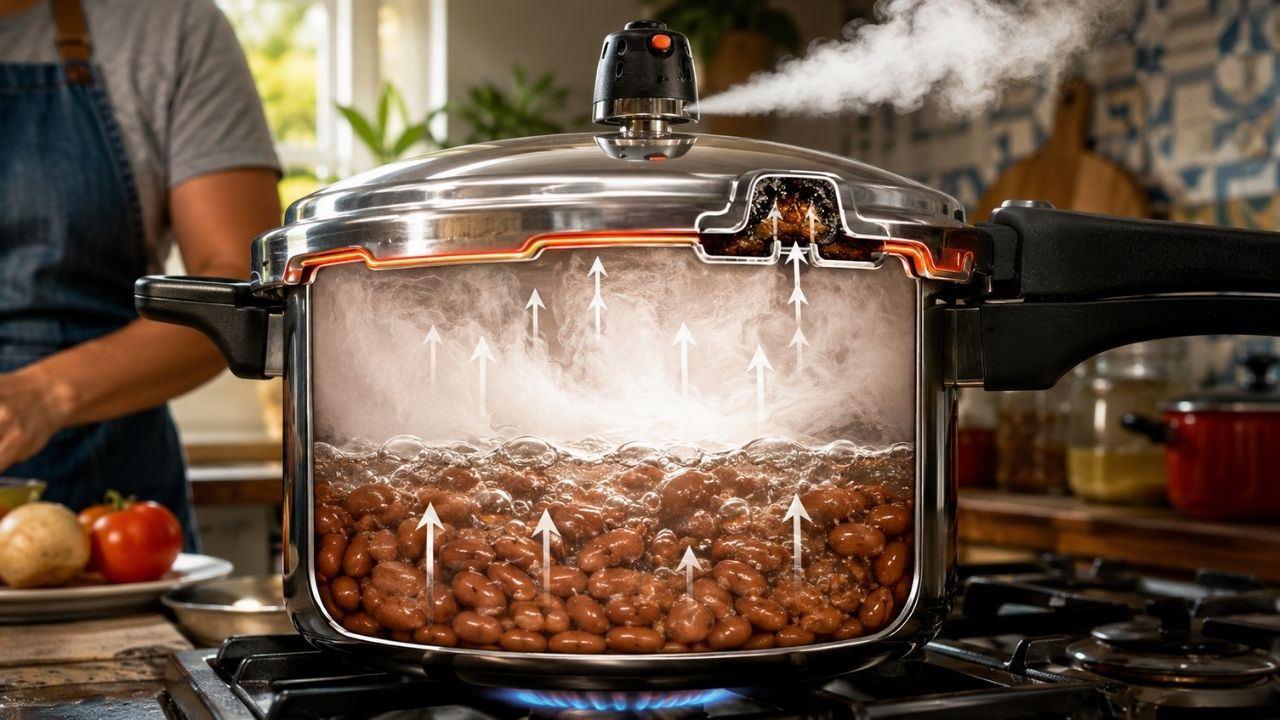

The pressure cooker speeds up cooking because it traps steam, raises the water temperature, and makes foods like beans soften faster. Experiment compares pots, explains valves, rubber, and water limits, and shows why blockages can cause serious accidents at home in the Brazilian domestic routine.
The pressure cooker returned to the center of an educational experiment on home safety by showing, in the kitchen, how trapped steam increases temperature, speeds up bean cooking, and turns a common utensil into a small lesson in applied physics.
With information from the channel Manual do Mundo, the demonstration was conducted in Brazil, in a kitchen used to compare bean cooking in a regular pot and a pressure cooker. The base material does not provide the exact date of the experiment but shows a complete explanation of the operation, risks, and necessary precautions before, during, and after use.
Trapped steam makes the temperature rise inside the pot

The pressure cooker cooks faster because it doesn’t let the steam escape freely. When water starts boiling in a regular pot, it reaches about 100°C under normal conditions and part of this energy escapes with the steam.
-
Your Old Gmail Address Might Be Obsolete Soon: Google Introduces Feature Changing Account Usage.

-
Lost Fossil Found in Brazil Unveils 240-Million-Year-Old Reptile Predating Dinosaurs, Redefines Evolutionary Map and Highlights Southern Brazil’s Role in Understanding Crocodile and Dinosaur Ancestors

-
China to Drill 15 Kilometers into the Earth, Set to Break Russia’s Record for Deepest Man-Made Hole
-
Researchers Use Algae to Enhance 3D-Printed Walls, Boosting Strength by 25% and Speeding Construction by 33%


In the pressure cooker, the steam is trapped. With more pressure on the water, it needs a higher temperature to boil, reaching nearly 120°C inside the utensil. This difference seems small but significantly changes the cooking process.
That’s why foods like beans, grains, and meats are ready faster. The heat not only cooks for a longer time; it operates at a higher temperature, helping tougher fibers and structures to soften.
In the experiment, the comparison showed that the beans cooked in the pressure cooker became soft in the same time frame that the beans in the regular pot remained hard. The difference came precisely from the combination of steam, pressure, and temperature.
Valve is the part that controls excess pressure
The pressure cooker valve is not there just to make noise. It functions as a safety and operational control, releasing steam when the internal pressure reaches the expected level.
When the valve starts to spin, it indicates that the cooker has reached working pressure. From this moment, many recipes begin to count the cooking time because the food is already subjected to a higher temperature.
The weight of the valve makes it difficult for the steam to escape immediately. This allows the pressure to increase up to a certain limit. When the steam has enough force, it lifts the valve and escapes in small jets, creating the movement known to those who cook.
This spin is also a visual and auditory alert. If the cooker is on the heat, heats up, but the valve does not spin, there may be a blockage. In this case, the safe procedure is to turn off the heat and not try to force open the cooker.
Beans demonstrate in practice why cooking speeds up
Beans were used in the experiment because they are one of the foods most associated with pressure cookers in Brazil. Even after soaking, they take much longer to cook in a regular pot.
In the comparison, the same amount of beans and water was placed in different pots. One was sealed under pressure; the other was cooked traditionally. The result showed a clear difference in texture.
The beans from the pressure cooker were much softer, while those from the regular pot still had hard grains. This reinforces that the gain is not just in time, but in the higher internal temperature.
The regular pot loses heat more easily and does not exceed the normal boiling point of water. The pressure cooker, on the other hand, creates a closed, hot, and controlled environment, accelerating reactions that soften the food.
The risk appears when the steam outlet is blocked
The greatest danger of the pressure cooker arises when the steam cannot escape. This can happen if the valve clogs with dirt, foam, food residues, or excess content inside the cooker.
When the steam outlet is blocked, the internal pressure can rise beyond safe levels. This scenario can lead to violent leaks, component rupture, or domestic explosions.
Foods that form foam or thick mass require extra attention. If the cooker is overfilled, this mixture can rise, reach the valve hole, and block the steam passage.
That’s why the rule of not exceeding about two-thirds of the cooker’s capacity is so important. It leaves space for steam, foam, and food movement during cooking.
Rubber and locks are also part of the safety
The sealing of the cooker depends on the rubber installed on the lid. This piece prevents steam from escaping through the sides and helps maintain the necessary pressure for cooking.
If the gasket is dried out, torn, or poorly fitted, hot steam may leak. This leakage can cause burns and also compromise the proper functioning of the pot.
Besides the gasket, the lid has locks and a design intended to withstand internal force. The pressure pushes the lid from the inside out, but the locking system prevents it from being opened while there is still pressure.
Some pots also have secondary valves or escape areas. These features act as backups in case the main valve fails, reducing the risk of a more serious accident.
Simple precautions reduce the risk of accidents
Before using the pressure cooker, it is important to check if the valve is clean and unobstructed. A simple test is to look against the light or blow gently to check if there is air passage.
It is also essential to observe the gasket, respect the water limit, and avoid filling the pot to the brim. Most problems start when pressure, foam, and lack of space combine.
Once the pot reaches pressure, the heat can be reduced. Keeping the flame too high does not make the temperature rise indefinitely; it only wastes energy and increases the intensity of the steam released.
At the end of cooking, the pot should only be opened after the pressure has completely released. Forcing the lid while still pressurized is one of the most dangerous actions in the kitchen.
Condensed milk requires even greater attention
The experiment also addresses cooking a can of condensed milk to turn it into dulce de leche. Although it is a known practice, it requires caution because the pressure can continue inside the can even after the pot loses pressure.
The risk lies in opening the can while it’s still hot. The internal content may be above the safe temperature and gush out when pierced, causing serious burns.
The safest recommendation is to let the can cool completely before opening. It’s not enough for the pot to seem cool on the outside; it’s necessary to ensure that the internal content has also lost heat.
This example shows that safety does not end when the valve stops spinning. Some foods and containers continue to accumulate heat and pressure for a longer time.
Domestic science explains fear and utility


The pressure cooker is feared because it works with hot steam under pressure, but it is also one of the most efficient tools in the Brazilian kitchen. When used correctly, it reduces preparation time and helps in cooking tough foods.
Fear makes sense when a person does not understand the functioning. But, by understanding valve, steam, rubber, water limit, and cooling time, the use becomes much safer.
The experiment shows that the utensil does not rely on mystery. It follows simple physical principles: higher pressure, higher temperature, and faster cooking.
The problem arises when maintenance is ignored, the pot is overfilled, or the steam outlet gets blocked. In this case, a useful tool can become a real risk.
What the pressure cooker teaches about kitchen safety
The pressure cooker shows that physics is present in common tasks, like preparing beans. The same steam that speeds up cooking also requires respect, maintenance, and attention to the utensil’s signals.
The secret is not to fear the pot, but to understand how it works. Rotating valve, rubber in good condition, correct water limit, and opening only without pressure are basic precautions that prevent accidents.
In practice, the experiment reinforces a simple message: the pressure cooker is efficient because it heats more, cooks better, and saves time, but should only be used with attention.
Do you use a pressure cooker with ease or are you still afraid to cook beans, meats, and other foods in this utensil? Leave your opinion in the comments.


