






 Portuguese
  Spanish


System inspired by the Canadian well uses buried pipes to cool rooms without air conditioning or electric compressor.
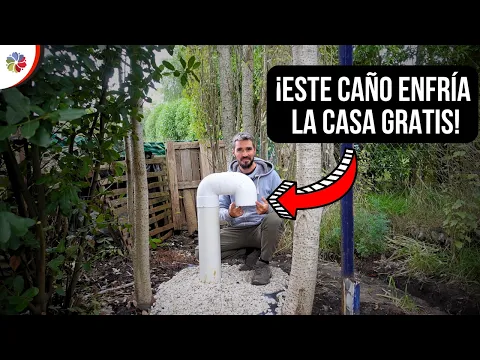
A content creator from South America has once again caught attention on social media after completing a residential geothermal system inspired by the so-called “Canadian well” or “Provençal well,” an ancient passive climate control technique that uses the stable temperature of the subsoil to cool indoor environments without relying on conventional air conditioning.
According to the project author, the installation began in 2022 and was only completed in 2026, although the rooms were already being partially cooled before the full completion of the structure. The system was installed in the children’s rooms and, according to him, eliminated the need for traditional cooling devices in the environments.
The case went viral because it showcases a low-energy consumption solution based on relatively simple physical principles: the outside air passes through pipes buried in the ground before entering the house, exchanging heat with the earth along the way and arriving cooler to the rooms.
-
AI Security System in Brazil Aims to Cut False Alarms by Differentiating Pets from Intruders, Enhancing 24/7 Monitoring for Homes and Businesses

-
Archaeologists Discover 1,500-Year-Old Byzantine Mosaic with Greek Biblical Inscription in Israel, Uncover Ruins of 10 Buildings Near Kiryat Gat
-
Ohio Carpenter Finds 308-Gram Meteorite the Size of a Baseball After Dreaming of Its Location

-
Chinese Student Builds Humanoid Robot for $2,100 at Age 20, Now Leads Robotics Startup in China



System uses constant subsoil temperature to naturally cool the air
The so-called Canadian well, also known as the Provençal well or air-ground heat exchanger, works by taking advantage of a natural thermal characteristic of the subsoil.

According to studies and technical publications on passive geothermal climate control, the earth’s temperature remains much more stable from approximately 1.5 to 2 meters deep, being less influenced by the extreme surface heat.
This means that during very hot days, the soil can remain several degrees cooler than the outside air. The system takes advantage of this exact thermal difference to naturally reduce the air temperature before it enters the residence.
Air passes through buried pipes before entering the house rooms
In the project presented by the creator, the outside air is drawn through pipes buried in the backyard. As it travels dozens of meters underground, the air exchanges heat with the soil around the pipes. Since the subsoil maintains a relatively constant temperature, the air reaches the rooms cooler than it was at the system’s entrance.
According to technical descriptions of Canadian wells, the pipes are usually buried between 1.5 and 4 meters deep depending on the local climate and the desired efficiency.
Materials such as PVC, polyethylene, and HDPE are frequently used because they resist moisture and underground corrosion.
System operates without a compressor and drastically reduces electricity consumption
Unlike a conventional air conditioner, the Canadian well does not rely on a compressor, refrigerant gas, or external condenser unit.
In most cases, the system uses only natural air circulation or simple low-consumption fans to move the flow inside the underground pipes.
This drastically reduces the electrical cost of air conditioning. According to studies on passive geothermal air conditioning, systems of this type can significantly reduce the need for artificial cooling in regions with large temperature variations.
In practice, the soil acts as a gigantic natural thermal battery capable of absorbing heat from the air during the underground journey.
Technique has been known for centuries and has regained strength with the energy crisis
Despite seeming futuristic, the concept of the Canadian well is old. Historical records show similar systems used centuries ago in hot regions of Persia and also in southern France, where underground galleries were used to reduce the temperature of indoor environments.

The name “Canadian well” gained popularity because cold countries began to use the same principle also to preheat the air in winter.
In recent years, the system has regained strength due to the rising cost of electricity and the growing search for passive air conditioning solutions.
Studies show that the soil can reduce several degrees of air temperature
Recent analyses of passive geothermal systems show that the subsoil can significantly reduce the temperature of the external air.
Studies cited by engineering publications indicate that soils at about 2 meters deep can reduce the air from approximately 27.5°C to about 23°C without significant direct energy expenditure.
The exact performance depends on factors such as depth, length of the pipes, type of soil, humidity, and local climate. Longer systems buried more deeply tend to offer greater thermal stability.
Project drew attention because it replaced conventional cooling in the rooms
According to the creator of the system shown on social media, the rooms in the residence began to operate without traditional air conditioning units.

Thermal comfort would be maintained solely by the effect of the Canadian well combined with natural air circulation. Installation began in 2022 and was expanded over the years until the final configuration was recently presented.
The case went viral precisely because it shows an apparently simple solution based on buried pipes and basic thermal physics, without intensive use of expensive equipment.
Canadian well can also work in winter to heat environments
The principle works both ways. During the summer, the ground is usually cooler than the outside air, allowing for natural cooling. In winter, in cold regions, the ground tends to remain warmer than the ambient air.
This allows the system to also preheat the air before it enters the residence.
According to geothermal climate control experts, the method is especially efficient in regions with large temperature variations between day and night or between seasons. Despite the advantages, the Canadian well requires proper technical planning.
Engineering publications warn that buried pipes need to have the correct slope for drainage of condensed water. Otherwise, accumulated moisture can cause bad odors, mold, and system contamination.
It is also necessary to use air intake filters and materials resistant to underground corrosion. The efficiency of the system depends both on thermal exchange and on the correct maintenance and hygiene of the piping.
Canadian well shows how old solutions are returning to modern engineering
The case reinforces an increasingly strong trend in sustainable architecture: recovering ancient principles using modern materials and techniques.
Instead of relying exclusively on powerful electrical appliances, part of current engineering tries to take advantage of natural environmental features to reduce energy consumption. The Canadian well represents exactly this logic, using the ground itself as a natural thermal stabilizer.
The question that is starting to gain traction among architects and residents is straightforward: given the rising cost of energy and increasingly intense heatwaves, can passive solutions buried under the backyard once again compete with traditional air conditioning in future homes?




Where There is a WELL there is a WAY. It is upto us how to AVAIL.