Portuguese
  Spanish


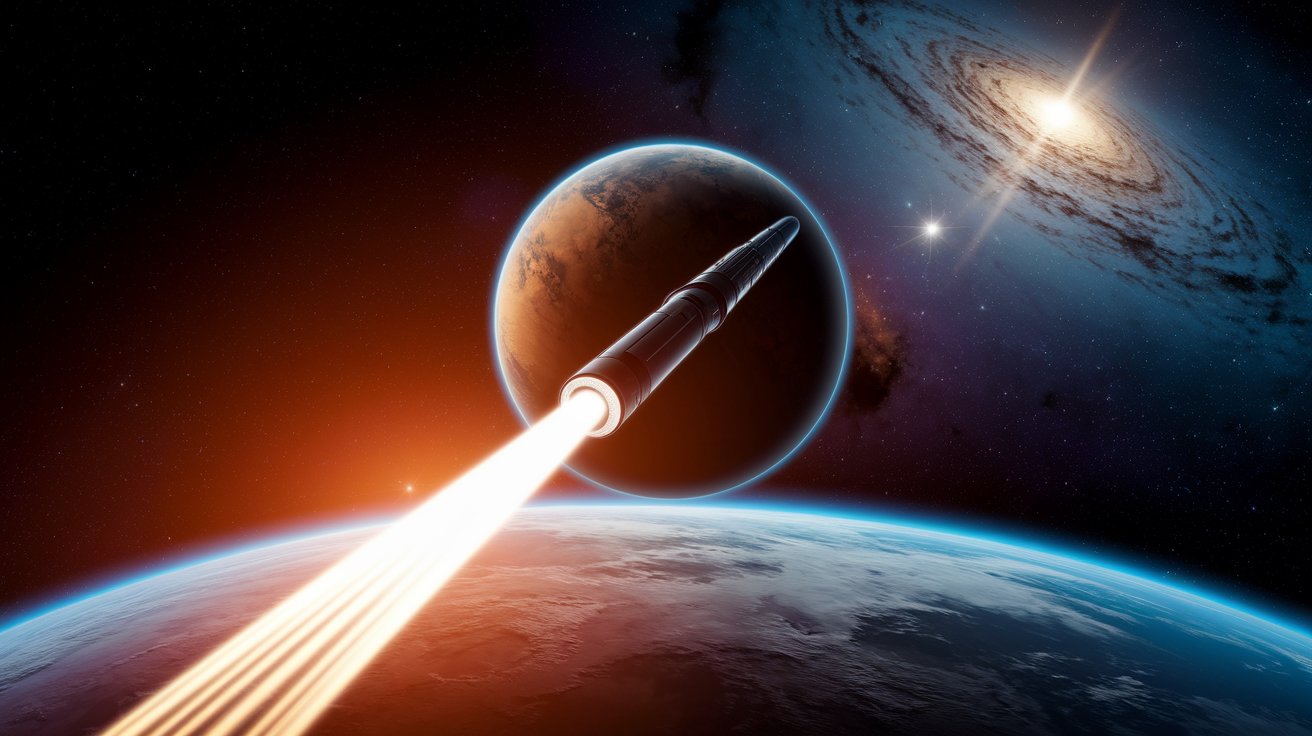


A British Startup Wants to Revolutionize Space Exploration with the Fastest Nuclear Rocket in History. Fueled by Fusion, the Sunbird Could Reach Mars in Record Time and Carry Spacecraft to Pluto in Just 4 Years! The New Era of Interplanetary Travel Is About to Begin – and Promises to Change Everything We Know!
British Startup Develops Nuclear Fusion Engine That Can Reach Speeds of Up to 805,000 km/h; First Mission Scheduled for 2027
A revolutionary rocket, powered by nuclear fusion, promises to transform the future of space travel by halving the time needed to reach Mars.
According to Pulsar Fusion, a UK-based company, the project named “Sunbird” could begin testing as early as 2027, paving the way for interplanetary missions that are much faster and more efficient than current ones.
-
Orphaned Youth Turns Dismissed Idea into Global Prestige with Innovative Wristwatch

-
AI Video Generator Automatically Creates Subtitles and Animated Captions

-
English Skills Boost Career Opportunities in the Oil and Gas Industry
-
São Paulo Unveils Latin America’s Largest Underground Reservoir, Holding 900 Million Liters, in the Greater São Paulo Area




The technology, inspired by the same reaction that fuels the Sun and other stars, is being funded by the UK Space Agency and promises to accelerate spacecraft to impressive 805,000 kilometers per hour, a speed greater than that of NASA’s Parker Solar Probe, which currently holds the record at 692,000 km/h.
What Is the Sunbird Rocket?
Designed to operate as a “space train,” the Sunbird has been conceived with the ability to dock with orbiting spacecraft, propelling them to their destinations at speeds never before experienced by humans.
The rocket’s engine uses a linear nuclear fusion reactor — unlike traditional terrestrial circular reactors — allowing highly energetic particles to escape in a straight line, generating the necessary thrust.
According to information released by José Casado from Revista Veja, and confirmed by Pulsar Fusion, simulations indicate that the engine could carry a one-ton payload to Pluto in just four years, whereas this journey currently takes about a decade with existing technology.
Despite the excitement, the Sunbird is still in the early stages of development and faces considerable hurdles.
One of the biggest challenges is miniaturizing the equipment needed to control nuclear fusion, which has traditionally been heavy and bulky in experiments conducted on Earth.

Nuclear Fusion: The Energy of the Future?
Unlike nuclear fission — the process used in terrestrial nuclear power plants — nuclear fusion combines two light atoms, such as hydrogen, to form a heavier atom while releasing large amounts of energy, without the dangerous radioactive waste associated with fission. This reaction is the same that occurs naturally inside the Sun.
While scientists have been seeking a way to make this energy viable on Earth for decades, no fusion reactor has yet succeeded in producing more energy than it consumes.
However, Pulsar Fusion’s proposal believes that the vacuum of outer space offers a more conducive environment for stable and efficient fusion reactions.
“Fusion doesn’t want to work in an atmosphere. Space is a much more logical and sensible place to do fusion because it’s where it wants to happen anyway,” said Richard Dinan, founder and CEO of Pulsar Fusion.
Potential to Accelerate Space Exploration
If the project is successful, the Sunbird rocket could not only revolutionize the way humans explore the Solar System but also significantly reduce the costs of space missions.
Faster trips mean less time exposure to cosmic radiation for astronauts, lower supply needs, and greater feasibility of return.
In addition to Mars, other destinations would become more accessible with this type of propulsion. NASA, for example, is already studying missions to Jupiter and Saturn with autonomous probes, but current timelines exceed 10 years. With a fusion rocket, that journey could drop to less than half.
Industry experts view Pulsar Fusion’s progress optimistically, but also with caution.
The fusion technology, while promising, still depends on a series of rigorous tests to ensure its safety, control, and efficiency in the space environment.
Faster and Safer Travel
If the 2027 mission occurs as planned, it could mark a turning point in modern space exploration.
The main advantage lies in the ability to turn long journeys spanning years into routes of just a few months, making it feasible, for example, to send supplies, robots, and research equipment continuously and at scale.
Beyond the UK, other countries have also been investing in the development of advanced propulsion systems.
In the United States, DARPA and NASA are working together on DRACO, a thermal nuclear rocket prototype expected to undergo orbital testing by 2027. China has also announced ambitious plans for electric and nuclear propulsion in future missions.
The competition for advanced propulsion technologies is seen as crucial for the new space race — this time aimed at deep exploration of the Solar System, and in the future, even beyond.
What If the Future Is Closer Than We Imagine?
The Sunbird rocket not only promises astounding speeds but also reignites the debate over the role of nuclear fusion as a clean and efficient energy solution for the future of humanity.
If it works as expected, the British project could propel not only spacecraft but also new ways of thinking about cutting-edge science and engineering.
In 2023, U.S. scientists achieved a groundbreaking advance by reaching a positive energy balance fusion reaction for fractions of a second, demonstrating that the energy of stars could indeed be within our reach — both on and off Earth.
The expectation now is that the next two years will bring more robust bench tests and, perhaps, confirmation that it is possible to leave Earth orbit towards Mars in less than three months.
What do you think, will nuclear fusion change the course of space exploration or are we still dreaming too big? Comment below!