






 Portuguese
  Spanish
  5 min of reading
  0 comments


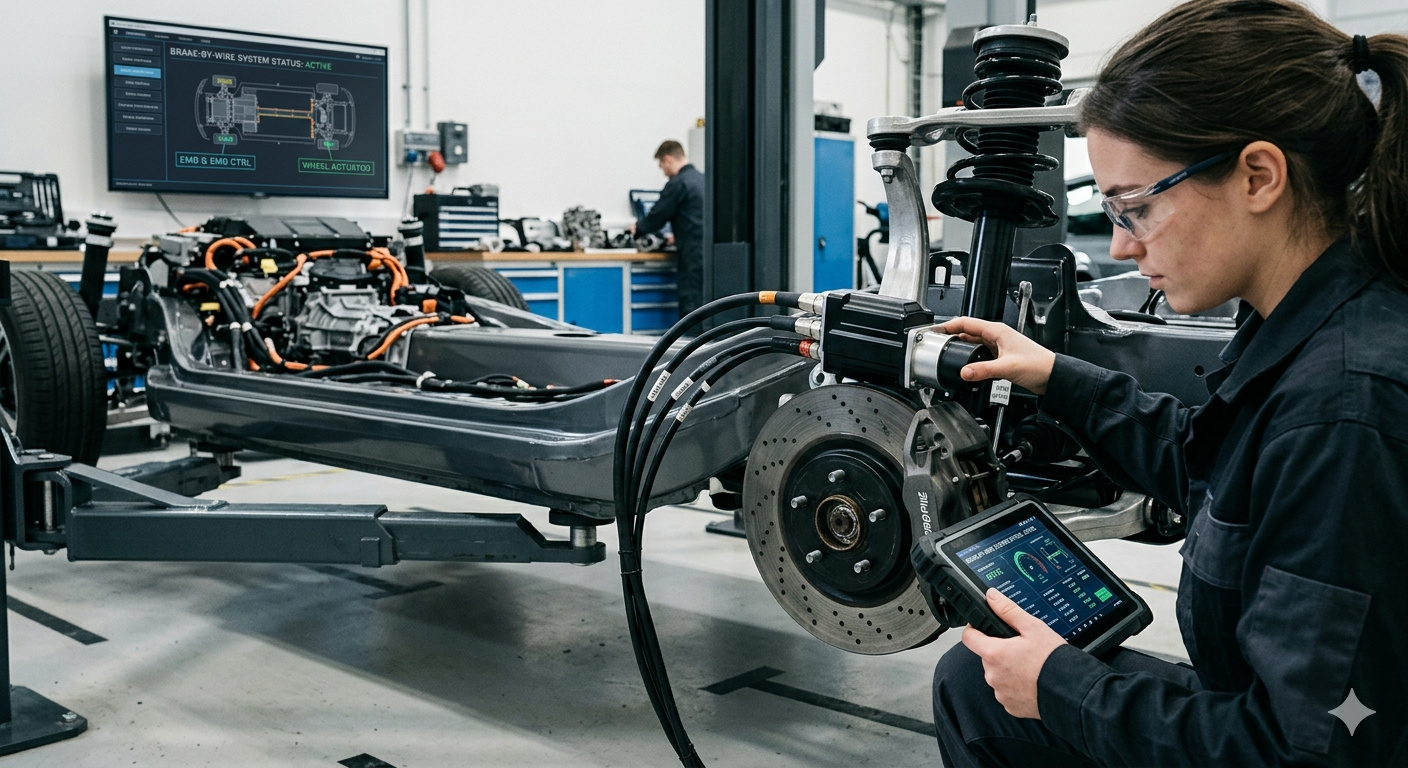
Dry brake systems without hydraulic fluid advance in the automotive sector and promise to transform braking into an intelligent electronic platform.
For over a century, virtually all cars in the world have relied on the same basic braking logic: hydraulic pressure transmitted by fluid through metal pipes and hoses to the wheels. Now, global manufacturers and suppliers have begun to accelerate a change considered one of the most profound in recent automotive history: the emergence of so-called “dry brakes,” brake-by-wire systems that eliminate traditional hydraulic fluid and transform braking into an entirely electronic operation.
Companies like Brembo, ZF Group, and Aumovio are already working on platforms that replace hydraulic cylinders, hoses, and pressurized circuits with sensors, electric actuators, and intelligent software. The promise is to create lighter, more efficient cars with extremely precise braking control, especially in electric vehicles and future autonomous models.
Continue reading to understand how dry brakes work, why hydraulic fluid may begin to disappear from modern cars, and what challenges still prevent this technology from completely replacing traditional systems.
-
Ferrari’s First Electric Car Divides Fans, Priced at $630,000, Amid Concerns Over Limited Editions; Brand Clarifies It’s Not Just for Future Perks

-
BYD Dolphin Mini: The Electric Car That Defies Depreciation, Losing Only 3.58% in a Year and Becoming the Best-Selling Retail Model Under $22,000

-
Electric Car JAC E-JS4 Loses $19,000 in Value in One Year, Leading Record Depreciation of Used Cars in Brazil Due to Expensive Battery and New Models
-
Used Civic and Corolla have been stuck in stock for months. “People are preferring Chinese cars,” says the car dealership owner.


Dry brake eliminates one of the oldest elements of the modern automobile
Since the first mass-produced automobiles, brakes have operated on a relatively simple principle. When the driver presses the pedal, a master cylinder compresses hydraulic fluid that transmits pressure to the calipers on the wheels.
This fluid is essential because it allows for efficient multiplication of mechanical force. So-called dry brakes completely change this logic. Instead of using hydraulic pressure distributed by fluid, the system electronically interprets the driver’s command and activates electric motors or actuators directly on the brakes. The car no longer relies on hydraulic fluid and begins to brake via electronic signals controlled by software.

Brake-by-wire technology transforms braking into a digital platform
Dry brake-by-wire systems use electronic sensors to interpret the force applied to the pedal. These signals are sent to computational control units that calculate exactly how much each wheel should brake. Electric actuators installed near the wheels perform braking independently.
This means the system can vary intensity, response time, and force distribution with much greater precision than conventional hydraulic architectures. In practice, the brake ceases to be merely mechanical and begins to function as an intelligent digital system.
Fluid elimination reduces maintenance and simplifies architecture
One of the main arguments from manufacturers is the structural simplification of the vehicle. Without hydraulic fluid, reservoirs, system bleeding, long hoses, and part of traditional periodic maintenance disappear. Furthermore, vehicles can reduce weight and gain greater internal design flexibility.
According to Aumovio, dry brake-by-wire systems also simplify production steps on assembly lines. The goal is to transform braking into a more compact, modular, and electronically integrated system.
Individual wheel control enhances stability and safety
In traditional brakes, hydraulic distribution has natural physical limitations. In dry electronic systems, each wheel can be controlled separately in real-time. This allows for much faster responses in critical situations, such as hydroplaning, sharp turns, or surfaces with uneven grip.

The software can instantly modulate the action of each wheel depending on the vehicle’s behavior. Braking becomes part of the car’s dynamic intelligence, working integrated with sensors, radars, and advanced assistance systems.
Electric cars accelerate the race for electronic brakes
The arrival of electric vehicles has created an ideal environment for brake-by-wire technologies. These cars already rely heavily on software for energy management, electric motors, and regenerative braking. Furthermore, electric vehicles typically use more advanced electronic architectures.
This facilitates the integration of fully digital braking systems. Dry braking appears as a natural part of the transition from mechanical to computational automobiles.
Dry systems can improve integration with autonomous driving
Another strategic reason for the advancement of brake-by-wire is autonomous driving. Autonomous vehicles depend on extremely precise electronic control over acceleration, steering, and braking.
Traditional hydraulic systems have more physical limitations and different response times. Electronic brakes, on the other hand, can work directly integrated with the car’s central computers. This transforms the brake into an essential part of the digital infrastructure of future autonomous vehicles.
Safety is still the main challenge of the technology
Despite the advantages, completely eliminating the hydraulic system requires extreme levels of redundancy. Brakes are one of the most critical systems in an automobile. Therefore, manufacturers need to guarantee operation even in the face of electrical failures, software problems, or partial sensor loss.
New platforms use multiple redundant systems, auxiliary power sources, and continuous monitoring. The car needs to continue braking even if part of the electronics fails, which makes development extremely complex.
Automotive industry has already abandoned other traditional mechanical connections
The advancement of dry braking follows a larger movement within the automotive sector. Electronic accelerators have already replaced mechanical cables in practically all modern cars. Steer-by-wire steering systems are beginning to eliminate traditional mechanical columns. Now, braking enters the same transformation. The modern automobile is gradually exchanging physical connections for sensors, actuators, and software.
Without the need for long hydraulic circuits, manufacturers gain freedom to redesign automotive platforms. This can facilitate the production of modular electric cars and more compact architectures. Furthermore, dry systems can reduce the space occupied by mechanical components in the engine bay and bodywork. The change affects not only the brake but also the entire structural engineering of future vehicles.
Traditional hydraulic brake will still remain dominant for many years
Despite technological advancements, experts state that traditional hydraulic systems will remain widely present for a long time. They are extremely reliable, well-known in the industry, and relatively inexpensive.


Furthermore, the mass adoption of dry brakes depends on rigorous regulations, safety validations, and cost reduction. The first fully electronic systems are expected to appear initially in premium, electric, and technologically advanced car models. The transition tends to be gradual, but it has already begun to change the direction of the global automotive industry.
The automotive sector is undergoing a transformation comparable to the arrival of electronic fuel injection
For decades, mechanical systems dominated practically all aspects of the car. Digitalization began with electronic fuel injection, advanced to electric power steering, assistance sensors, and intelligent engine management.
Now, braking definitively enters this transformation. Dry braking represents another step in converting the automobile into a machine predominantly controlled by software and embedded electronics.


Be the first to react!