






 Portuguese
  Spanish


Zero Tolerance Program promises to change the reality of Rio’s coastline
The exploitation of street vending by criminal factions returned to the center of discussions in Rio de Janeiro after the city hall announced a comprehensive inspection package for the beaches of the South Zone. According to information released on Tuesday, July 8, 2026, the Rio de Janeiro City Hall announced the Zero Tolerance Program to combat the irregular occupation of public space and the activities of organized crime on the city’s coastline.
The information was disclosed by the newspaper O GLOBO in a report published on July 8, 2026, with information from the Rio de Janeiro City Hall, the Municipal Public Order Secretariat (Seop), the State Public Security Secretariat, and representatives of the United Street Vendors Movement (MUCA). According to the authorities, some criminal factions charge between R$ 200 and R$ 300 per day from vendors to allow them to sell products on the coast. Furthermore, this entire criminal structure would move approximately R$ 100 million per year.
Given this scenario, the city hall decided to expand inspection actions. At the same time, it intends to reinforce the presence of security forces in areas considered strategic. The goal is to protect residents, tourists, and workers who operate legally.
-
Entrepreneur Turns Motorhome into Hot Dog Business, Sells 850 in Four Days, Plans to Travel Across Brazil

-
Paraíba Teen Foregoes 15th Birthday Party for Laptop, Wins Gold in Brazil’s Largest Public School Math Olympiad
-
Surprising Discovery Reveals That the History of Artesian Wells Began Over 7,000 Years Ago, Revolutionizing Humanity’s Access to Groundwater

-
Brazilian Designer Turns Ketchup Packets and Old Keyboards into Unique Bags, Gaining Fame for Upcycling at Kuhra



According to the municipality, the program will start operating on the next July 16. Additionally, the teams will operate 24 hours a day, every day of the week.
Inspection will have permanent action on the beaches of the South Zone
The Zero Tolerance Program will bring together different municipal bodies in a continuous operation. Additionally, civil and military police will work together with Seop to expand inspection.
Among the main measures announced are:
- Ostensive patrolling 24 hours a day;
- Implementation of access control points;
- Preventive actions along the entire coastline;
- Seizure of goods without proof of origin;
- Combat against clandestine warehouses used by irregular commerce.
According to the city hall, the teams have already identified 22 clandestine warehouses used to store goods intended for irregular commerce.
For this reason, a decree published in the Official Gazette ordered the expropriation of two properties, one located in Copacabana and the other in Ipanema. Subsequently, these properties will function as official support depots for operations.
In addition, the authorities intend to hinder all logistics used by criminal organizations to supply irregular vendors.
Daily charges would move around R$ 100 million per year
During the program presentation, the municipal secretary of Public Order, Marcus Belchior, detailed how part of the exploitation practiced by criminal organizations works.
According to him, some factions demand payments between R$ 200 and R$ 300 per day from street vendors who wish to occupy certain points on the boardwalk and the sand strip.
However, this charge represents only a part of the illegal activity.
In addition to the fees imposed on vendors, criminal groups would also control clandestine depots, equipment rentals, and other services linked to irregular commerce.
As a result, this entire structure would move approximately R$ 100 million per year, according to estimates presented by the city hall.
During the announcement, the state secretary of Public Security, Victor César Santos, stated that combating these organizations is essential to preserve the safety of the population.
Additionally, he emphasized that the operation also seeks to protect the international image of Rio de Janeiro.
According to the secretary, millions of tourists visit the Rio coastline annually. Therefore, allowing criminal organizations to economically exploit this space compromises both public safety and tourist activity.
Still according to Victor Santos, organized crime cannot turn one of the most well-known regions of Brazil into a permanent source of illegal revenue.
Street vendors protest against new rules announced by the city hall
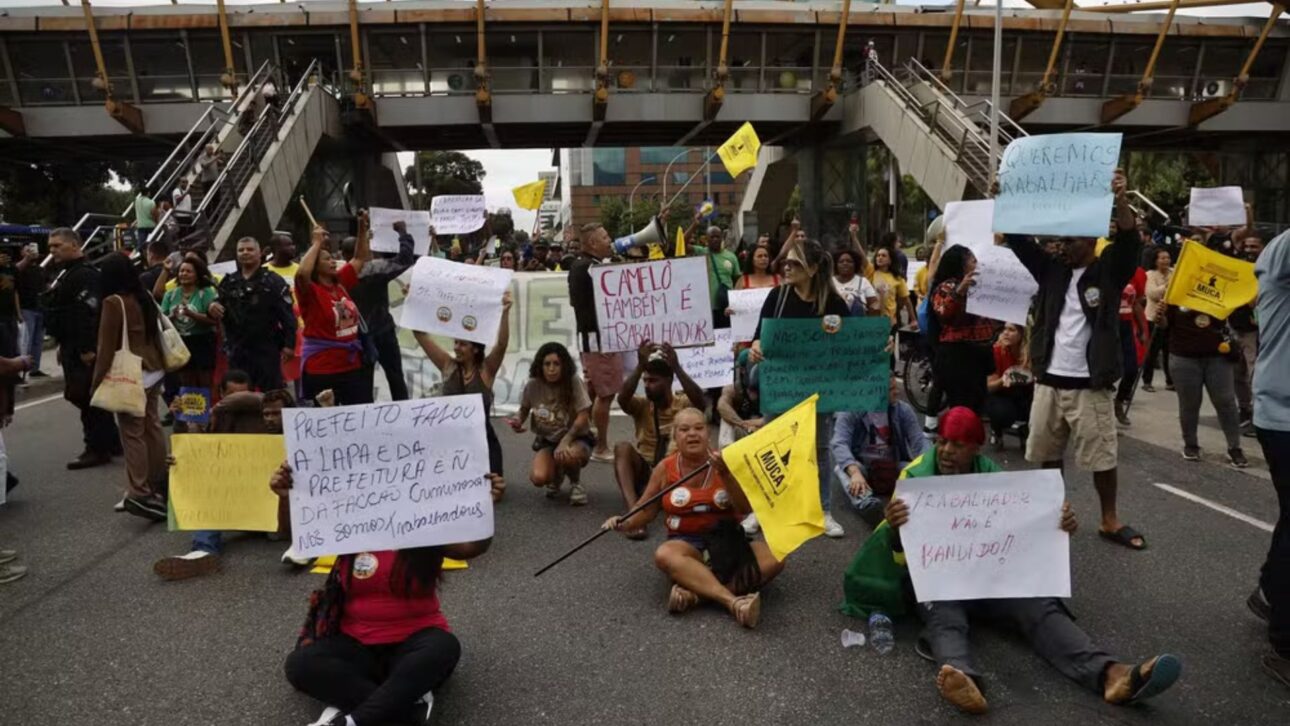
While the city hall was presenting the new inspection program, street vendors organized a demonstration in front of the São Sebastião Administrative Center, the headquarters of the municipal government, located in Cidade Nova. The protest took place on Wednesday, July 9, 2026, a day after the official announcement of the program by the city hall.
The act was organized by the United Street Vendors Movement (MUCA). The protesters carried posters, banners, flags, and pans. Additionally, they occupied part of Avenida Presidente Vargas and even sat on the asphalt under the metro walkway.
As a consequence, traffic was slow for drivers heading towards the Center via Praça da Bandeira and Leopoldina.
According to Maria dos Camelôs, general coordinator of MUCA, the workers advocate for the regularization of the category. At the same time, they support efficient enforcement against criminals. However, she states that it is not correct to treat all street vendors as participants in illegal activities.
According to the movement’s representative, the city hall and the vendors have been negotiating since the beginning of this year. During this period, both parties discuss the creation of authorized points for street vendors in the South Zone.
Additionally, another demand involves the region of the Selarón Steps in Lapa. The location will receive a revitalization project recently announced by the municipality.
Maria also stated that cases of theft, trafficking, or involvement of criminals should be investigated by the competent authorities. However, according to her, this does not justify holding the entire category responsible.
Regularization may reduce the activity of factions
During the protest, MUCA representatives cited the experience carried out in the Uruguaiana region, in the center of Rio de Janeiro.
On that occasion, the city hall registered 198 street vendors working in the area. After the analysis, 75 vendors were authorized to continue their activities.
According to the movement, the measure brought positive results.
Besides organizing public space, enforcement reduced the illegal charges made by groups that financially exploited the workers.
For this reason, representatives of the street vendors advocate that the same model be adopted in other regions of the city.
Meanwhile, the city hall states that the new program has a broader objective. The municipal administration intends to combat the entire economic structure used by criminal factions along the Carioca coast.
Dispute between factions reinforced the need for the operation
In recent days, reports published by O GLOBO showed that the so-called non-aggression pact between the Comando Vermelho (CV) and the Terceiro Comando Puro (TCP) no longer exists in sections of the Leme and Copacabana beaches.
According to the information released, the dispute for control of the region began to involve pursuits, cell phone searches, armed men circulating along the boardwalk and the sand strip, as well as conflicts related to drug trafficking and street vending.
In light of this scenario, the city hall decided to intensify the presence of enforcement teams.
Additionally, civil and military police will work together to combat criminal organizations that economically exploit informal vendors.
Consequently, the municipality expects to reduce the illegal collection of fees, eliminate clandestine deposits, and regain control of public spaces.
The Zero Tolerance Program will officially begin on July 16, 2026. The operation will run permanently on the beaches of Leme, Copacabana, Ipanema, and Leblon.
According to the city hall, the goal is to strengthen enforcement, increase security, and prevent factions from continuing to profit from illegal activities in one of Brazil’s main tourist attractions.
In your opinion, will stricter enforcement be able to weaken the actions of factions without harming the vendors who work legally?


